

The current short-term uptrend continues, but the indexes look like they are starting to falter and are preparing for the next short-term downtrend (or sideways consolidation).
This has been one of the stronger short-term uptrends, and I am sure that I am not the only one surprised by its strength and refusal to roll over. The PMO index has been at or near the top of its range for about two weeks and I usually associate extended period of market strength with bull market behavior.
In a bull market, this PMO index can stay at the top of the range much longer than you think and frustrate people like me who might have taken partial profits too early and are eagerly waiting for the next short-term buying opportunity. The October-November 2021 period is a good example.

This chart does a good job of showing the direction of the short-term trend and how the PMO index helps to confirm the direction of the trend and the likelihood of a change in trend.
At the moment, it looks like the most recent uptrend line was broken on Thursday with the PMO index at the top of its range, which is a set up for a trend change. But because the market is showing surprising strength, I'm thinking we need to see a tick lower in the PMO to go with this trendline break before declaring the next short-term downtrend.

Here is a look at the major indexes in relation to their 5-day averages. All three are below their averages, which is another important element that sets us up for the next downtrend. I wouldn't think of the market as trending lower unless these indexes were under their 5-day averages.

The bullish percents are indicators very similar to the PMO index, and the bullish percents of the SPX and NDX are now under their moving average and pointing lower while near the top of their range. This certainly has the look of the start of a new downtrend.

The 10-day call-put was looking really strong early in the week, but then started to falter on Thursday, and it now looks ready to point lower.

These buy-write indexes tend to lag the other indicators when the market is near the top of a short-term trend, and they provide a late confirmation of a downtrend (but tend to lead the market higher near the bottom of a short-term trend).
So, I like to look at this chart as a final confirmation that a new downtrend has started. On Thursday, it seemed that the buy-writes were signaling the transition from uptrend to downtrend, but Friday's bit of strength indicates that the new downtrend hasn't quite started yet.

On Tuesday, the small-caps broke above really well-defined resistance, but by Friday they had given back what they had gained. This index hasn't broken down by any means, but it has definitely been a short-term disappointment for bulls.

There are too many new 52-week lows, and simply stated, bull markets don't have a lot of new 52-week lows. In my opinion, this chart indicates that the broader market isn't healthy behind the scenes portrayed by the major indexes.

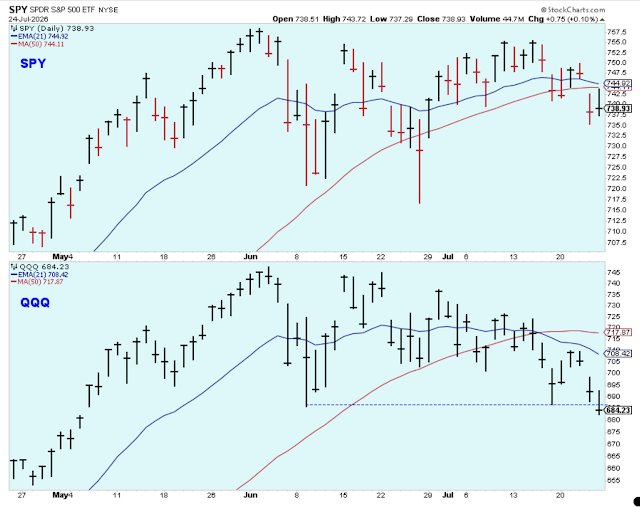
The chart above indicates an unhealthy broad market, but the chart below indicates some strength in the major indexes by regaining their footing above their 50-day averages. How to reconcile the chart above with the chart below?
With the major indexes above their 50-day averages, you have to back off from being too bearish because the larger trend, maybe call it the medium-term trend, has broken to the upside.
It may just be that the market often retains medium-term strength until it works off the excessive number of bears, or, who knows, maybe the bulls are right and the bull market re-emerges. We have to be patient and wait to see. In the meantime, I'll be trading the short-term trend.

Here is another look at the major indexes but with the 200-day as well as the 50-day. The SPX is looking healthier and the next bullish technical step would be for the 50-day to start rising and then cross above the 200-day. The NDX has more work to do because it is still below its 200-day, but it could easily move above with a brief period of market strength.
I use this chart because it helps force me to objectively assess the market rather than fall back on my subjective assessment which tends to be bearish. I can find a dark cloud in the stock market on even the sunniest day.

Bottom line: My accounts are 25% cash, 30% short via bear 3x ETFs, and 45% long mostly inflation-sensitive stocks. On Thursday, I added the bear funds to my accounts based on that day's weakness, and I'm thinking that unless the indicators really start to show market weakness, 30% short is the maximum, or maybe even too much.
The ECRI index has started to tick higher again after hitting a fairly low level. While this indicator points higher, the prospects for the economy brighten a bit.
I'm of the opinion that stock traders should not use their own assessment of the health of the economy, and instead use an objective, unbiased party such as the ECRI. Lakshman Achuthan knows what he is talking about, and he believes that realistically, you can only predict the economy about four to six months into the future.

Outlook Summary
- The short-term trend is up for stock prices as of March 14.
- The economy is at risk of recession as of March of 2022.
- The medium-term trend is down for treasury bond prices as of Jan. 3 (prices down, yields up).


Comments
Log in or sign up to join the conversation.