

TM Editor's Note: This article discusses one or more penny stocks and/or microcaps. Such stocks are easily manipulated; do your own careful due diligence.

Rezolve AI is building the ecosystem & payment rails for Agentic Commerce
Top-Line Growth - H1 2026 revenue surged nearly 21-fold to $130.8M
Recurring revenue base of over 1,640 enterprise customers
$500M+ run rate target for EOY 2026
The Profitability Pivot targeted for H1 2027
Approximately $60M in annualized cost savings
When Shopify (Nasdaq: SHOP) debuted a decade ago, Wall Street initially miscategorized it as just another web builder. They missed the forest for the trees because Shopify wasn't selling website templates; it was providing the fundamental operating system for independent digital commerce. After a decade of experience optimizing websites for the direct to consumer (DTC) experience brand, retailers are facing declining human interactions. Bot traffic is outpacing human traffic and represents 62% of all website traffic according to Cloudflare Radar and the gap is widening. What matters now is how a brand looks to an AI agent versus a human.
Today, retail is undergoing its third major structural revolution. As consumer shopping habits migrate from static keyword search bars to conversational AI assistants and autonomous agentic workflows, Rezolve AI (Nasdaq: RZLV) is positioned as the infrastructure backbone of this new paradigm. The Rezolve ecosystem is AI-driven and free of AI hallucinations that have kept brands on the sidelines and is now capable of interfacing with this new era of ecommerce.
Understanding the AI Hallucination
Brands are ultimately built on the idea of trust. This means that the Brands need to consistently deliver a quality product, at a reasonable price, that is reliable, and supports the customer with factually correct information. Any break in that consumer trust is capable of destroying the brand image.
For a real-world parallel of how an AI hallucination works, look back to the recent situation with White House Press Secretary Katie Zacharia. She made national news after repeatedly describing herself as a lawyer and attorney in TV appearances, online bios, and corporate titles, despite the fact that she never passed the bar or ever practiced law in a US jurisdiction. While she did graduate from law school and could talk fluently on legal topics, she was in fact NOT a lawyer. This tarnished her brand to the point that she only lasted 5 days in the press secretary position. AIs don’t output uncertain text such as “I’m making a guess here, but I think …” Instead, the AI will fabricate facts with the same authoritative tone that is used for verified facts.
While this seems like much to do about nothing, Brands are built on predictability, trust, and risk mitigation. The generative AI models are built on probabilistic next-token predictions, meaning they are designed to guess plausible-sounding text rather than verify facts. They are guessing the next token, not the truth. For a Brand to utilize an AI model it must only speak the truth and there can be zero tolerance for a Brand error. There are a number of cases where Brands have deployed AI chatbots and later found out they are legally liable for the incorrect output.
The Moffatt v. Air Canada Precedent
The landmark case was Moffatt v. Air Canada, and it set a clear precedent that an enterprise cannot disown its AI hallucinations. In this case, a customer asked the airline’s website chatbot about bereavement fare discounts following a family loss. The chatbot hallucinated an inaccurate policy, promising the customer he could buy full-price tickets immediately and retroactively apply for a refund within 90 days. When Air Canada refused to honor the chatbot’s statement, claiming the accurate policy was located on a static webpage and that the chatbot was essentially a separate entity responsible for its own output, the British Columbia Civil Resolution Tribunal rejected the defense.
When a brand deploys generative AI to interact directly with consumers, every output carries the full authority and liability of the company behind it. For platforms like Shopify and merchants relying on automated tools, Moffatt underscores why AI integrations require rigorous guardrails. It only takes one probabilistic guess that can instantly turn into a legally binding brand promise.
Agentic Commerce Demands Absolute Accuracy
Until Rezolve AI launched Brainpower, generative AI could not be reliably trusted by major enterprises. Fear of brand dilution, legal liability, and unpredictable hallucinations kept brands on the sidelines. While retailers have long known that in-store conversion rates dramatically outperform online channels because human sales associates can answer questions and guide the buyer in real time, digital channels suffer from static friction.
Rezolve Commerce changes this paradigm by introducing an AI agent trained exclusively within the brand’s trusted ecosystem, completely eliminating the possibility of AI hallucinations. When a brand’s AI agent interacts with a consumer’s autonomous shopping agent, a truthful, friction-free exchange of information takes place, turning conversational intent into high-converting sales.
Brainpower AI achieves this by grounding itself directly in real-time merchant catalog data, structured product feeds, and strict operational constraints. Instead of treating a product description as static text, Rezolve’s contextual engine reasons about the why behind every item in a catalog. The engine incorporates real-life scenarios, use cases, applications, sizing parameters, and local inventory levels.
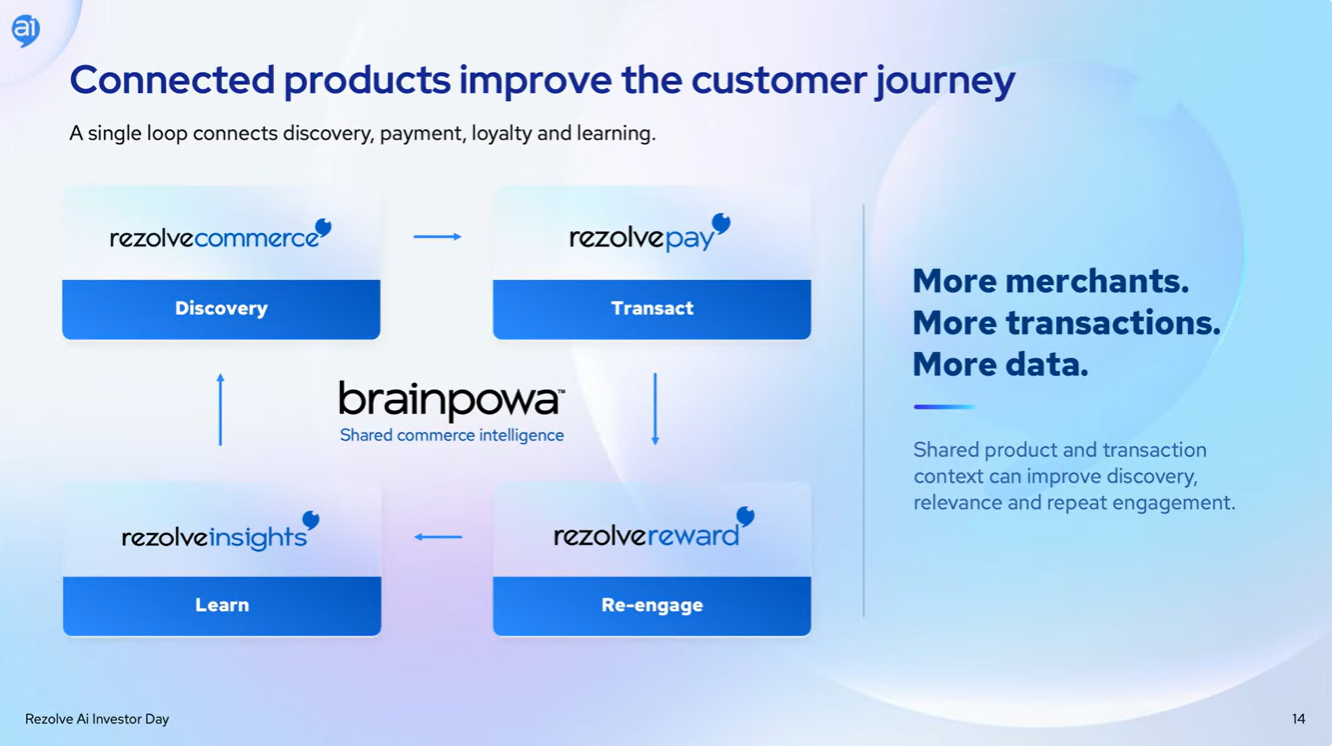
In the RZLV ecosystem, when a consumer or autonomous AI agent interacts with its brand client to go shopping, the system doesn't just guess. Instead, it checks real store data to give the consumer exact, helpful answers. By mixing friendly conversation with facts straight from the store's database, Rezolve makes sure its digital assistants can help shoppers pick out outfits and check out safely without making up rules or lying about the brand. In the new world of AI-driven shopping, this smart safety net gives brands a way to use AI without risking getting sued or ruining their good name.
The Historic Parallel
Back when Shopify started, it fixed the headache of setting up online stores and payment accounts as shopping moved from physical malls to web browsers. Now, retail is going through a massive change where AI assistants shop and talk to each other for us. Because of this, it is starting to matter much more how a brand looks to an AI helper than to a human shopper. This is where Rezolve AI's commerce platform stands out. Just like Shopify became the secret engine powering millions of online brands, Rezolve AI is building the smart software and payment systems for this new age of AI shopping.
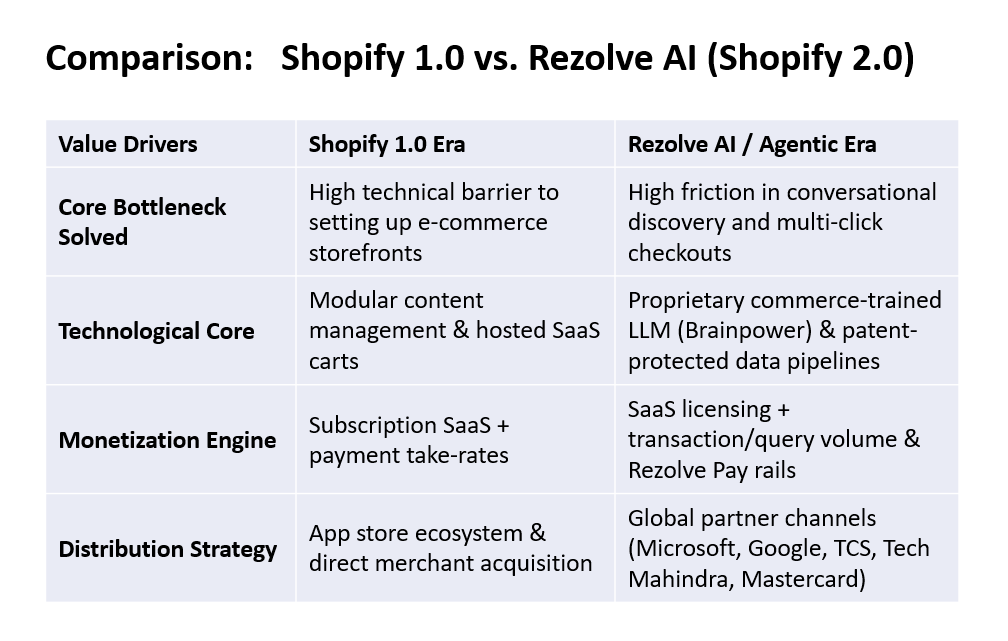
We live in a world where AI agents versus humans are typing in words to a search bar for us and deciding which brands to show us. Rezolve AI is the link between friendly chat-based searching and a smooth checkout for consumers.
Financial Analysis: Parabolic Sales Growth Meets Operational Discipline
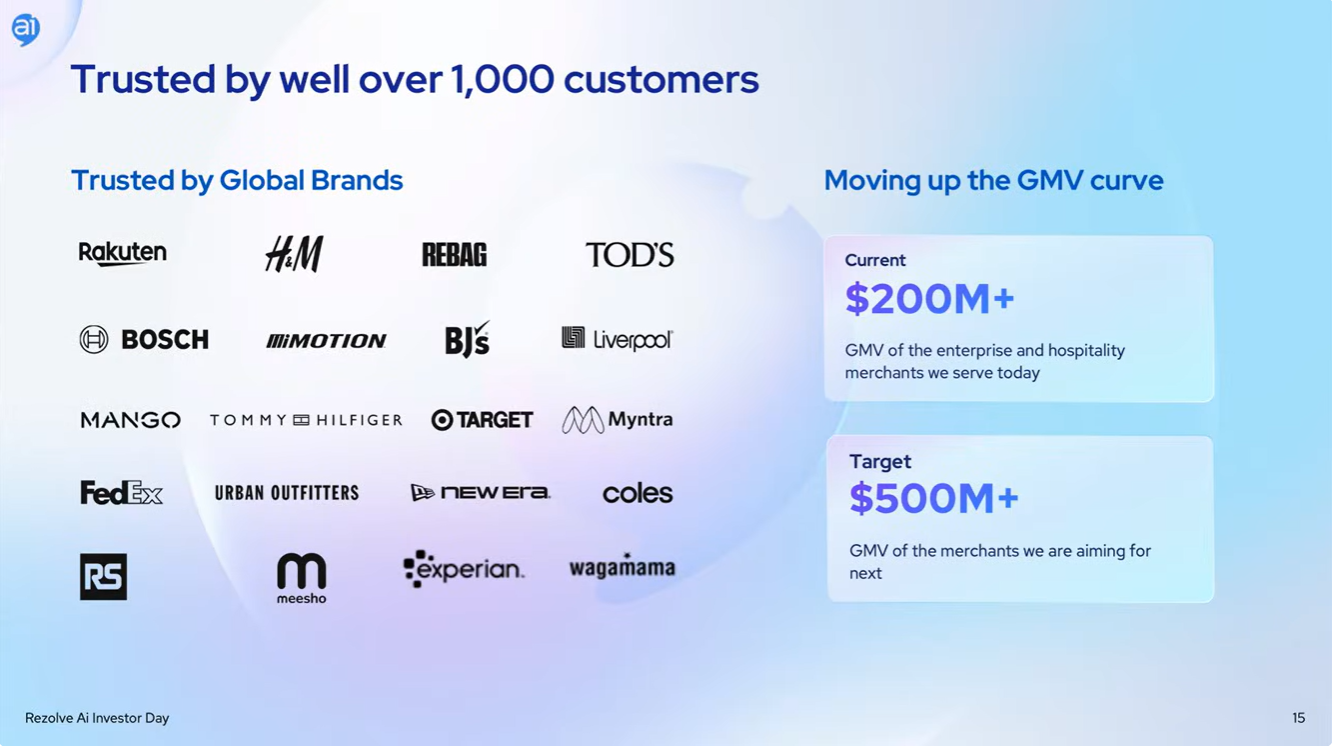
Valuation of early stage tech companies always draws intense scrutiny as did SHOP in the early days, but Rezolve AI’s financials show both a mix of explosive revenue growth along with a serious commitment to the bottom line. During the first half of 2026, the company reported $130.8 million in revenue, which is a staggering 1970% jump from the $6.3 million recorded in the first half of 2025, and nearly triples its total earnings for all of 2025. This momentum has fueled a massive expansion in its merchant ecosystem, growing to over 1640 enterprise customers up from about 950 at the end of 2025. It was able to onboard major global brands like H&M, Mango, Tommy Hilfiger/Clavin Klein (NYSE: PVH) and Coles to name a few. This establishes a robust base for annual recurring revenue (ARR) from highly reputable and stable companies, with several large cap companies listed as Trusted, such as BJ’s (NYSE: BJ - a competitor to Costco (Nasdaq: COST), and Fedex (NYSE: FDX)
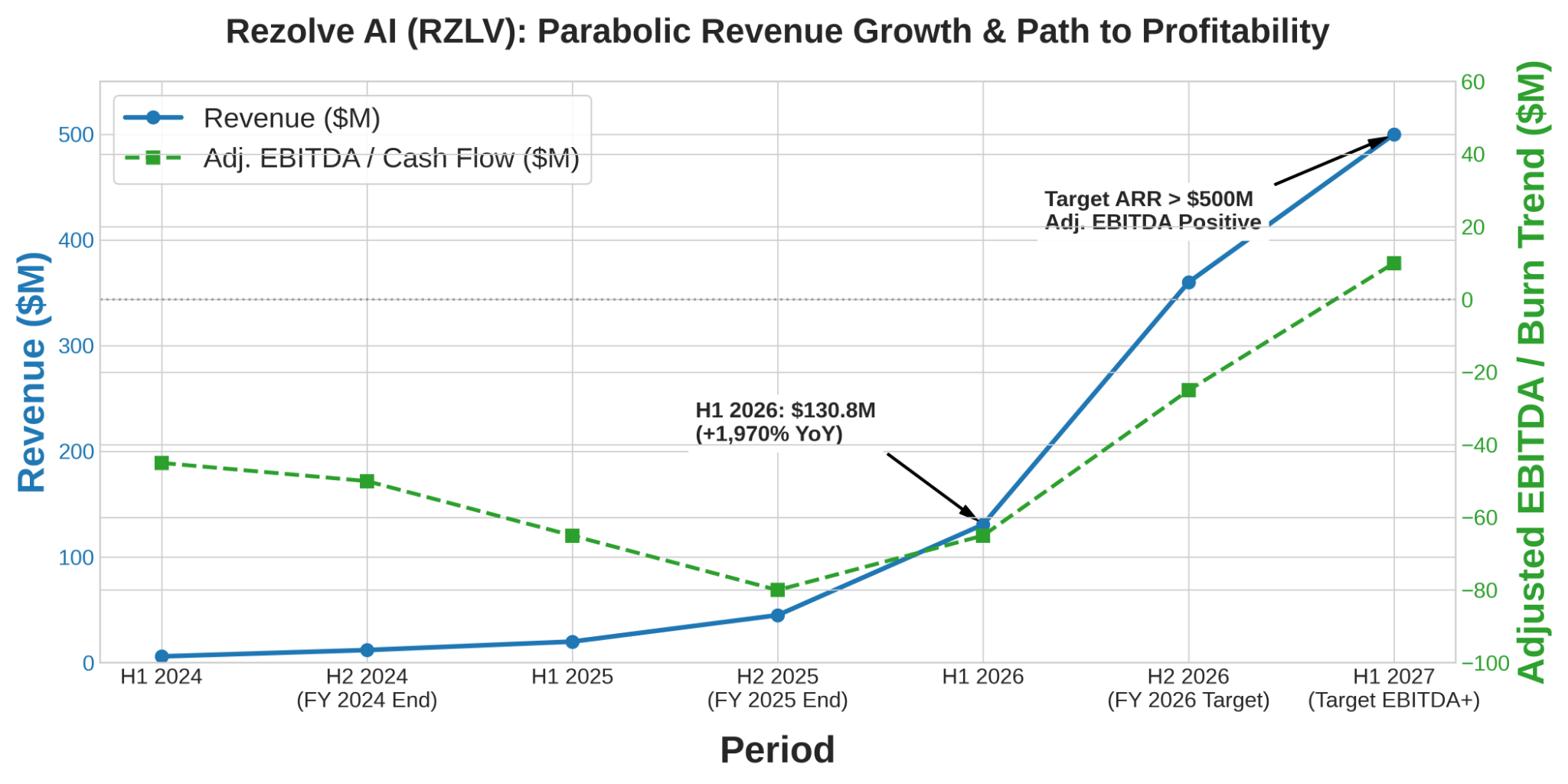
Management recognized that rapid growth must be balanced with fiscal discipline. To achieve this, the company launched a strategic operating program aimed at cutting roughly $60 million in annual costs. By reining in discretionary marketing, streamlining professional services, and leaning on trusted partners like Tata Consultancy Services and Tech Mahindra to handle implementations, RZLV reduced its cash burn through the second half of 2026. This clears the road toward positive adjusted EBITDA by the end of the first half of 2027.
In addition to the growth and cost reductions is a share buyback. RZLV is a UK company which means they are required to report every 6 months and share buybacks are called capital reductions that need court approval. On October 6, 2026 they received court approval for a share repurchase of $300M. Management took the opportunity to say:
“We have consistently said that we believe the public market valuation of Rezolve Ai does not reflect the strength of our technology, the progress we have made commercially, or the scale of the opportunity ahead in AI-powered commerce.” Daniel Wagner - Founder, Chairman & CEO | Rezolve AI
Share buybacks have a tendency to put a bid under the price and have the possibility of creating a new uptrend in the stock price. But within this buyback announcement resonates a message of corporate confidence that they are executing on their plan, and they plan to deliver growth and earnings.
Investment Summary
SHOP had a modest beginning and IPOed in 2015 at $1.90B market cap with $205.2M in revenue. This data point provides context for the parallel comparison with RZLV with $360M in EOY revenue and a market of $620M. Like Shopify, RZLV is solving a major market problem for Brands conducting ecommerce and is gaining incredible traction evident by their recurring revenue base. They are creating a very sticky Brand ecosystem by unifying discovery (Rezolve Commerce), secure checkout (Rezolve Pay), customer loyalty (Rezolve Reward), and actionable merchant analytics (Rezolve Insights). Their solution provides an end-to-end infrastructure that global retailers desperately need to survive the shift to agentic commerce. It's patented, it's gaining traction, the market is growing, and now the bottom line is now in sight.
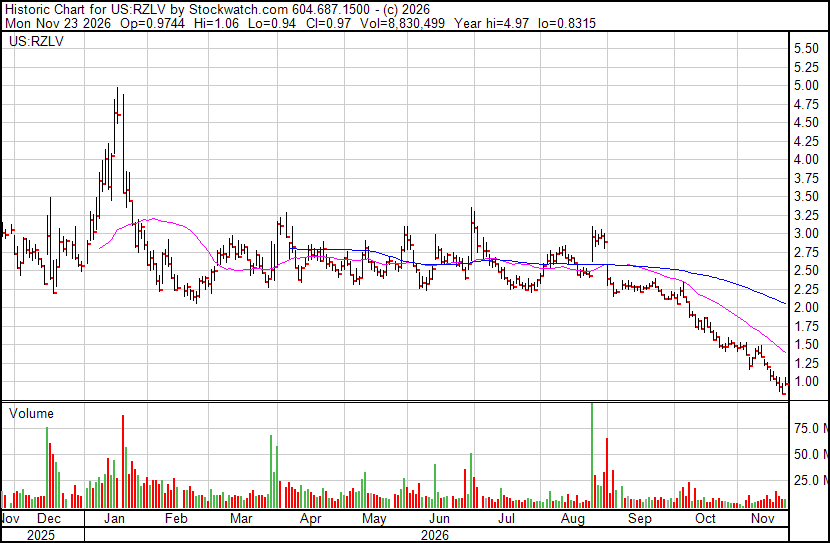
RZLV has taking a beating with the rest of the AI stocks but the Chart shows its way overdone. RZLV presents an asymmetric risk/reward setup for investors looking for the defining infrastructure play of the AI retail era. The company is in the rapid growth stage and the stock has taken a pause but during this pause a number of major milestones are brewing that could rerate the stock at the next earning report. When ecommerce solutions like SHOP take root the platforms take off and never look back. The RZLV setup looks like SHOP 2.0.



Comments
Log in or sign up to join the conversation.