

TM Editors' note: This article discusses a penny stock and/or microcap. Such stocks are easily manipulated; do your own careful due diligence.

MITI has spent the past three years repositioning itself toward AI infrastructure, edge computing, and related software opportunities.
Institutional investors, Calvary Capital and Mercer Street invested $10M and have been involved for approximately five years, potentially signaling confidence in a future uplisting, acquisition, or other strategic transaction.
Fully diluted market cap is only ~$2.0M, meaning the market assigns near-zero value to Centcore, Sportzfolio, or RoboAgent
The upside case hinges on execution, financing, and whether MITI can convert its strategic repositioning into revenue or an acquisition catalyst.
Extraordinary returns could come from a merger / uplisting, although dilution risks remains as they try to execute their business plan
Mitesco (MITI) has been positioning itself for a potential expansion into AI infrastructure and edge computing over the past three years. MITI is a holding company with a technology focus on anything data center related. Management has also been working to address legacy balance-sheet obligations, including the conversion of approximately $10.5M of debt into 2.68M shares at an effective conversion price of approximately $4.00 per share. That $4.00 price corresponds with the minimum price of a NASDAQ listing.
MITI's recent S-1 filing appears to have concerned some retail investors. However, the filing may also represent an important step in clarifying the company's capital structure and preparing it for a potential strategic transaction. At the current share price, the stock appears to offer substantial upside if the company can grow one or more of its core business segments or complete a transformative acquisition. That outcome is far from certain, but the potential asymmetry is what makes MITI worth watching.
Low Market Cap Represents Opportunity Instead of Risk
According to OTC Markets MITI is valued under $1.0M because the records don’t reflect the fully diluted value of the company. At a fully diluted market cap of just ~$2.0M (50M shares × $0.04), MITI is pricing in virtually no value for its Centcore data-center division, Sportzfolio marketplace, or Robo Agent AI platform.
Management discussed a potential TC/DC edge-node initiative that could eventually generate at least $25 million in revenue over the next two to three years. While this is just a projection, if MITI were able to approach that level of revenue, the current valuation would look unusually low relative to many publicly traded AI-infrastructure companies. MITI is remarkedly undervalued at a multiple of .08X Revenues when you consider AI infrastructure stocks on the NASDAQ start at an average of 15X Revenues.
Institutional Investor Backing – A Good Omen
Institutional Investors and retail investors poured a lot of money into MITI to the tune of $26 million. Their only chance to be made whole is to bring in a large asset and uplist to NASDAQ to get the liquidity they need for an exit. The Series A Amortizing Preferred shareholders have been in MITI for close to 5 years and are carrying approximately $14.0M in debt. The top two institutional investors are Calvary Capital and Mercer Street. Together they own $10.0M of the Series A.
Their continued involvement may be viewed as a constructive signal, particularly if these investors believe a strategic transaction or larger financing could ultimately improve liquidity and recovery value. The probing questions investors should be asking is why haven’t these investors taken their lumps and moved on? What do they know that we do not?
We need to follow the breadcrumbs. The first breadcrumb was from a recent MITI press release offers a potential description of the acquisition targets.
“While we cannot provide specifics about the acquisitions under consideration at this time, I can say that all of our prospects are technology-oriented and play into the data center growth story, whether software, systems, or aimed at power and data center components and needs. These include: a) a unique process for materials processing, similar to a 'rare earth' situation, which supports the growing power distribution, IC, and circuit board manufacturing needs” – Mitesco CEO, Brian Valania
Hone in on the part of the rare earth situation supporting growing power distribution. Investors should be looking for a company that has technologies supporting the broader data-center supply chain.
One company that warrants attention is Alluminous, which appeared in a SmallCap Voice interview on May 15, 2206. However, it was recently uploaded on MITI's YouTube channel August 4, 2026. For the past 2 years Mitesco has been talking on SmallCap Voice. It might be more than a coincidence that Alluminous, which has an interesting investor, appeared on the SmallCap Voice discussing the importance of high-purity alumina (HPA) in data-center and power-related applications. Investors might ask why did this private company curiously show up on Mitesco’s YouTube channel?
Alluminous is a relatively young company (1yr) whose origins reportedly trace back to ChemX, an Australian-listed company. Mercer invested $6.0M in ChemX convertible notes in August 2023. Based on publicly discussed bankruptcy and restructuring information, Mercer subsequently acquired intellectual property and technology associated with ChemX out of bankrupty. That intellectual property became a core asset of Alluminous, which was formed around a licensing arrangement.
Investors need to explore the link to Alluminous. Turns out aluminous is only 1 year old but it traces its roots to ChemX which was on the Australian stock exchange until they went bankrupt 2 years ago. Who was the lead investor in ChemX? Looks like it was Mercer who also happens to be the lead investor now merged with Calvary in MITI. Check out the sizeable investment Mercer made in ChemX. Mercer placed $6.0M in convertible notes on Aug 4, 2023. According to the bankruptcy court records Mercer acquired the intellectual property and technologies of ChemX.
This intellectually property became the core asset of Alluminous which was licensed by Mercer on formation. According to the website they have a test site in production in Perth Australia and looking expand to the USA and have site in TX and LA. This expansion will require capital of upwards of $100 million over the next 3 years. The management team of Alluminous came from ChemX, which was a public company; Mercer only invests in public companies; with a$100M dollar investment on the horizon you have to think a public company that could qualify for NASDAQ would be the ideal candidate. This week MITI made an interesting 8-K where a sizeable number of shares went to the founding directors and new turnaround team at MITI. The timing of this has to peak investor curiosity about a potential transaction that might be in the making.
AI Data Infrastructure Play
America has a love hate relationship with data centers. We love them as long as they aren’t in our backyard. The overarching reason is because they suck a lot of power and could spike electric bills for consumers in a region if they keep growing. MITI seems to have the answer which is a small format data center that handles compute at the local level. Many might not realize the cooling infrastructure has to be in place in these large format data centers before the compute is scaled inside of them. This build it and they will come ideology is risky versus a small format data center that is scalable to meet real world demand but also improves latency by positioning the data centers closer to that last mile. From a political perspective it defangs the debate of “not in my backyard” because people are actually paid to have it in their back yard and don’t suffer from rising electric prices.
MITI’s latest update laid out their business plan in detail. They are in the market looking for data facilities that are approximately 10,000 SF in size. They also talked about an edge computing network that uses a TC/DC modular data center node design that looks like a big old school desk top with massive AI computing power using Apple (AAPL) chips with 2,5, or 10 processors. The data center would be in a garage running off of a battery backup that might be recharged by 110v solar panels. This concept is already being testing by an Nvidia (NVDA) startup EdgeNest which uses Pulte Homes (PHM) to place its mini data centers with the allure of boosting AI performance in the future. Its way more complicated than MITI’s hey can we pay you $100/month to put this big metal box in your garage and hook it up to your electric.
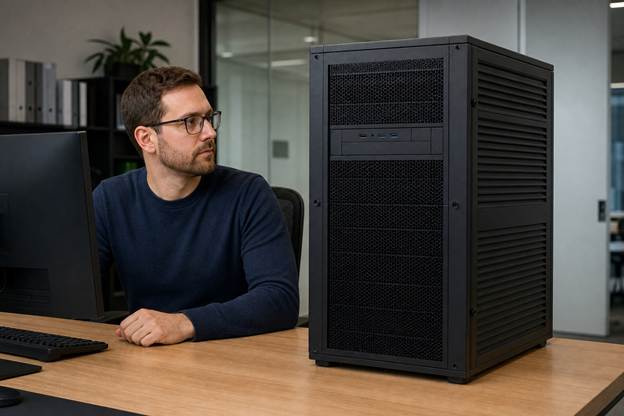
The nodes cost about $10K each, but their payback is about 6 months before it brings in lasting recurring revenue streams. The company is estimating about 10,000 units in about 2-3 years which means if they can deploy about 3,000 units in their first year, they can generate about $6.0 mil in revenues conservatively assuming $2k in monthly revenue per machine.
RoboAgent Software Play
In order for investors to understand the magnitude of the RoboAgent productivity software, they need to know the answer to the median age of realtors in the United States. Most wont guess that its 60 years old. The question is how do you organize a 60-year-old agent to keep up with the demands of a real estate professional? If you guessed RoboAgent you’re on track and realize that a 60-year-old has the discipline to show up to work and knows how to sell but they need someone to prioritize daily tasks and help them convert leads into sales. RoboAgent uses AI to basically set their schedule and tell them what to do so they can do what they do best which is closing sales. It accomplishes this in a conversational way very much like a coach reminding you to tie your shoelaces before you get out on the track.
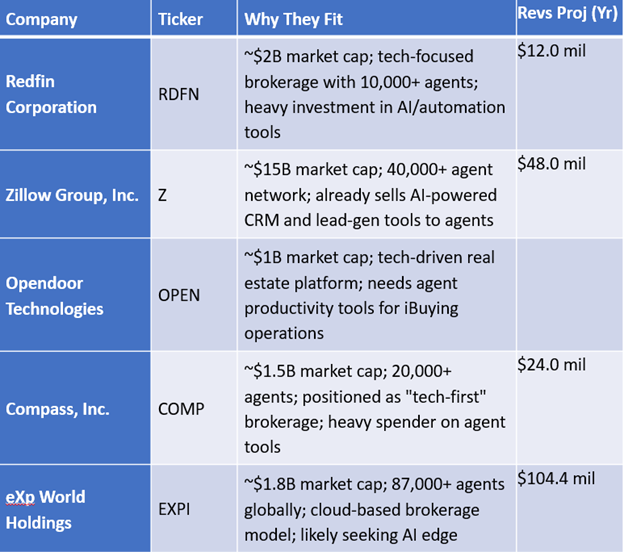
RoboAgent started beta testing in June 2025 then started its market validation work in January 2026. All that data helped refine the product allowing a number of industry professionals from US EXP Realty (EXPI), The Lotierzo Group and Kim Hughes and Company to test and comment on why its so powerful. The consensus was that the software made the realtor accountable for all the little things that a realtor must do to become successful so that they can focus on servicing the customer and not have to worry about what they need to do to keep up the business side of things. MITI gave guidance that the first commercial licenses are expected in Q4 2026 along with its full production version. It hinted that public companies are its primary targets and the one with the most agents was on the YouTube interview talking extremely favorably about it.
Balance Sheet Cleanup
The recent S-1 cleaned up the balance sheet by converting ~$12.0M of old preferred debt and bridge notes into 2.638M common stock over 2026–2027, eliminating refinancing risk and setting the stage for a pivot into high-margin AI infrastructure and edge computing.
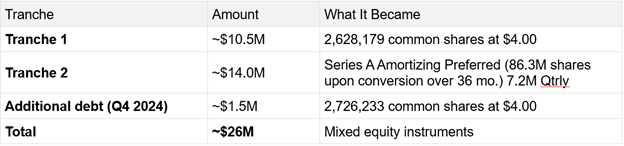
At first glance investors will see the S-1 registers resale of up to 106.5M shares, but whats easily missed that is that NO NEW CAPITAL is being raised. Part of the capital does trickle into the Outstanding share count from the Series A Preferred estimated at 7.2M Quarterly but that quarterly share count drops substantially to only 300,000 shares per quarter if the price goes back to $4.00.
Management Pedigree: Turnaround Specialists With Enterprise DNA
Mitesco's leadership team brings a rare combination of microcap capital formation experience and enterprise-grade operational expertise:
Mack Leath (Chairman) – 30+ years managing businesses across petrochemical distribution, software, construction, and healthcare; former president/board member of a $150M continuing-care retirement community; prior Mitesco board experience spanning multiple cycles.
Dr. Jordan Balencic, D.O. (Independent Director) – Physician-entrepreneur and serial microcap advisor; founder of cognitive-health brand EVERMIND; deep experience in capital formation and board governance for public companies.
Brian Valania (CEO/CFO) – Enterprise data/analytics veteran (Experian, Dun & Bradstreet (DNB), SAP (SAP) ecosystem); previously GM of Centcore; now driving both software and data-center strategy with hands-on technical credibility.
This is not a promoter-heavy shell. It's a turnaround team with the exact skill set needed to execute a pivot from legacy obligations into AI infrastructure.
Revenue Pipeline: Conservative Projections
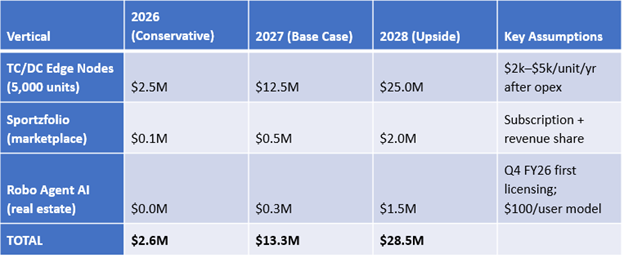
Management's July 28, 2026 business update provided key metrics: TC/DC edge nodes generate $2,000–$5,000 per unit annually after operating costs, with a target of up to 10,000 units deployed over 2–3 years.
Below is a conservative, scenario-based revenue table framing disclosed projects as pipeline opportunities (not guaranteed contracts):
Upcoming Catalysts
TC/DC pilot deployments – Any announced installations at public housing, rural properties, or sports facilities would validate the $2k–$5k/unit revenue model.
Robo Agent licensing – First master-license deal (targeting Q4 FY2026) would prove the $100/user SaaS model.
Sportzfolio monetization – Early subscription/transaction revenue would show marketplace traction.
Uplisting pathway – Management has signaled interest in strategic mergers and uplisting; any progress would improve liquidity and institutional access.
Risks
The company has been unable to bring in any meaningful revenue, but they have also not had the funding to do so. Therefore, the execution risk is high but offsetting that is a proven management team behind MITI. The company has seen a lot of selling pressure as the preferred stock has leaked into the market and the liquidity hasn’t improved that much but that will work to investors advantage if an acquisition comes into play. SaaS is inherently risky because software is so easy to mimic with the rise of AI. The company hopes to achieve a NASDAQ listing but the listing requirements are tightening versus easing. If their ability to uplist is in jeopardy then the odds of success go down significantly.
Bottom Line
Mitesco is a high-risk, high-reward microcap with a clean cap table, experienced turnaround management, and a credible pivot into AI/edge infrastructure. The S-1 is not a threat but rather a cleanup tool the company employed to become NASDAQ enabled. The final step is either a large software sales contract or financing to help scale the small data center node business scale. The strong institutional investor base headed by Calvary and Mercer seem willing to provide ample money for working capital or acquisitions which signals a potential green light for a pending merger/ acquisition the CEO talked about which could be transformative. At a $2.0M fully diluted market cap, the market is pricing in near-zero probability of success. Even modest execution on the TC/DC rollout (5,000 units → $12.5M–$25M revenue) would imply a 5–10x re-rating.



Comments
Log in or sign up to join the conversation.