


Gold gets the seat at the head of the table.
At $4,027 an ounce, with central banks stacking it by the hundred tonnes, gold has already blown past its inflation-adjusted 1980 average…
Yet, silver never got the invitation.
Adjusted for inflation, the metal that spiked to $118 in January still trades 60% below its January 1980 monthly average. In June 2026 dollars, that month averaged $167 an ounce. Today: $67.
Here’s what six decades of silver look like in today’s money:
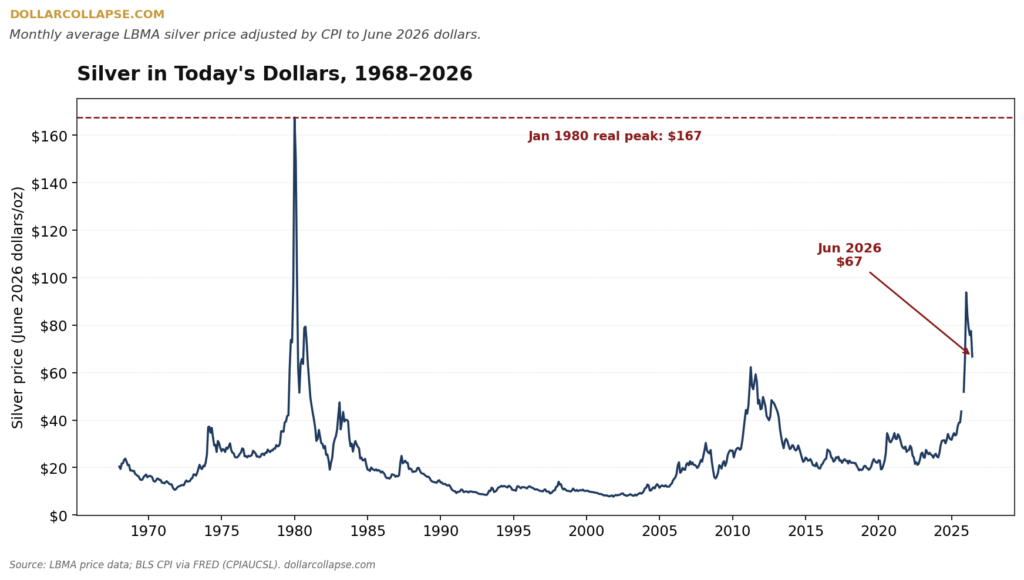
Gold made new real highs this cycle. Silver hasn’t even revisited its old one.
The relative measure tells the same story. One ounce of gold buys 69 ounces of silver today, against a 16:1 average across the centuries when both circulated as money:
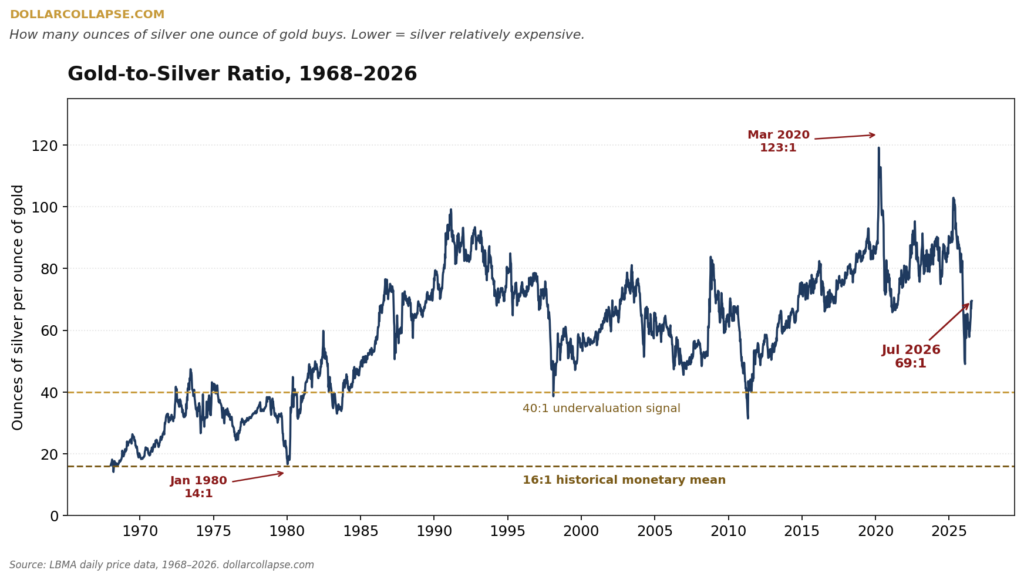
Silver is cheap relative to gold. And even cheap relative to its own history. And cheap at the exact moment its supply picture is the tightest in decades.
The Silver Institute reports:
Global Silver Investment to Remain Strong in 2026 Against the Backdrop of a Sixth Consecutive Annual Market Deficit
“The silver market is expected to remain in deficit (total supply less demand) for a sixth consecutive year in 2026.”
So why does the Dollar Collapse Playbook still rank silver behind gold?
Because insurance you can’t hold onto is worthless. Silver’s volatility runs about twice gold’s, and the same metal that doubled into January got cut in half by July. Move 9 is blunt about the order of operations: complete the gold position first, then add silver at 3 to 8% of liquid net worth for the reversion math.
Physical only. Sovereign coins and recognized bars, never the paper substitutes. Dollar-cost average over 6 to 12 months, and treat the gold-to-silver ratio as background information rather than a timing signal, because the ratio can stay stretched for years.
Honestly,gold is the insurance policy. Silver is the insurance policy that also happens to be on sale.
At $67 in today’s dollars, against a record of $167, the discount rack is in plain view.
The other monetary metal. Still the cheapest insurance in the room.

Comments
Log in or sign up to join the conversation.