


Over the past several years, the S&P 500 has recovered after its incredibly massive correction from the COVID money-printing bubble. It’s recovery has come from the tech industry. Specifically, the introduction of OpenAI’s ChatGPT in 2022. Now, the S&P 500 continues to climb as the US money supply continues to increase. This year, the S&P 500 is up 14% and sits at record highs.
Look under the hood, though… and the picture changes. The index doesn’t look so great…
On October 12, Reuters reported more than 4 in 10 stocks in the index are down in 2026. The median stock has gained about 4%. Technology alone accounts for more than 10 points of the index’s 14-point gain.
So a handful of AI names carry the whole market on their backs, and that market has never been bigger compared to the economy underneath it.
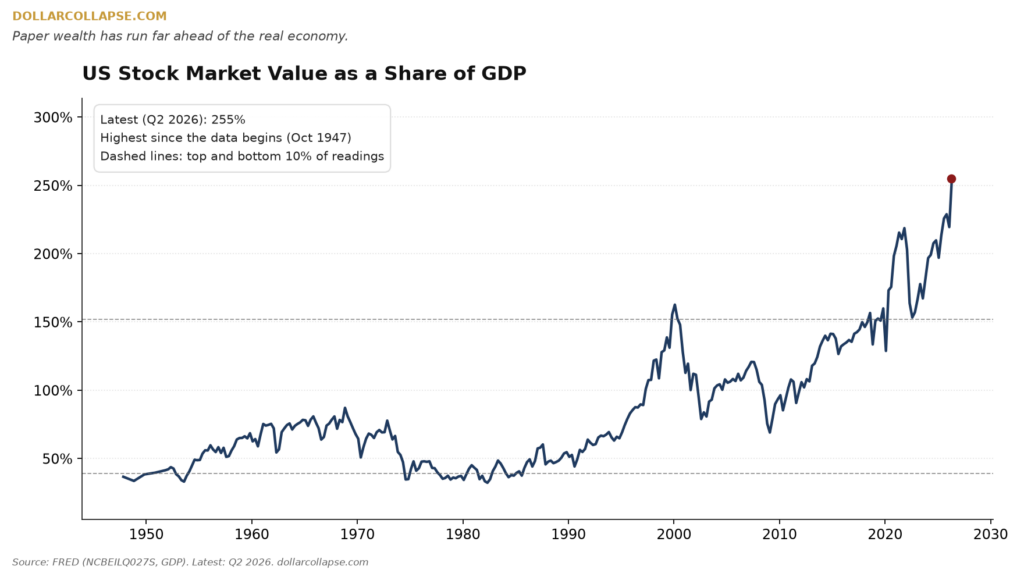
Total US stock market value now equals 255% of GDP, which is the highest reading since the data begins in 1947, and well above the 2000 dot-com peak.
Real assets went the other way.
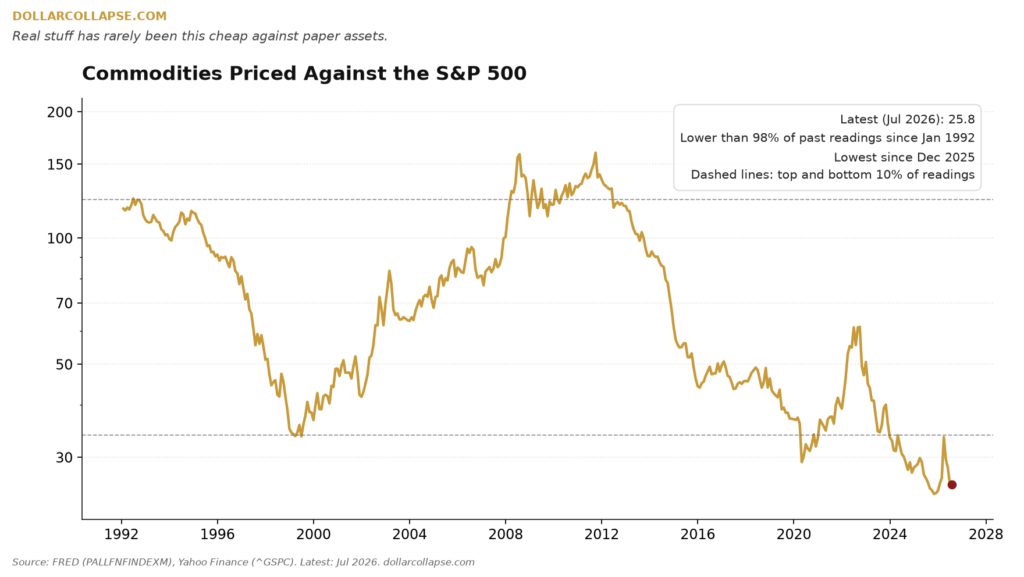
Comparably, commodities are ridiculously cheap. A broad basket of commodities, priced in S&P 500 units, is lower than 98% of all readings since 1992. Real stuff has rarely been this cheap against paper, but some items are still ridiculously high despite the ratio.
Three examples show how lopsided it got.
Oil
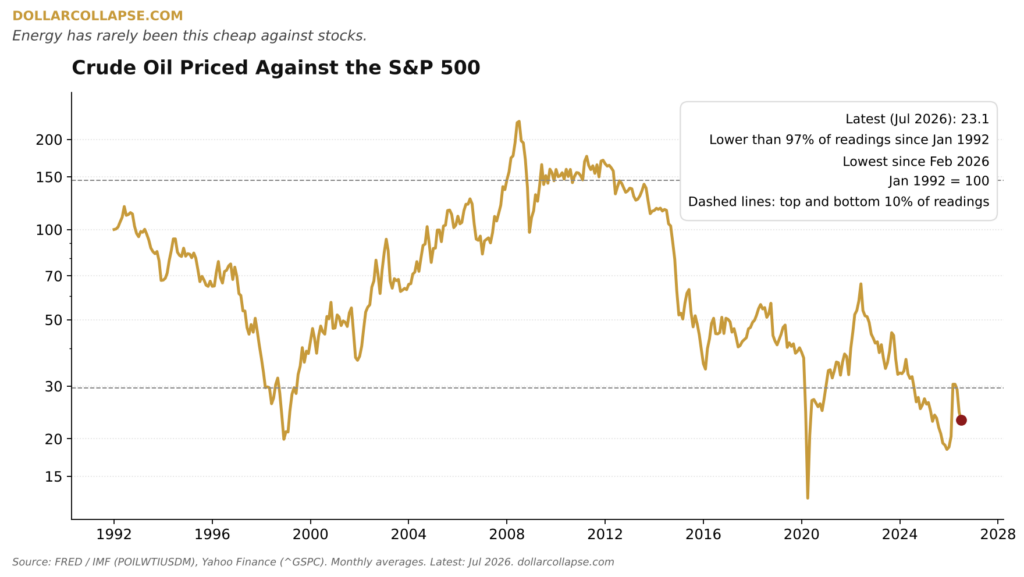
In June 2008, a barrel of West Texas crude averaged about $134, and the S&P 500 traded near 1,280. In July 2026, oil averaged under $80 while the S&P sat near 7,490. Measured in stocks, a barrel now buys about one-tenth of what it bought in 2008.
Now picture the AI bubble bursting. When the dot-com bubble burst, the S&P 500 fell 49% from its 2000 peak to its 2002 low. A drop that size today would take the index from about 7,490 down to around 3,800.
Even then, oil at $80 would still be cheap against stocks. Since 1992, one unit of the S&P has typically bought about 34 barrels. After a crash like that, it would still buy about 48. For oil to get back to its normal ratio, a barrel would need to cost about $111.
Corn
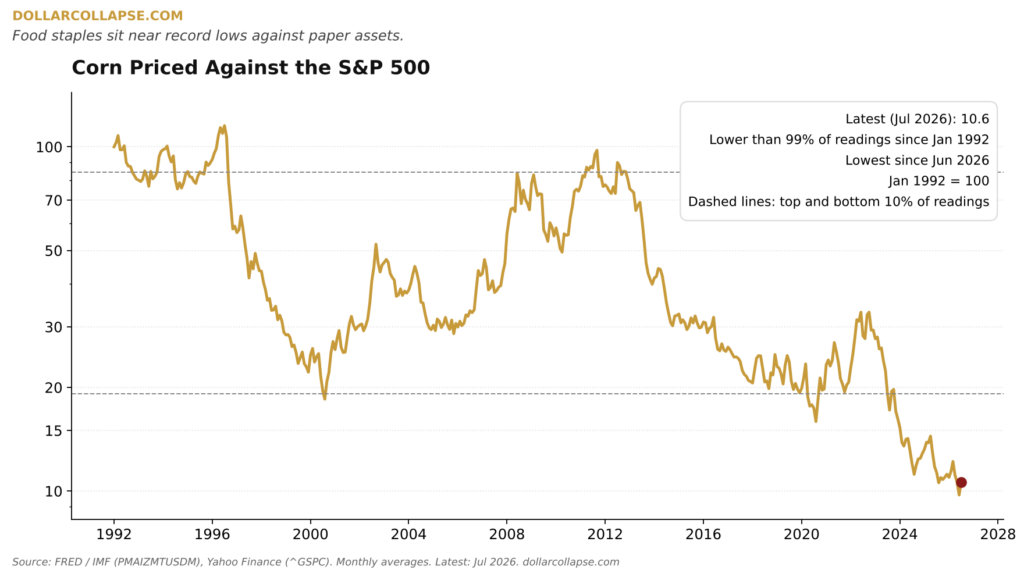
Corn feeds cattle, goes into gas tanks as ethanol, and shows up in half the grocery store. It averaged $213 a metric ton in July, or about $5.40 a bushel, down from $336 a ton in March 2022. Against the S&P, corn set its lowest reading since 1992 this past June.
Now, run corn through the same crash.
With the S&P near 3,800, corn would need to reach about $334 a ton, or roughly $8.50 a bushel (It’s about $5.40/bushel right now.), just to get back to its usual ratio. That’s about where it traded in March 2022.
Aluminum
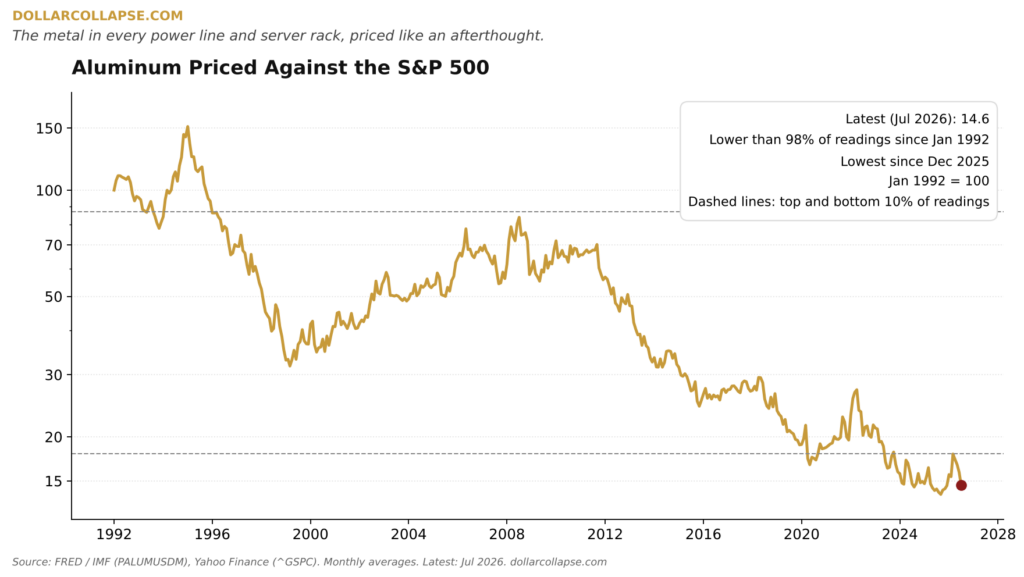
Aluminum is probably one of the best opportunities.
Aluminum goes into power lines, cars, beverage cans, and the server racks inside AI data centers. It averaged $3,158 a ton in July, about where it traded in mid-2008 ($2,968). So aluminum went nowhere for 18 years while the S&P rose almost sixfold.
After a dot-com-sized crash, aluminum would need to sell for about $4,900 a ton to return to its normal relationship with stocks. That’s 56% above today’s price, for a metal the AI boom needs in every data center and power line it builds.
So are commodities a buy right now? Against stocks, they are about as cheap as they have been in 34 years. Oil, corn, and aluminum would still look cheap even after a dot-com-sized crash.
Cheap isn’t the same as safe, though. In 2008, oil fell from $134 to about $40 a barrel along with stocks, then climbed back above $100 by 2011. A bust could drag commodities down first.
What the ratios show is where the long-term odds sit. So, the maxim should be…
Paper is priced for perfection, and real stuff is priced like nobody needs it.
When the air comes out
Bubbles end when new money dries up.
And that’s already started in the bond market, where the debt behind the biggest AI data centers is losing value.
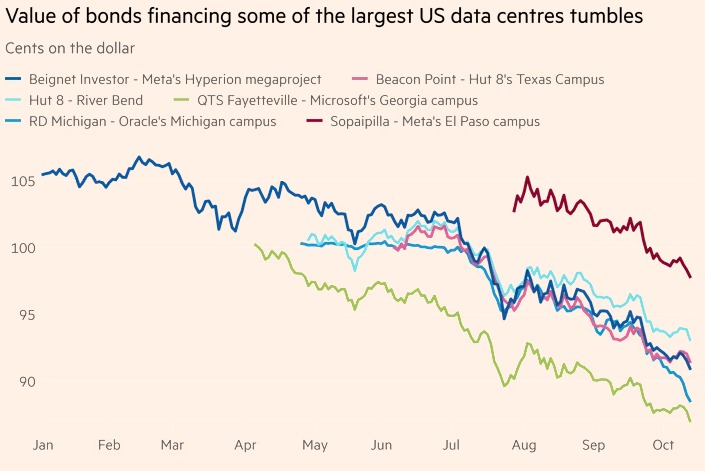
Bonds that fund Meta’s Hyperion megaproject in Louisiana traded near 107 cents on the dollar in February. By mid-October, they had dropped below 90. Debt for Microsoft (MSFT)’s Georgia campus and Oracle (ORCL)’s Michigan campus has slid to roughly 87 to 88 cents. As lenders pay less for this data center debt, they cost more to build.
Stocks are feeling it too.
The New York Times reported last week that chip stocks slid on doubts over AI spending.
The Philadelphia Semiconductor Index, the benchmark for the AI chip makers, fell into correction territory, meaning a drop of more than 20% from its peak. Most of its members went with it:
“Of the 30 companies in the index, 25 are now in correction.”
The New York Times, October 15, 2026
If AI stocks crack, two things tend to follow.
First, money leaves the crowded trade and looks for assets that never ran up. Oil, corn, and aluminum sit near the bottom of that list… which gives them the most room to move.
Second, the Fed steps in. It cut its target rate from 6.5% to 1% between 2000 and 2003. Its balance sheet grew from $4.2 trillion in early 2020 to $9.0 trillion by April 2022. Then each rescue put more dollars into the system and made real things cost more of them.
I’m not guaranteeing a crash next month (or profits from what I’ve talked about so far). What I’m showing you is that stretched markets can stay stretched for years.
For example, the last comparable low for commodities against stocks came in June 1999.
Over the next 12 years, that ratio rose almost fivefold.
Today’s reading sits even lower, and one of the two lines on that chart, paper or stuff, has to move.

Comments
Log in or sign up to join the conversation.