

IT IS DIFFERENT THIS TIME. IT’S A FIRST AS WELL.
To date, we have 4000+ years of recorded commerce with banking and interest rates, 300+ years of experimentation with some form of central banking/reserve currencies, and more than 50 years of an unhinged fiat monetary system. But this is the first time in human history that we are going to experience the follow-on effects of the loosening part of a credit cycle (under a worldwide fiat currency system) that started bottoming earlier this decade, when the 30-year Treasury rate hit a nadir of 0.7% in 2020.
Even after the start in 1971 of the fiat system, the first decade and a half was really dealing with the effects of credit loosening that happened during the Gold Exchange Standard of the 1960s, with the advent of Guns AND Butter, i.e., the Vietnam War, as well as the Great Society program that included the War on Poverty, Medicare, and Medicaid. It was not until the Maestro, Alan Greenspan, came along that the world embarked on a unidirectional experiment with easy money (as evidenced by falling 30-year Treasury rates and rising national debt).
With no real-world examples of what lies ahead, how then do we extrapolate it? Fortunately, we are in the good hands of Von Mises and Rothbard’s “Austrian Business Cycle Theory”, or, as it is more commonly referred to, the “Boom-Bust Cycles of Monetary Inflation”. Besides, there is extensive evidence that the first two smaller boom-bust cycles, as explained below and leading up to today’s crescendo, have indeed panned out as forecasted in ABCT.
1990 to 2022 – THE GREAT MONETARY EASING CYCLE WITHOUT A PAYBACK
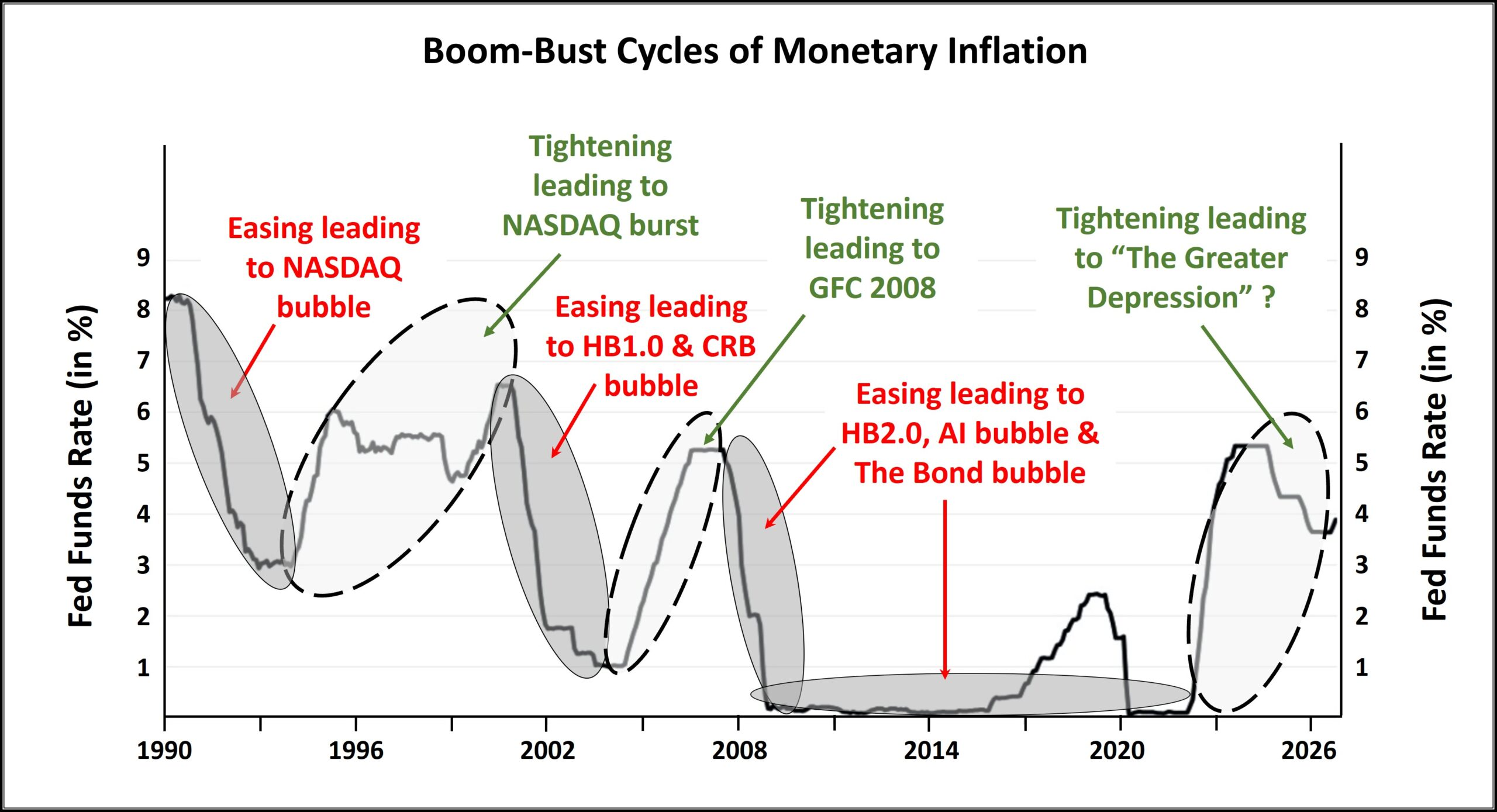
A short summary of how the Business Cycle works is given below
The lowering of interest rates by the US Fed results in malinvestments (leading to supply in excess of demand, as would be mandated by genuine savings) being made. These investments would eventually have to be liquidated, resulting in the bust.
Good examples of the malinvestments would be the internet infrastructure created around the year 2000 as part of Nasdaq’s Irrational Exuberance Another good example of excess supply is the 2008 housing bubble.
The malinvestments are the result of an excess supply of money and credit directed towards specific industries/assets. This credit eventually spills over into consumer prices, forcing the Federal Reserve to hike rates. This intermediary, temporary tightening (within the overall easing of the 30-year easing cycle from 1990) brings about the bust and eventually leads to a recession.
If the recession is allowed to run its course without any fiscal and monetary interventions, then the malinvestments of the prior period are cleared by the markets and the economy restarts on a more balanced foundation. But invariably, governments intervene, prolonging and worsening the structural imbalances.
The cycle of boom-bust keeps repeating till we reach the point that Mises referred to as the “Crack Up Boom,” i.e., hyperinflation. Any easing attempted at this point would result in a rapid decline in the currency’s purchasing power.
Some facets of the boom-bust cycle are given below for a better understanding.
The later cycles of monetary easing need increasingly greater stimulus to produce the desired effects. For example, an interest rate of 3% for a couple of years led to the NASDAQ 2000 bubble. The easing after the dotcom bust required a 1% interest rate to stimulate the economy. The easing required after the GFC in 2008 was, of course, on a logarithmic scale higher than the previous round. With nearly 15 years of ZIRP coupled with Quantitative easing, and a near 10-fold increase in the US Fed Balance sheet, the monetary stimulus required to bring about a semblance of stability was unprecedented.
The extent of the bust or the depth of the recession is proportional to the monetary stimulus that led to the artificial boom. It stands to reason that the malinvestments that need to be liquidated are indeed a function of the stimulus applied. The recession of 2000, after the dotcom crash, was indeed bigger than those of the 1980s and 1990s, but pales in comparison to the Great Financial Crisis of 2008.
Which brings us to the here and now. What type of recession/depression are we looking at ahead when the current malinvestments have to be liquidated? We will get to that in a while, after comparing the prior bubbles with the current ones.
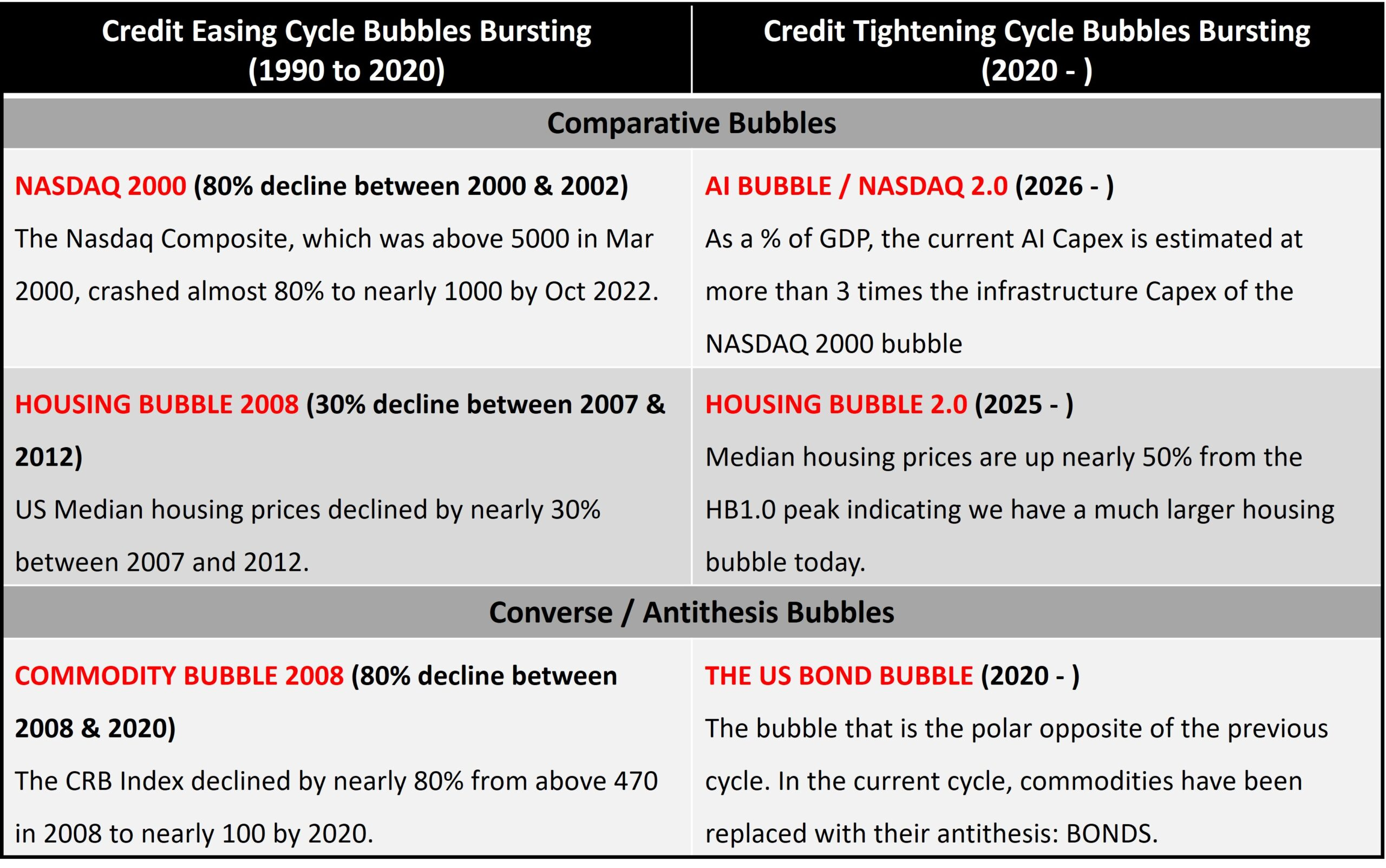
A COMPARISON OF BUBBLES
A few short comments on the above comparison would be helpful before we proceed further.
The size of current bubbles is much larger as compared to the previous cycle bubbles. This follows from the fact that the size of the economic stimulus has been much greater, leading to greater levels of malinvestments.
Perhaps more than the size/scale of bubbles, it is the changing credit conditions that will cause much greater disruptions to the markets on account of the bubbles bursting.
The current bubbles are winding down under conditions of tightening credit, increasing price inflation, increasing 30-year Treasury rates, and an economy on the verge of a depression rather than a severe recession.
The traditional fiscal/monetary policy tools (rate cuts, QEs, etc.) used to handle the previous cycle’s bubbles bursting would be ineffective. Indeed, would probably be very counterproductive, leading to a swift destruction of the purchasing power of the US Dollar.
An economic depression, with cumulative GDP contraction in excess of 25%, is the best-case scenario for the US. In all probability, this would be accompanied by very high price inflation, but is not outright Hyperinflation.
HOW DID THE US EVEN END UP HERE? WHAT WENT WRONG AND WHERE?
We can start the blame game with Greenspan, and it would indeed be very appropriate to do so. Given his understanding of Austrian economics, as he wrote so eloquently in “Gold and Economic Freedom”, Greenspan would have known that the state today would be the endgame. The Road of Monetary Easing provides no easy U-turns.
But why step on his grave when we have equally culpable individuals around us? If Gold and Economic Freedom were an intellectual masterpiece, the Courage to Act is its Antithesis. Bernanke often quotes, and supposedly draws inspiration from, Walter Bagehot’s “Lombard Street: A Description of the Money Market”.
Most Austrian economists despise the idea of a central bank and believe its functions fundamentally violate individual property rights. But given the reality of existence, I suspect most would agree with Bagehot’s proposal for a central bank’s role in a crisis: “lend freely against good collateral at a high rate of interest.”

Whatever happens in the months ahead is a direct outcome of Greenspan’s initial monetary easing actions, carried on in increasing spades by every successive Fed Bank Chair without exception. This is the result of more than 30 years of loose monetary policy, artificially low interest rates, and an unhinged US Federal Government Spending plan through the decades.
Courage for a Central Banker is to keep real interest rates high in the face of political opposition. When price inflation in the US was around 13% during 1980-81, Volcker hiked the Fed funds rates to more than 20%, offering a real yield of nearly 8%. What Bernanke did at the helm was keep real interest rates negative throughout his tenure. This is not courage. A more appropriate title for his book Courage to Act would be A Sellout to the Banking Cartel.
THE US DOLLAR’s ENDGAME
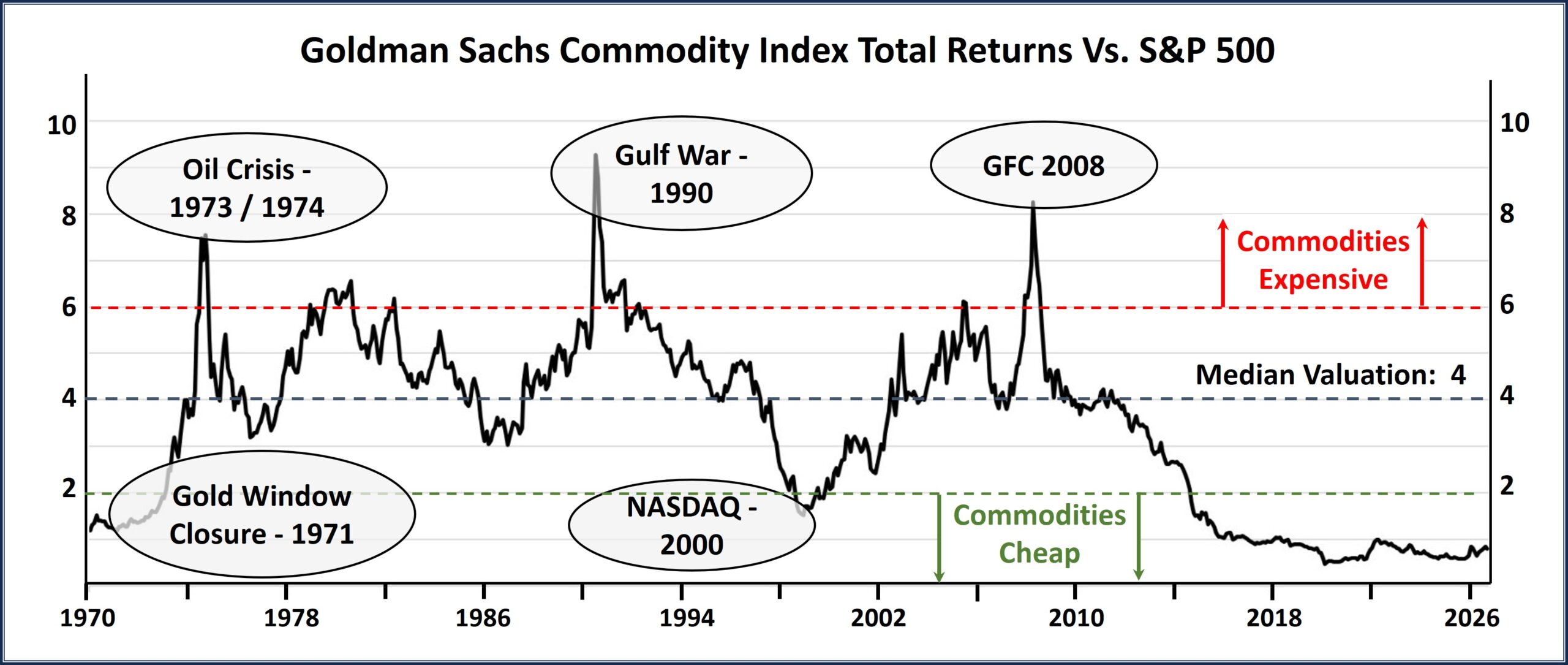
While it’s important to understand why the CRB Bubble has been replaced by a bubble in US Bonds today, the explanation would have to be extensive and perhaps beyond the interests of most readers. An easier way would be to just look at data – the relative valuation of Commodities vis-à-vis financial assets.
On a relative basis, Commodities today, and despite the CRB index nearly quadrupling over the last 6 years, remains at levels below those of 1970 and 2000 – the two previous bear market bottoms in the space of commodities.
I don’t have a crystal ball for when precisely the HB2.0 and AI bubbles will burst. Or as to what event would trigger the same. At least on valuations, we are well below the peak in median housing prices. The SpaceX post-IPO sugar rush might well have been the peak of the AI bubble.
In the recent sell-offs, the dollar has strengthened against other currencies and gold. This is a typical market reaction when market players deleverage existing speculative positions (AI trades, housing-related investment positions) and their safe trades (gold and commodities). Few realize that swapping gold for dollars at this point is perhaps the worst strategic swap one can make given the setup. Gold is well on its way as the rightful choice as the Numero Uno Neutral Reserve Asset, while the US Dollar is on the verge of a Crack Up Boom and possibly becoming confetti.
What is certain is that when the bubbles burst, the Fed would have no option but to double down on QEs. Especially with the market constraint on how low interest rates can be pushed, given prevailing price inflation. In the reflation trade, even with very conservative projections, the bull market ahead in commodities is going to be one for the record books.



Comments
Log in or sign up to join the conversation.