

The past few weeks have been rough for most investors.
Oil is trading above $110 a barrel. The Strait of Hormuz -- a critical shipping lane that handles roughly 15% of the world's oil supply -- has seen traffic essentially grind to a halt. Bond markets are tumbling. Mortgage applications just fell 10% in a single week. And the S&P 500 has broken below its 200-day moving average.
In short, investors are scared. Really scared.
And you can measure exactly how scared with one number.
Meet the Market's "Fear Gauge"
Wall Street has a tool called the VIX (formally known as the CBOE Volatility Index) and traders have nicknamed it the market's "fear gauge" for good reason.
The VIX measures implied volatility. Essentially, the VIX determines how much investors are willing to pay for options contracts that protect them against sudden market moves.
Think of it like this: when markets are calm and predictable, investors don't feel a desperate need for protection.
The VIX stays low. It started this year below 15.
But when fear grips the market... When headlines are scary, when oil spikes, when war breaks out... investors scramble for protection.
They'll pay almost anything for contracts that shield their portfolios from disaster. The VIX spikes.
When the Iran conflict escalated, the VIX shot as high as 35. As of Monday's close, it was sitting at 26.15.
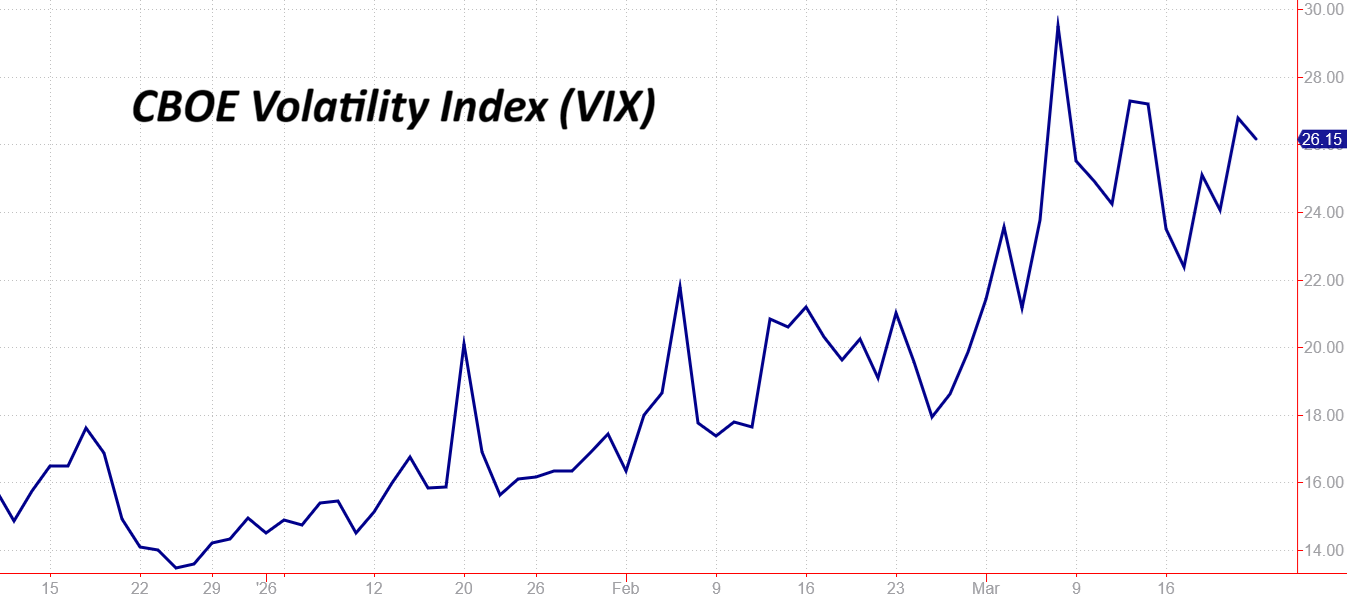
That's a lot of fear priced into the market right now.
For most investors, a high VIX means one thing: brace for impact.
But for one particular strategy, a high VIX means something else entirely.
It means more income.
The Business of Selling Insurance
Let me show you what I mean with a simple analogy.
Imagine you get a speeding ticket. Maybe you had a minor fender bender last year too. Suddenly, your auto insurance renewal arrives, and the premium is outlandish.
Your insurance company has looked at your recent history, decided you're a higher risk, and jacked up the price accordingly.
It's painful to be on the paying side of that equation. But what about the insurance company?
For them, elevated risk means elevated premiums. The scarier the environment, the more they collect upfront. Their business gets better when the world gets more dangerous.
Options markets work the same way.
When the VIX is low and markets are calm, investors don't need much protection. Option contracts are cheap. Sellers of those contracts collect modest premiums.
But when fear spikes... when the VIX jumps from 15 to 26 to 35... investors are suddenly desperate for protection. They'll pay significantly more for the same contracts. Premiums swell.
And if you're in the business of selling those contracts?
Your income goes up. Substantially.
How to Be the Insurance Company
This is exactly the principle behind the strategy I use in my Accelerated Income Model.
Here's the basic idea: instead of buying options for protection (like a nervous investor paying sky-high insurance premiums), we sell put contracts on high-quality stocks we'd actually be happy to own.
When you sell a cash-secured put, you collect an upfront premium. That's real cash that lands in your brokerage account immediately.
In exchange, you're agreeing to potentially buy shares of that stock at a pre-set price if it falls to that level.
Here's what makes this so powerful in a volatile market: because the VIX is elevated right now, those premiums are significantly higher than they were just a few weeks ago.
The same trade that might have generated modest income in January could generate substantially more income today... because fear has inflated the price of every option contract in the market.
The strategy is conservative by design. We target stocks we'd be comfortable owning anyway. We only sell puts at prices we consider attractive entry points. And the cash-secured structure means we always have the funds set aside to back up the commitment.
In calm markets, this approach generates solid, consistent income.
In fearful markets like this one? It generates exceptional income.

Comments
Log in or sign up to join the conversation.