

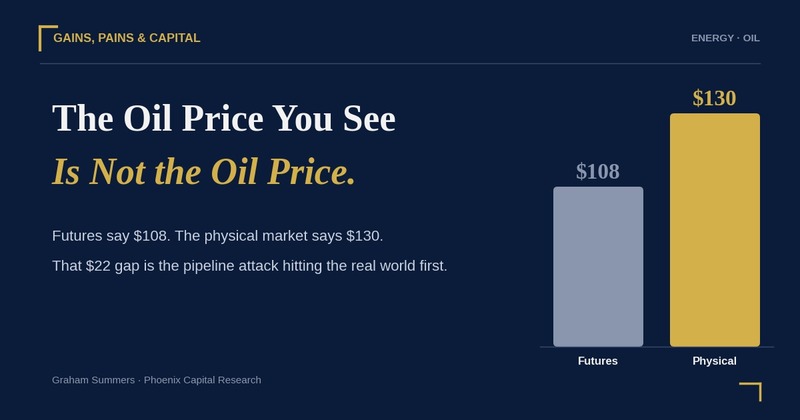
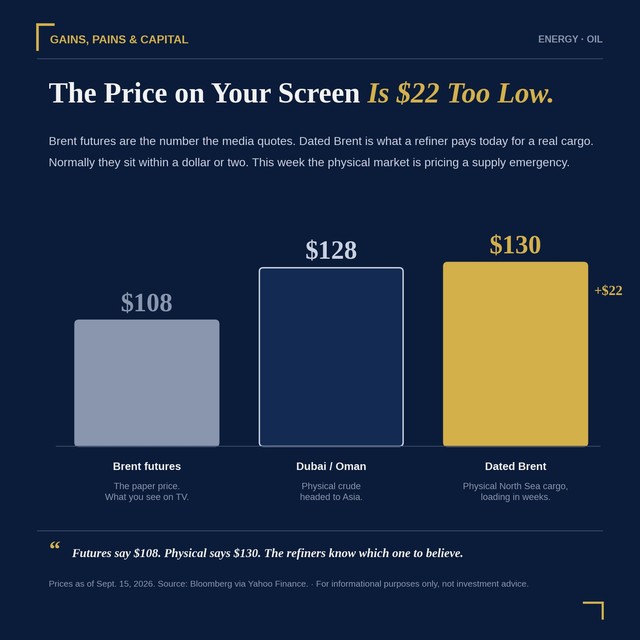
Brent crude futures closed Tuesday around $108.
Dated Brent, the price for physical barrels that actually get loaded onto tankers, traded above $130.
Dubai and Oman grades, the benchmarks for crude going to Asia, were near $128.
If you only watch the ticker on CNBC, you are looking at the wrong number. The real oil market is already $20 higher than the one everyone is quoting, and that gap is the pipeline attack showing up in the physical world before the paper world catches up.
Here is the difference between the two prices.
The Brent price you see on your screen is a futures contract. It is a financial instrument, traded on an exchange, that settles on the expected price of oil a month or more from now. It is where hedge funds, airlines, and pension funds place their bets. It is deep, liquid, and easy to quote, which is why the media uses it.
Dated Brent is the price a refiner pays today for a specific cargo of North Sea crude loading in the next few weeks. It is set by actual transactions between people who need barrels and people who have them. No leverage, no speculation, no roll. It is what oil costs if you have to have it now.
Normally the two prices sit within a dollar or two of each other. When physical trades far above futures, the market is telling you there are not enough barrels available right now, and the people who need them are paying whatever it takes.
That is where we are. A $22 premium for physical over paper is the kind of spread you see in a genuine supply emergency. The last time the gap was anywhere close was the spring of 2022, in the weeks after Russia invaded Ukraine and European refiners scrambled to replace Russian barrels.
Put simply, the East-West pipeline shutdown removed 5 million barrels a day from the physical market, and the physical market is pricing it. Futures are still pricing the pipeline coming back and the Iraq militia deadline holding on September 30.
Now think about who pays $130.
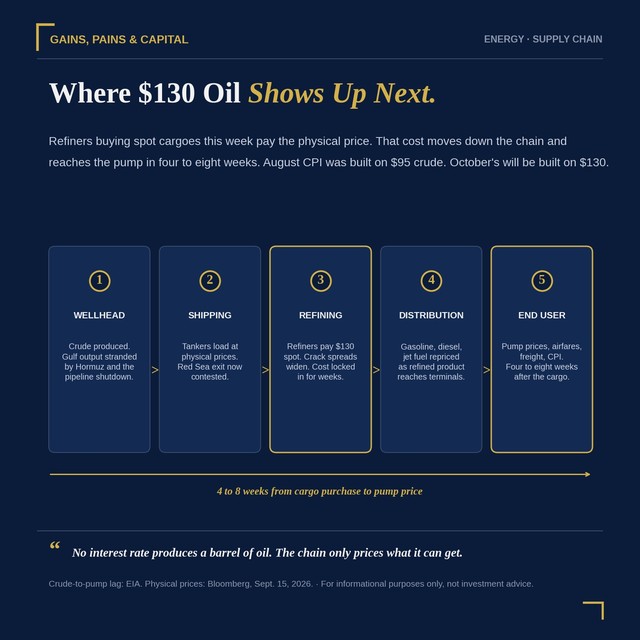
Refiners do. Every refinery in Europe and Asia buying spot cargoes this week is paying physical prices. That cost goes into gasoline, diesel, jet fuel, and heating oil over the next four to eight weeks, which is the normal lag between crude purchases and pump prices. August’s CPI already had gasoline as more than a third of the monthly increase. That was with Brent at $95. September’s number will reflect the run to $108. October’s will reflect whatever refiners are paying today, and today they are paying $130.
To be clear, physical premiums do not stay this wide forever. Either futures rise to meet physical, which means $130 becomes the price you see on TV, or physical falls back toward futures, which requires the pipeline reopening and the Red Sea staying navigable. The second outcome depends on decisions in Riyadh and Baghdad. The first happens on its own. I know which one I would bet on.
The physical market is telling you something else, too. Dubai and Oman at $128 means the Asian buyers, who take most of the crude that used to move through Hormuz, are competing for the same shrinking pool of barrels as Europe. China, Japan, South Korea, and India import the vast majority of their oil, and most of it came through the Gulf before March. They are the ones being squeezed hardest. The U.S. imports very little from the Gulf and is a net exporter. Every dollar of that premium is a transfer from Asian and European economies to whoever has barrels to sell, and the largest seller on earth is the United States.
Which brings me back to yesterday’s point. A few thousand dollars of drones added 8% to futures in a week. In the physical market, they added closer to 30%. The risk premium in oil is now a permanent feature of a world where infrastructure is expensive and the tools to hit it are cheap, and the physical market is the first place it shows up.
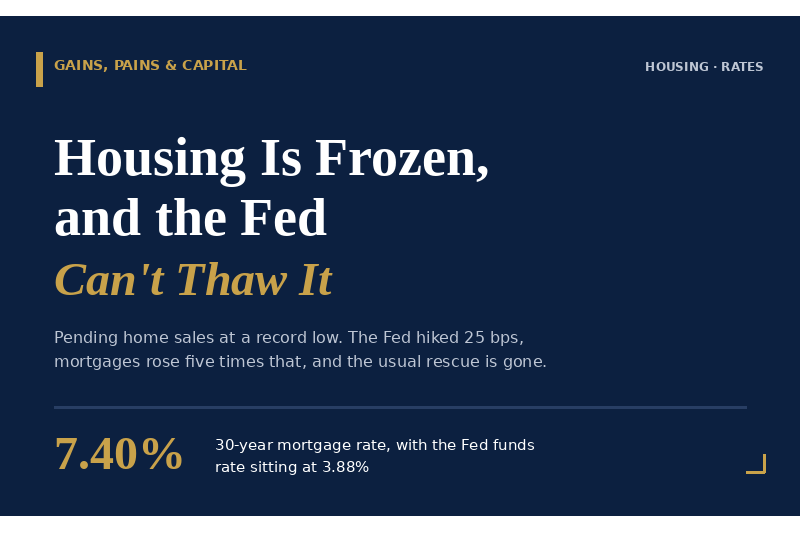
The Fed decides on rates at 2 p.m. today. It will almost certainly hike. It will not close the gap between $108 and $130, because no interest rate produces a barrel of oil. What closes that gap is either more supply or less demand, and the only large economy with more supply to offer is the one that does not need Hormuz to get it to market.
The physical market has already repriced. The futures market will follow. The stocks that produce oil inside borders no militia can reach will follow that.
Which brings me to the part that matters for your money.
Refiners are paying $130 for crude today. That cost reaches the pump in four to eight weeks. August’s inflation report was built on $95 oil and it still came in hot enough to put a Fed hike on the table. September’s will be built on $108. October’s will be built on $130.
Put simply, the inflation the Fed is about to hike into has not even shown up in the data yet.
Comments
Log in or sign up to join the conversation.