

The foreign exchange market is proving to be very difficult for market strategists to figure out. Economists have long argued that the behavior of exchange rates reflect growth prospects, trade performance, and, above all, relative interest rates. Higher growth rates and trade surpluses boost the external value of a country’s currency. By the same token, relatively higher interest rates encourage foreigners to purchase assets abroad. The US dollar index is a relative price and is viewed against a basket of six currencies---the Euro, Japanese Yen, British Pound, Swedish Krona, Canadian Dollar, and the Swiss Franc. Movements in foreign-exchange rates capture comparative changes in the economic and political conditions within the basket. Since 2000 the US dollar index hit a high of 121 during the dot.com boom and a low of 71 just prior to the financial crisis of 2008-9. So, currency markets are no stranger to large cyclical swings.
US Dollar Index
(Click on image to enlarge)
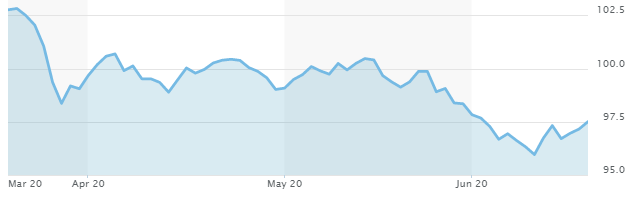
The textbook relationship showing how growth and interest rates influence currency movements has broken down. Since the onslaught of the virus pandemic, the US dollar index has lost ground to its major trading partners. From March 20, the start of the lockdowns in the United States, the dollar index has fallen about 5 %. Not only has the US dollar declined against the basket of currencies that make up the US dollar index, but also against currencies such as the Australian dollar which gained 18% against the US dollar.
In theory, currencies react to interest rate differentials between countries. The United States still has the highest interest rates, especially compared to Japan and the EU where through out the yield curve bond yields are negative. Logically, money should be flowing into the United States to take advantage of the higher rates. And, this has been happening, especially in the bond market where recent US government bond auctions have been met with overwhelming foreign demand. Yet, the US dollar index remains under pressure.
In a recent article, Stephen Roach, formerly of the Morgan Stanley Asia, argued “the US economy has been afflicted with some significant macro imbalances for a long time, namely a very low domestic savings rate and a chronic current account deficit”. Technically, Roach is correct that the United States has been relying on foreigners to use their savings to fund US government deficits. At the same time, the United States has been running trade account deficits sending more dollars overseas. These imbalances cannot persist indefinitely without dollar devaluation. Remarkably, the US dollar has been able to ignore these macro-economic imbalances for decades. Roach argues that is no longer sustainable and we are about to witness the mighty US dollar fall from its perch. Roach goes on to make the case that China and the eurozone account for 40% of US trade. These two currencies will rise because of their long-standing current account surpluses. There is the counter-argument, however, which states that the US dollar is the world’s reserve currency and is indispensable to global transactions. But that premise may not hold indefinitely.
Roach’s argument is soundly based especially in his final point: “A weaker dollar would boost US competitiveness, but only for a while. Notwithstanding the hubris of American exceptionalism, no leading nation has ever devalued its way to sustained prosperity”.


Comments
Log in or sign up to join the conversation.