


I've been trading for 25 years now, and if I had to name the concepts that trip up more options traders than anything else, I wouldn't say the "direction" of the stock.
Most people spend all their energy trying to guess whether a stock goes up or down. That matters, of course.
But two other forces, volatility and time, often matter just as much. And they're the reason a correct prediction can still lose money, or a well-timed trade can make money even when the direction call wasn't perfect.
I want to walk you through both of these today, because once they click, options stop feeling like guesswork and start feeling like a repeatable process.
Volatility: Why Some Options Are Always More Expensive
Here's something that trips up a lot of people. Options tend to be more expensive ahead of a big event like an earnings report.
As long as that option has an expiration date falls after that event it will carry extra value the entire time leading up to the specific event.
Think of it this way: If a company reports earnings on a specific date, any option contract that expires after that date has to "cover" the possibility of a big move on the announcement.
Since options give traders the potential to profit from a large price swing, and Wall Street knows a bigger-than-normal swing is possible around that report, those contracts are priced higher across the board.
For weeks in advance, not just in the final days.
So the real question is whether the option is overpriced, relative to how much the stock is actually likely to move.
That's the question I ask myself constantly.
If a stock moves more than the options market has priced in, a directional bet can pay off in a big way.
But if the stock barely moves, even correctly guessing the direction can still result in a loss. Because the stock simply didn't move enough to justify the extra premium you were paying the entire time you held the position.
Getting Paid Instead of Paying
Once you understand that some options carry persistently inflated premium, a natural question follows: Is there a way to be on the receiving end of that, instead of the paying end?
There is, and it's one of my favorite tools.
Instead of buying an option and hoping a big move happens, you can sell an option and collect that inflated premium yourself.
Here's a simple example:
Say a stock has pulled back to a level you believe will be strongly defended, a level you'd genuinely be happy to own the stock at if it dropped that far.
You could sell a put contract at that price.
By selling one put contract, you're agreeing to buy 100 shares of the stock at your chosen strike price, but only if the stock is trading below that level when the contract expires.
In exchange for taking on that obligation, you collect the premium upfront.
If the stock stays above your strike price, the option expires worthless and you simply keep the income. If the stock falls below your strike, you end up buying shares at a price you already decided you were comfortable with. And your real cost basis ends up lower than that strike price once you account for the premium you already collected.
This is a strategy I turn to often when premiums are elevated and I have real conviction that a stock will find support at a specific level. You get paid for your patience.
Time Decay: The Silent Cost Every Option Buyer Fights
There's a second force at work in every single option, separate from volatility entirely. It's called time decay, or Theta, and it affects every option buyer whether they realize it or not.
Every single day that passes, an option loses a small amount of value, purely because there's less time remaining for the trade to work out.
This happens even if the stock doesn't move at all.
Traders often call this the "melting ice cube" problem, and it's one of the most common reasons a correct prediction still ends up losing money.
Here's how I minimize that risk while still trading aggressively. Instead of buying options that are at-the-money, meaning the strike price is close to the stock's current price, I favor options that are deep in-the-money.
Let's say a stock is trading at $100. A call contract giving you the right to buy that stock at $80 is already worth $20 today, just based on the math.
That's called intrinsic value. You might pay around $23 for that contract, meaning only about $3 of the price is time premium, the part vulnerable to decay.
Compare that to an at-the-money option, a $100 call on that same $100 stock. That option might cost $8 or $9, and every single dollar of that is time premium. None of it is locked in today. It's a pure bet against the clock.
The less time premium you're carrying, the less exposed you are to that daily melting effect.
A deep in-the-money option still gives you real leverage and real upside if you're right about direction. You're just not handing nearly as much of your capital over to time decay while you wait for the story to play out.
This works the same way in reverse for bearish trades using deep in-the-money puts.
Harnessing Decay Instead of Fighting It
Here's where it gets interesting. Time decay isn't a fixed, steady drip. It accelerates as expiration approaches.
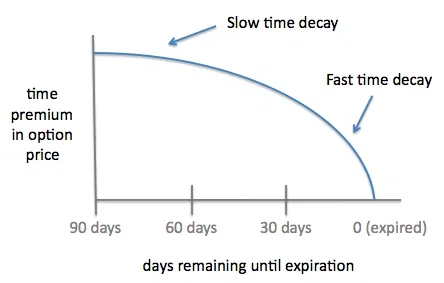
Notice the shape of that curve. In the early weeks of an option's life, value melts away slowly. But in that final 30-day stretch before expiration, decay speeds up dramatically.
That's where the bulk of an option's remaining time premium disappears.
If premium melts away that quickly in that window, why not be the one collecting it instead of paying it? That's exactly what selling cash-secured puts allows you to do.
I like selling puts that are a bit out-of-the-money, with 4 to 8 weeks left until expiration.
That window sits right where time decay is accelerating, but there's still enough premium available to make the trade worthwhile.
Since the put is out-of-the-money, there's no intrinsic value at all, the entire price is time premium, which means the entire position is working in your favor as the clock ticks down.
Either the option expires worthless and you keep the full premium, or its price drops enough that you can buy it back early and lock in a profit.
Same force that hurts option buyers, just working in the opposite direction. Instead of being the melting ice cube, you're the one collecting the melt.


Comments
Log in or sign up to join the conversation.