

 Greetings from the United States. After quite a bit of traveling, I’ve finally made it stateside and am spending some time with family. The markets, however, have been anything but quiet. Over the last several days, technology stocks came under pressure, AI spending came under scrutiny, oil surged, bond yields moved higher and Bitcoin (BTC.X) showed some surprising resilience before slipping back below $64,000. Taken together, the picture is starting to look increasingly K-shaped. Some parts of the economy are being squeezed by higher costs, tighter financial conditions and geopolitical uncertainty, while others continue attracting historic amounts of capital. Sitting right in the middle of it all is artificial intelligence. |
01 / Artificial Intelligence AI ENTERS ITS “SHOW ME THE MONEY” PHASE |
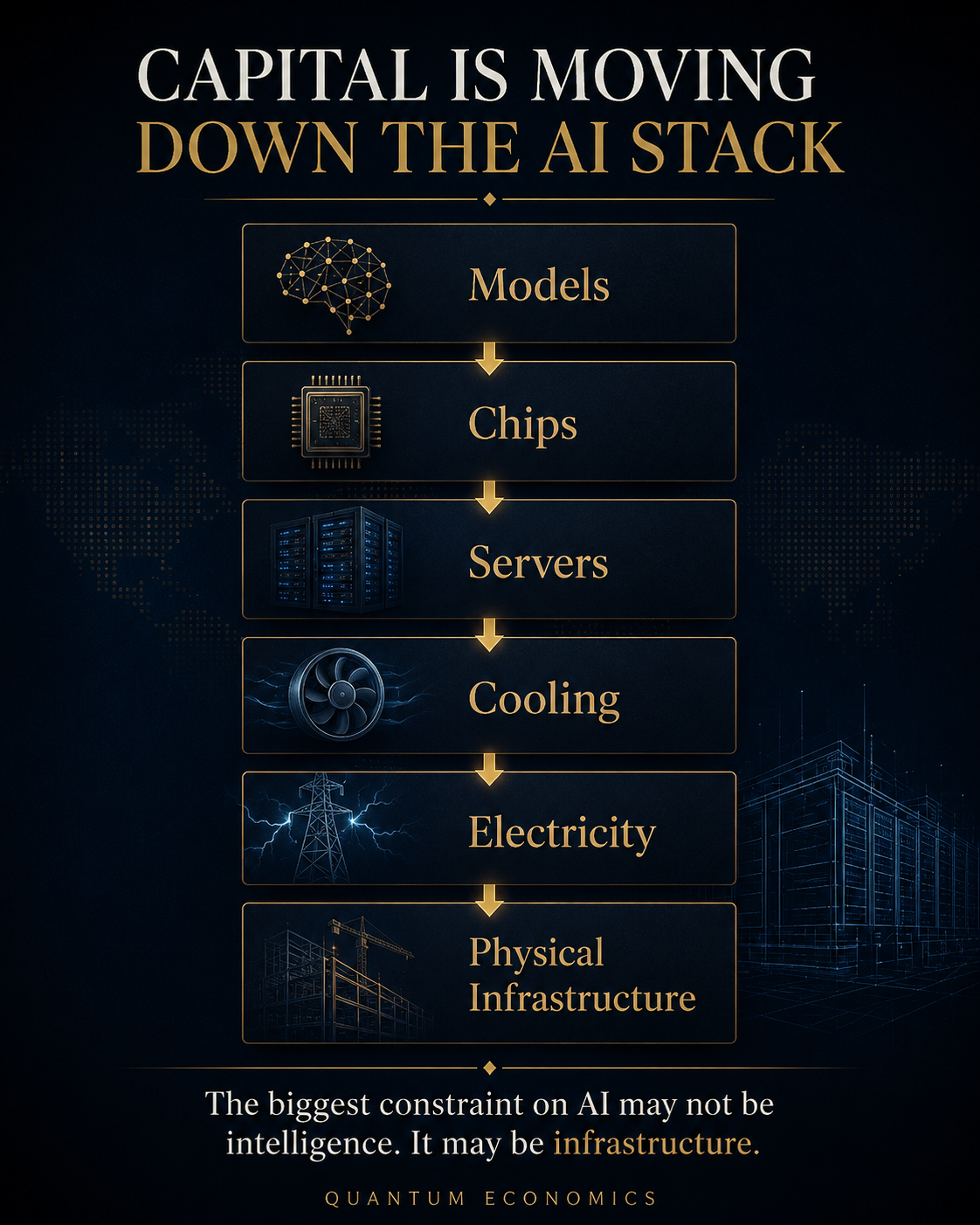
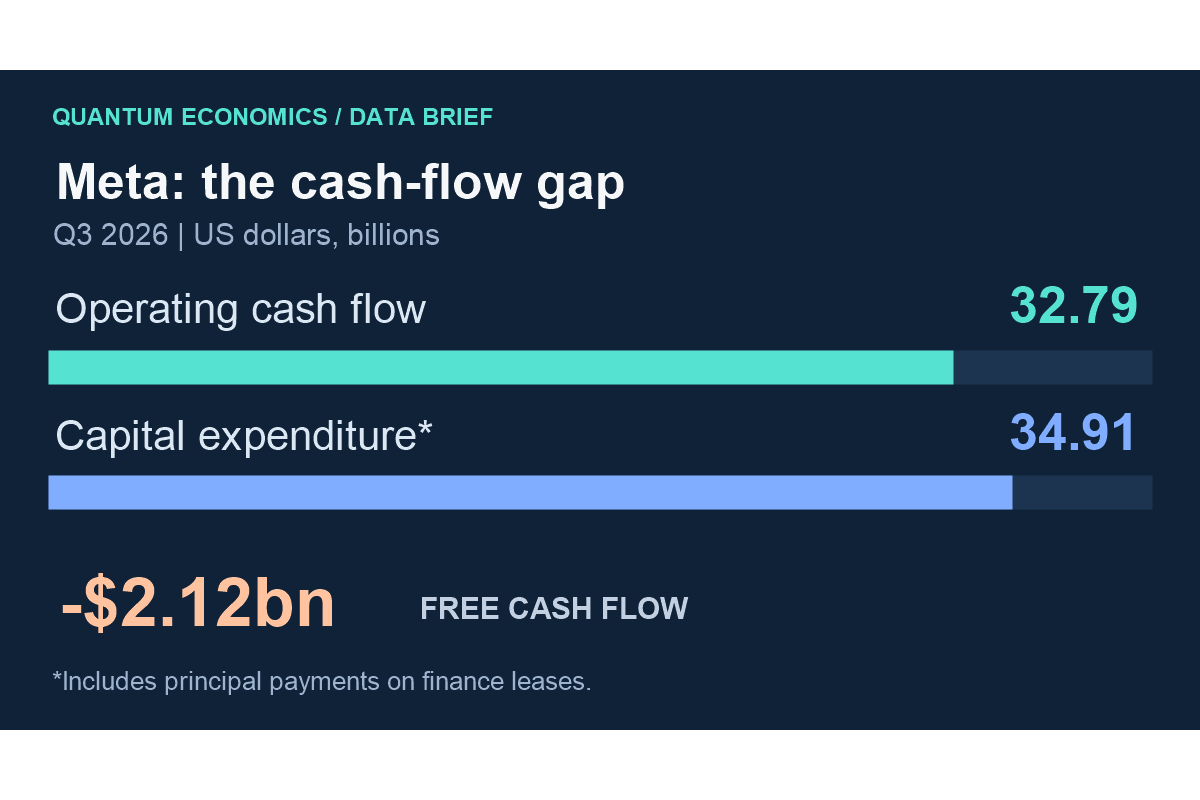
For the last few years, markets have been extraordinarily forgiving when it comes to AI spending. Companies were encouraged to build the models, buy the chips and construct the data centers, with profits expected to follow eventually. That patience may be starting to wear thin. Alphabet (GOOGL) recently reported negative quarterly free cash flow for the first time on record, even as Google Cloud revenue surged. That tells us something important: demand for AI is not slowing, but the cost of serving that demand is becoming impossible to ignore. The market can become less enthusiastic about AI stocks without becoming less enthusiastic about AI itself. In fact, capital may simply be moving further down the stack, from models to chips, from chips to servers, and from servers to cooling, electricity and physical infrastructure. The first phase of the AI boom was dominated by NVIDIA (NVDA), GPUs and large language models. The next phase may be far more physical. Electricity, transformers, natural gas, nuclear power, transmission, cooling, data centers and land are all becoming part of the same investment story. Unlike software, you cannot deploy a patch and create another gigawatt of power. The biggest constraint on artificial intelligence may not be intelligence at all. It may be infrastructure. Markets have spent years chasing digital scarcity. They may now be forced to price physical scarcity. |
 |
02 / Cross-Market Pressure OIL, YIELDS AND BITCOIN |
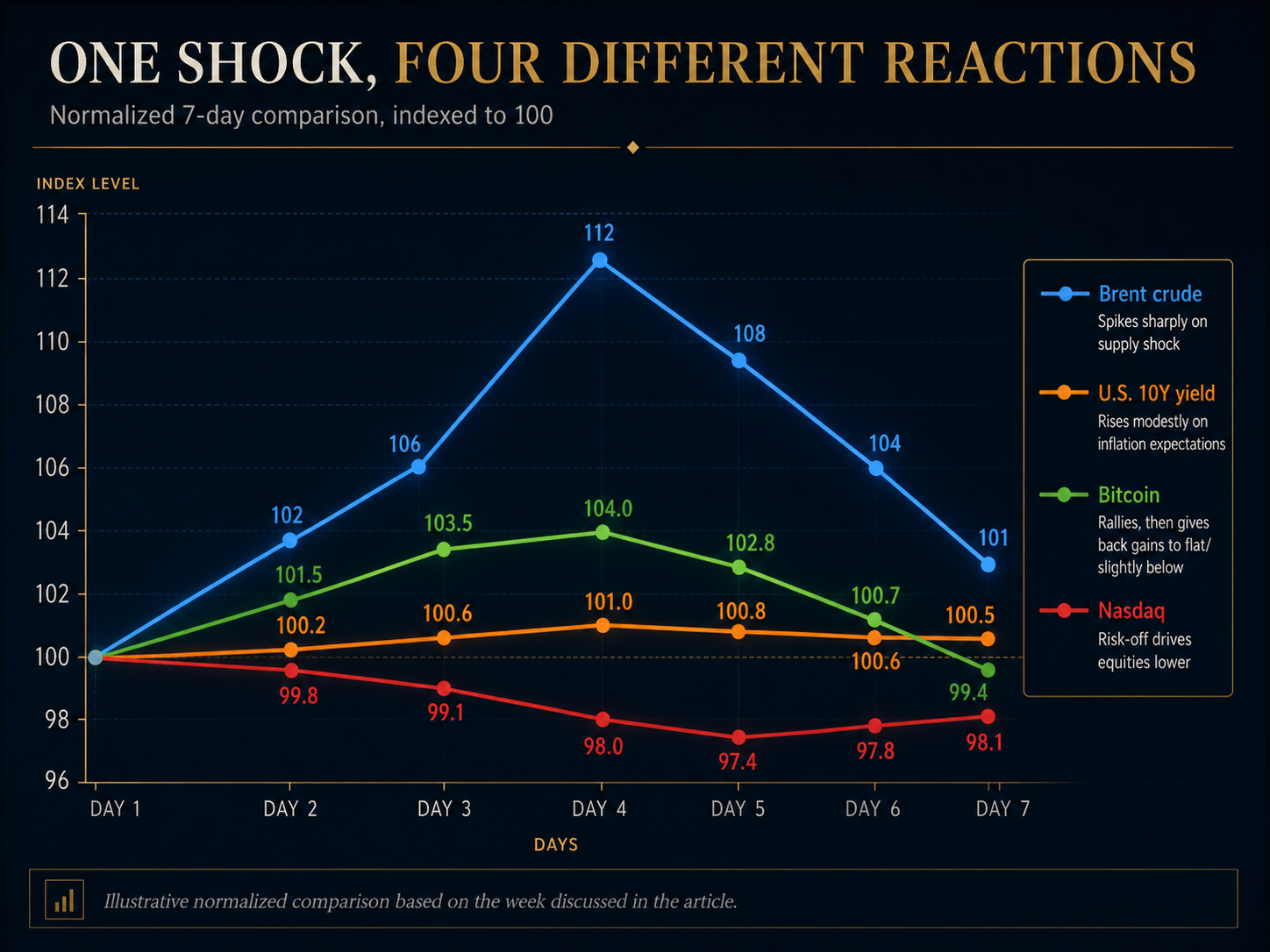
Energy markets added another layer to the story. Brent crude surged above $100 per barrel last week before falling back below $90 as hopes of renewed diplomacy briefly eased supply concerns. That relief did not last long. Brent jumped nearly 8% today to around $91 as Middle East hostilities intensified again, providing another reminder of how quickly geopolitical risk can move through energy markets. Oil remains one of the most effective ways geopolitics finds its way into financial markets. Higher energy prices raise transportation and production costs, push inflation expectations upward and make it harder for central banks to lower interest rates. The U.S. 10-year Treasury yield climbed above 4.7% before easing back toward 4.63%. The Federal Reserve held rates steady today, although three policymakers voted for a hike, reinforcing the idea that higher-for-longer financial conditions remain a threat to expensive and highly leveraged assets. Bitcoin’s reaction was particularly interesting. BTC recovered strongly from its July lows and pushed back into the mid-$60,000 range, even as technology stocks weakened, oil jumped and Treasury yields moved higher. I would not call this a decoupling. Markets do not establish new regimes overnight, and Bitcoin’s resilience is now being tested after slipping back below $64,000. Still, the relative strength is worth watching. Bitcoin has spent much of this cycle trading like a highly leveraged technology asset. If it begins behaving differently during periods of tech weakness, that could become one of the most important market developments of the coming months. For now, $64,000 is the first level Bitcoin needs to reclaim, while $68,000 remains the major test above. Meanwhile, Washington still has homework. Momentum around the CLARITY Act continues to build, but the Senate appears unlikely to complete the legislation before the summer recess. That may be frustrating for the industry, but the larger shift is difficult to ignore. We are no longer debating whether digital assets deserve a regulatory framework. We are debating what that framework should look like. That represents enormous progress from where the industry stood only a few years ago. |
 |
Chart reflects market performance through July 28 and does not include today’s renewed Brent rally. |
03 / Korra Intelligence WHAT KORRA IS SEEING |
While I was traveling, Korra processed more than 100 high-conviction signals across financial markets, social activity and macroeconomic narratives. The dominant theme was the same divergence appearing across the wider market. Legacy industries are dealing with tighter conditions and rising input costs, while AI infrastructure, compute and digital markets continue attracting extraordinary amounts of attention and capital. Korra recorded several successful directional calls during the week. Bitcoin reclaimed $65,500, Brent crude cleared both $87 and $89.50, and the U.S. 10-year Treasury yield reached 4.65%. According to Korra’s internal tracking, the directional win rate currently stands at 76%, representing 28 correct calls out of 37 resolved calls. The more difficult exact-target hit rate, which requires Korra to identify both the specific level and the timing, stands at 57%. These figures are based on Korra’s internal tracking methodology and have not been independently audited. One signal stood out above almost everything else. The global “recession” narrative experienced a 26.69-times spike in social volume across Korra’s monitored feeds. That does not mean a recession is imminent. Social activity measures attention, not economic reality. But narrative acceleration matters because markets often begin worrying about something long before those concerns appear clearly in traditional economic data. Korra also detected a rare six-signal Bitcoin convergence on July 21. Price action, social momentum, developer activity, macro data, institutional signals and market narratives all aligned at once. Shortly afterward, Bitcoin reclaimed $65,500. The individual prediction was interesting, but the convergence was more important. Markets generate an enormous amount of noise. When several independent datasets begin pointing in the same direction, that is when we start paying closer attention. Korra’s recent Act Two upgrade is designed to identify more of these relationships. Its Unified Market Engine can now analyze crypto, stocks and macro signals through the same framework, while Causality Mapping works to distinguish between what caused a move and what merely reacted to it. That means Korra can begin answering more useful questions about how NVIDIA sentiment, oil, Treasury yields and AI infrastructure spending interact across markets. |
 |
04 / The Week Ahead WHAT MATTERS NEXT |
The market is giving us several important questions in the days ahead. Can Bitcoin reclaim $64,000 and challenge $68,000? Will oil remain elevated without reigniting inflation fears? How much AI spending will investors tolerate before demanding clearer financial returns? Will Treasury yields continue challenging risk assets? And perhaps most importantly, where is the real scarcity? In artificial intelligence, scarcity may be moving from GPUs to electricity. In markets, scarcity may be moving from capital to liquidity. And in Bitcoin, scarcity remains exactly where it has always been: 21 million. That part hasn’t changed. The rest of the world certainly has. |


Comments
Log in or sign up to join the conversation.