


The Origins of Gold as Wealth
Long before gold was used as currency and minted into coins, it was an object of immense value to the ancient civilizations of Egypt and Sumer. It was highly prized for its scarcity, malleability, and aesthetic appeal. Before the advent of coinage, gold was used in trade but was not considered money in the modern sense. Instead, it circulated as jewelry, rings, or raw ingots. Because these items lacked standardization, every single transaction required the gold to be painstakingly weighed and tested for purity. While it functioned well as a store of wealth for sovereigns and a unit of account for large, state-level transfers, it was far too cumbersome for daily commerce.
The true breakthrough occurred around 550 BCE under the Lydian King Croesus, who introduced a revolutionary bimetallic system by minting the first standardized coins of pure gold and pure silver. By stamping these coins with an official state guarantee of weight and purity, the king transformed gold into true circulating money. This innovation drastically accelerated trade and gave birth to the concept of commodity money.
Imperial Expansion and the Gold Standard (500 BCE–1900s)
Once the utility of standardized gold coinage was proven in Lydia, the concept was rapidly exported and weaponized by expanding empires:
The Persian Empire (600 BCE): After conquering Lydia, the Persians adopted the system and minted the Daric, a widely circulated gold coin that became the standard for international trade across the ancient Near East.
The Uncompromised Roman Standard (312 CE): The Roman Solidus, introduced by Constantine, maintained its weight and purity for centuries. It served as the international economic anchor for the Byzantine Empire, proving that geopolitical longevity requires an honest currency base.
The Classical Gold Standard (1871–1914): During the peak of global industrial expansion, paper banknotes were not independent currencies—they were simply warehouse receipts for physical gold held securely in bank vaults. This structure enforced strict fiscal discipline, capped structural inflation, and facilitated decades of global capital growth. This era lasted until nations abandoned convertibility to print fiat paper money to fund World War I.
The Fiat Experiment (1971–Present)
The Bretton Woods system, established by the Allies after World War II, attempted a compromise by pegging global currencies to the US dollar, which in turn was backed by gold at $35 an ounce. However, when spending on the Vietnam War and the Great Society programs caused offshore dollar liabilities to heavily outpace the physical gold holdings at Fort Knox, President Richard Nixon severed the gold window on August 15, 1971. This historic move ushered in our current era of unbacked fiat currency and the subsequent debasement of the US dollar.
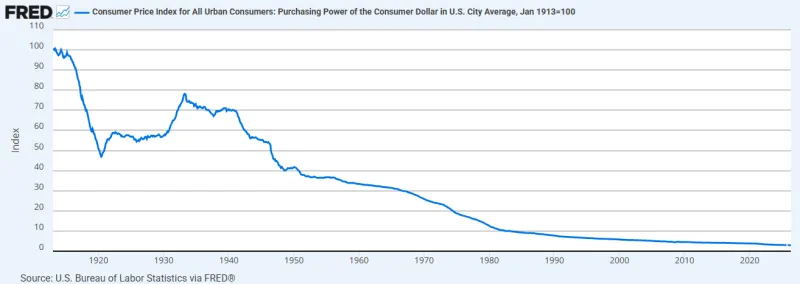
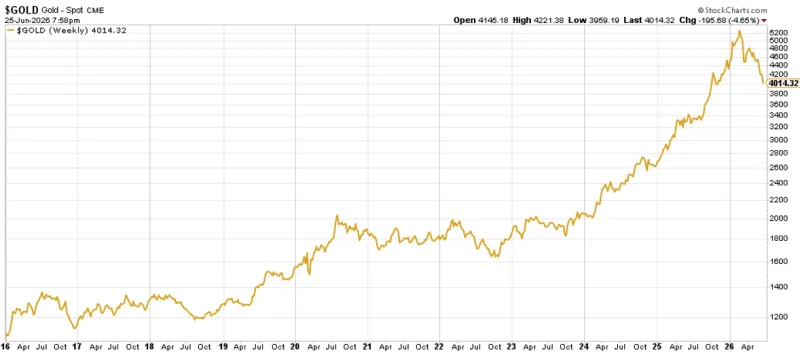
After a 55-year run of pure fiat money, gold is once again resuming its historical role as money. In 2026, the European Central Bank (ECB) and the World Gold Council officially confirmed that the total value of global gold reserves has surpassed holdings of US Treasuries for the first time since 1996. According to a June 2026 ECB report, gold’s share of total official reserves rose to 27%, moving past US Treasury holdings, which fell to 22%.
This shift did not occur overnight; it is the result of a multi-year structural transition driven by two powerful macroeconomic forces:
Exponential Price Appreciation: The price of gold has surged from a low of $1,133 in December 2016 to an all-time high of $5,278 in February 2026—a staggering 366% return in just ten years.
Aggressive Central Bank Accumulation: Central banks have been physically buying gold at unprecedented levels, exceeding 1,000 tons annually for three consecutive years, led aggressively by China. Total official central bank holdings have now swelled to more than 36,000 tons.
This massive accumulation is driven by two main factors: geopolitical de-risking and fiscal concerns. The weaponization of the US dollar following the invasion of Ukraine—specifically the freezing of Russia’s foreign exchange reserves—fundamentally altered how non-aligned nations view US Treasuries. They are no longer viewed as risk-free assets; instead, they carry distinct counterparty risk.
Simultaneously, foreign central banks are growing wary of the trajectory of US structural deficits and a national debt projected by the CBO to rise to $50 trillion by 2030 and $63 trillion by 2036. Rather than absorbing endless mountains of depreciating fiat debt, central banks are choosing to diversify their balance sheets into hard assets.
Why Has Gold Fallen Short-Term?
After a massive 75% run-up that culminated in a peak of $5,608 an ounce in January of this year, gold has experienced a corrective phase, falling close to 30% from its all-time high. This drop is due to a few distinct short-term headwinds:
A Hawkish Federal Reserve Pivot: The primary catalyst is the market pricing in a "higher-for-longer" interest rate environment. Expectations of Fed rate cuts have vanished, and the market has even flirted with pricing in potential rate hikes due to lingering inflationary pressures from geopolitical conflicts, such as the ongoing tensions involving Iran.
A Surging Dollar and Rising Real Yields: Because gold pays no yield, its traditional inverse correlation with real interest rates has returned aggressively. Rising 2-year and 10-year Treasury yields, combined with a 13-month high in the US Dollar Index, make cash and short-term debt highly attractive relative to unyielding bullion.
Tech-Led Liquidity Raising: A deeper sell-off in global technology and AI equities from their record highs has forced institutional investors to raise fast liquidity. When large funds face margin calls in their equity portfolios, they historically liquidate their most liquid winners—which, in this cycle, included gold.
The Ultimate Disconnect: Paper vs. Physical
Just like the oil markets, there is currently a massive disconnect between the paper markets for gold and the physical markets. The paper market controls short-term pricing, which reflects the immediate spot price. The physical market is anchored by Swiss refiners, Chinese demand, and central bank buying, which places a long-term structural floor under the price.
The Paper Market (COMEX & London): This is where institutional money, hedge funds, and algorithms trade gold exposure via futures contracts, options, and unallocated accounts. This market is vastly larger than the physical market, often trading the equivalent of the world's entire annual mined supply in a matter of days. Highly leveraged, paper gold is heavily influenced by Western macro indicators like US bond yields, the dollar, and short-term liquidity needs.
The Physical Market (Shanghai, Dubai, Swiss Refiners): This is the market for actual, physical, allocated bars and coins of 99.99% purity. Here, leverage is virtually non-existent; buyers pay for the metal, and it moves directly into a secure vault. This market is driven by central banks, sovereign wealth funds, and private accumulation, particularly in Asia.
When the paper market drops due to hawkish Fed commentary or a surging dollar, it triggers a wave of algorithmic selling in New York and London. However, in the physical market, the exact opposite occurs: lower prices act as a beacon for physical buyers in the East, who step in to heavily absorb supply.
The Swiss Refining Pipeline: Gateway to the East
Switzerland is the undisputed hub of the physical gold world, refining roughly two-thirds of global annual production. Swiss customs data reveals exactly where the world's physical wealth is migrating:
Purity Transformation: Swiss refineries (such as Valcambi and PAMP) take unrefined mine supply or standard London Good Delivery bars (99.95% pure, 400 oz) and recast them into ultra-pure 1kg kilobars (99.99% pure) highly preferred by Asian markets.
A Metric of Real Flows: When Swiss gold exports surge, it signals heavy institutional and sovereign accumulation. Even during paper market consolidations, Swiss refiners maintain high-capacity utilization (often around 85%), signaling that while Western paper investors are trading in and out of positions, physical gold is steadily flowing one way: East.
China as the Physical Anchor
China dominates the physical gold market just as it does key industrial minerals. It is both the world's largest producer and, alongside India, one of the largest consumers of gold. The Chinese market operates primarily through the Shanghai Gold Exchange (SGE), which functions very differently from Western paper markets:
Physical Delivery Enforcement: Unlike the COMEX, where contracts are almost always settled in cash and physical delivery is rare, the SGE is built entirely around physical settlement. When you buy gold on the SGE, physical bars are routinely withdrawn from the vaults and delivered to the buyer.
Insulated Buying Power: China's net imports frequently spike when Western paper prices drop. In early 2026, Chinese net imports spiked to over 300 tons in a single quarter as buyers took advantage of price pullbacks.
Institutional Allocations: Beyond the People's Bank of China (PBOC) adding to reserves, China's domestic institutional capital is rotating into the metal. For example, China's top insurance companies recently received regulatory approval to allocate up to 1% of their massive Assets Under Management (AUM) directly into physical gold.
The Shanghai Premium: Because capital controls make it difficult to move money out of China, intense domestic demand frequently drives the Shanghai gold price to a significant premium over the London/New York spot price. This premium acts as an arbitrage mechanism that pulls physical metal out of Western vaults, refines it in Switzerland, and stores it permanently in Asian hands.
Long-Term Secular Drivers for the 2020s
While short-term headlines and paper market liquidation can cause temporary corrections, the long-term structural drivers for the remainder of this decade appear to remain fully intact. Here are four such drivers:
Sovereign Debt Saturation & Fiscal Dominance: With US federal debt exceeding 120% of GDP and structural deficits running at 6–7% annually, major developed economies (including Japan, the UK, and France) are trapped. Central banks may ultimately be forced to cap yields to keep government interest payments sustainable, which would mean that long-term real interest rates remain deeply negative or artificially suppressed.
Irreversible Central Bank De-Dollarization: Central bank buying has seen a structural shift. Emerging economies like China, Brazil, and India still hold less than 10% of their total reserves in gold (compared to 60–70% in many Western nations). Steady diversification away from the USD as a non-neutral reserve asset appears to provide a continuous floor for global gold demand.
Supply Constraints and Rising Marginal Costs: The mining industry faces structural supply limits. High-grade, easily accessible deposits are largely depleted. Combined with rising ESG compliance costs, deeper extraction depths, and sticky energy inflation, the marginal cost of production has shifted permanently higher, raising the baseline break-even price floor for miners.
Severe Under-Allocation by Western Portfolios: Despite recent price action, global macro wealth managers and retail investors remain drastically underweight in hard assets. Historically, during regime shifts, even a minor 1–2% rotation of global institutional capital into gold-backed ETFs or mining equities creates massive upward price asymmetry due to the extreme illiquidity of the physical market.
How to Position: The Investor Playbook
Asian physical buyers are viewing this current correction as an opportunity to absorb more supply, effectively draining the available unallocated float in Western financial centers and setting up a tight physical supply squeeze for later this decade. For investors whose investment objectives and risk profile support an allocation to precious metals, I believe this correction presents an attractive opportunity to build positions in precious metals and high-quality miners a few different ways:
Closed-End Physical Trusts: Investors seeking exposure may wish to consider for closed-end physical trusts that frequently trade at steep discounts to their Net Asset Value (NAV) during precious metal corrections.
Shift from Unallocated Paper to Allocated Custody: Consider moving capital away from unallocated synthetic paper positions in traditional bank or brokerage accounts. In bank custody, unallocated gold is merely a financial claim on a balance sheet. In a true physical squeeze, these arrangements may be subject to high tracking errors or cash-settlement clauses, meaning you may be handed paper currency rather than the physical bullion depending on the applicable agreements.
Own Quality Miners: Gold mining equities are currently caught in a crossfire—their stock prices are dragged down by Western paper market sentiment, but their corporate earnings are supported by the physical price floor. Many tier-one miners have all-in sustaining costs (AISC) between $1,300 and $1,500 an ounce. Even with gold well below its previous highs, these companies are generating substantial free cash flow, resulting in dividend increases and stock buybacks.
The Bottom Line: While predicting the exact bottom of a cyclical correction is difficult, I believe the structural fundamentals of this gold bull market remain largely intact. We are witnessing what may prove to be the largest wealth transfer in modern history between the East and the West—many Western investors are selling paper liabilities, while Asian investors and Central Banks are accumulating the physical counterpart. For investors with an appropriate investment objective and risk tolerance, this may present an attractive opportunity to increase exposure to physical precious metals.



Comments
Log in or sign up to join the conversation.