

The financial landscape in May 2026 continues to demonstrate that for an economy as deeply integrated into global networks as India, domestic resilience is constantly interacting with geopolitical developments.
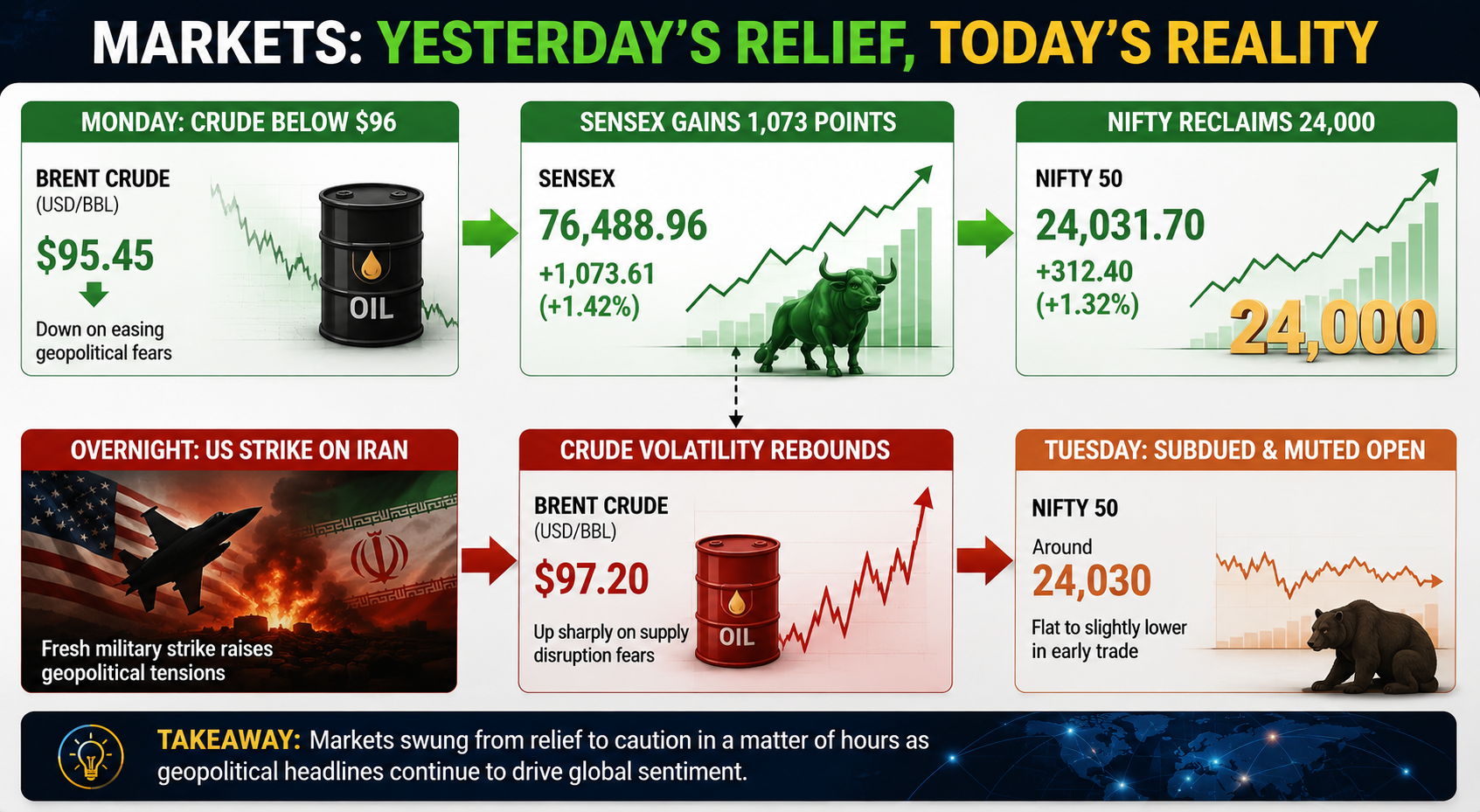
Just yesterday, Dalal Street celebrated what appeared to be a turning point. Optimism surrounding progress in US-Iran diplomatic talks triggered a sharp correction in global crude oil below the $96 mark, prompting an expansive relief rally. The Nifty 50 and BSE Sensex posted their strongest single-day gains in weeks, while the Indian Rupee notched a multi-session high.
However, overnight tracking shows how quickly geopolitics can shift financial expectations. Reports that the US executed a defensive military strike on Iran have abruptly reversed that near-term calm, altering trading strategies across energy, currency, and equity desks this morning.
The Yesterday vs. Today Contrast: A Dynamic Shift
To understand the macro stress currently filtering through Indian desks, one must look at the stark contrast in market behavior between yesterday’s close and today’s active session.
Yesterday’s Bull Run (May 25, 2026)
On Monday, the equity market staged a powerful, broad-based breakout. Relieved by falling oil prices and a stabilizing currency, the BSE Sensex skyrocketed 1,073.61 points (+1.42%) to close at 76,488.96. Concurrently, the Nifty 50 shot up 312.40 points (+1.32%) to cross the crucial psychological barrier and finish at 24,031.70, driven by heavy buying in rate-sensitive banking, financial, and automobile blocks.
Today’s Market Reaction (May 26, 2026)
The overnight military headlines completely altered early morning momentum. The offshore GIFT Nifty, which had initially signaled a positive continuation, immediately gave up its gains. While the domestic benchmarks are attempting to hold onto yesterday's hard-won structural levels with the Nifty 50 hovering around 24,031.70 in morning trade, the aggressive, one-way upward momentum has hit a structural roadblock.
Trading desks are exhibiting immediate caution. The robust risk appetite that fueled yesterday's mid-cap and small-cap rallies has transitioned into selective profit-booking, with capital rotating defensively back toward software exporters and pharmaceutical firms.
The Currency Angle: The Rupee’s Complex Defensive Battle
The foreign exchange market provides a highly clear, real-time assessment of this geopolitical friction. Driven by yesterday’s crude correction, the Indian Rupee advanced for a third consecutive session to close at 95.23 against the US Dollar, moving well away from its historic, panic-driven lows of 96.61.
However, the broader macro pressure has not disappeared. In a candid public interview, Reserve Bank of India (RBI) Governor Sanjay Malhotra noted that while the central bank does not target a rigid level, the rupee's 2.3% slide this fiscal year, on top of an 11% depreciation in FY26, has made the currency appear fundamentally undervalued.
With the US military strike reviving supply disruption fears across the Strait of Hormuz, the vital shipping artery that handles 20% of global oil supplies, corporate dollar demand from oil marketing companies (OMCs) has resurfaced. Analysts from Barclays maintain that despite aggressive, multi-billion-dollar smoothing operations by the RBI, the structural backdrop points to a gradual, weaker path for the currency toward the 98.00 corridor in the coming weeks.
India VIX: The Calming of the Fear Gauge
Surprisingly, the stock market’s primary fear gauge, the India VIX (Volatility Index), is providing a unique perspective during today's session. While a sudden military conflict typically triggers an immediate spike in implied volatility, the VIX is actually reflecting a sigh of relief from option writers who had spent the prior week pricing in worst-case structural scenarios.
According to live derivatives data from the National Stock Exchange (NSE), the India VIX is trading down near 15.91, down 6.76% from its previous close of 17.91.
Volatility Index | Active Trading Level | Intraday Movement | Market Implication |
India VIX | 15.91 | Down ~6.76% | Option premium compression; markets are digesting risks rather than panicking |
This compression in the VIX indicates that while the US strike introduces fresh operational friction, the market is treating it as a contained, calculated military engagement rather than an unmanageable escalation. Risk desks are actively utilizing this lower-volatility window to re-hedge portfolios, adjusting option premiums to account for structural range-bound trading rather than absolute systemic panic.
Structural Transmission and the Road Ahead
The fundamental risk for the Indian economy is that these international trends eventually filter down to ground-level corporate economics. The 2026 Iran war has already been labeled by the International Energy Agency (IEA) as the largest supply disruption in global oil market history, forcing refiners worldwide to aggressively draw down inventories.
For India, an elevated energy baseline eventually compounds into second-order inflation. When landing import costs remain high, it limits the central bank’s capacity to lower interest rates, directly impacting industrial credit expansion and capital expenditure cycles.
Dalal Street’s resilient stance today proves that the massive cushion of domestic institutional liquidity remains a powerful stabilizing force. However, the contrast between yesterday’s enthusiastic rally and today’s watchful, subdued posture serves as a vivid reminder: in a highly integrated global financial architecture, complete macro decoupling remains an elusive goal.

Comments
Log in or sign up to join the conversation.