


If you want to understand how quickly institutional psychology shifts, look no further than the last 48 hours. Just days ago, trading desks worldwide were defensively positioning for a worst-case scenario in the Gulf: a full-scale energy shock, triple-digit crude oil, and a crippling global inflation spiral.
Today, the entire narrative has been flipped on its head.
A sudden diplomatic pivot from Washington has triggered one of the most explosive global relief rallies of the year. But the most revealing aspect of this market surge isn't the green on the screens, it's the widespread skepticism. Markets rarely stage massive rallies when everyone is comfortably in agreement; they climb when investors are caught off guard and forced to rapidly reprice risk.
The Catalyst: From Severe Escalation to a Tentative Truce
The massive sentiment reversal was sparked by a dramatic shift in U.S. foreign policy. After launching severe rounds of airstrikes and threatening to execute direct strikes on Iran’s core oil infrastructure, including its massive export hub on Kharg Island, US President Donald Trump unexpectedly reversed course. He announced that he had called off the new military strikes, stating that discussions with Iran's highest leadership had been approved and a deal is expected shortly.
This sudden de-escalation caught macro funds completely out of position. Prior to this, the narrative was heavily anchored in deterioration. In fact, pointing out the fragility of the global engine, the World Bank downgraded its global growth forecast to 2.5%, warning that a prolonged energy freeze through key chokepoints could drag that figure as low as 1.3%. Investors were fully braced for impact. Instead, they received a sudden window of diplomatic hope.
Global Equity Markets Unleash a Relief Wave
The global equity response to the cooling tensions was swift and aggressive, especially across Asian and American trading floors:
KOSPI (South Korea): Rocketed an astonishing +8.3% as semiconductor and industrial heavyweights led the short-covering charge.
Nikkei 225 (Japan): Surged +4.3%, capitalizing on a broader stabilization in global supply expectations.
Wall Street: Extended its powerful rebound, with the Dow Jones Industrial Average jumping 929.97 points (+1.86%), alongside sharp gains in the S&P 500 (+1.75%) and the Nasdaq Composite (+2.54%).
Crude Oil Capitulates to Two-Month Lows
The epicenter of the relief wave materialized in the commodities pits. Only a week ago, energy desks were intensely debating how far beyond $100 a barrel Brent crude would break. Following the diplomatic breakthrough, that premium evaporated.
International benchmark Brent Crude prices plunged back to hover near $89.08 per barrel, while WTI Crude slipped toward $86.08. This swift correction is fundamentally shifting the immediate conversation from entrenched inflation back toward macro disinflation.
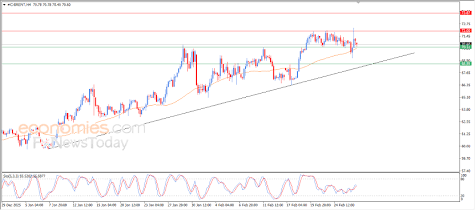
Brent Crude Oil Market Performance Tracker. Source: Economies.com
The India Perspective: Breathing Room for Dalal Street
For the Indian economy, few things matter more than sub-$90 crude. India structurally depends on foreign corridors to fulfill more than 85% of its petroleum needs. When oil moves lower, it triggers a positive macroeconomic chain reaction across the entire domestic ecosystem:
Trading Economics
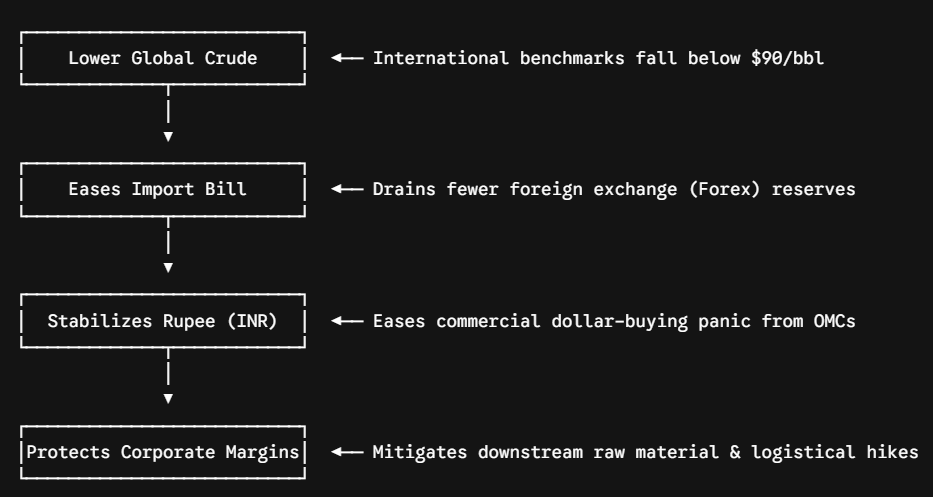
1. Dalal Street's Rebound
The immediate impact was clearly visible on domestic trading terminals. After facing notable selling pressure during the prior session, where profit-booking across green energy and utility shares dragged the BSE Sensex down to 73,832.55 and the Nifty 50 to 23,173.80, the market experienced a powerful gap-up recovery.
At the time of writing, the Nifty 50 was surging back to trade at 23,416.55, while the benchmark BSE Sensex rebounded firmly by 0.59% to scale back up to 74,709.27.
2. The Rupee Reclaims Ground
The pressure relief valve extended directly to the currency desk. The Indian Rupee, which had faced severe friction and weakened toward the 95.76 level on the back of intense corporate dollar demand, staged a healthy advance. Backed by the drop in crude and smoothing operations, at the time of writing, the USD/INR spot exchange rate recovered to trade stronger near 95.18.
Macro Parameter | Current Market Level | Intraday Structural Status |
|---|---|---|
Nifty 50 Index | 23,416.55 | Gapping up; reclaiming short-term moving averages |
BSE Sensex | 74,709.27 | Rebounding over 870 points off yesterday's closing lows |
USD / INR Spot | 95.18 | Strengthening as import-driven dollar billing pressures ease |
Brent Crude Oil | $89.08 / bbl | Consolidating at two-month lows; stripping out geopolitical premiums |
Gold Futures | ~$2,222 / oz | Holding structural baselines as safe-haven demand softens |
Sector Rotation: Mapping the New Realities
As capital actively repositions, the internal dynamics of Dalal Street are shifting from defensive hoarding back into growth cyclicals.
The Clear Beneficiaries
Financials & Banking: Lower macro stress directly improves credit conditions and limits asset quality deterioration risks, boosting private and public banking majors.
Automobiles & Logistics: A combination of stable industrial input costs and falling fuel transport expectations removes major headwinds from operating margins.
Aviation & Discretionary Consumption: Falling aviation turbine fuel (ATF) costs offer direct earnings visibility for carriers, while easing retail inflation preserves urban discretionary spending.
Spaces to Monitor with Caution
Energy Producers: Upstream oil and gas exploration firms may see near-term revenue projections moderate as realizations track closer to $85–$89 rather than triple digits.
Defense Utilities: The near-term geopolitical premium that crowded into public defense blocks over the past month could temporarily cool as diplomatic channels advance.
The Contrarian Reality Check
The psychological challenge confronting asset managers now is straightforward: Do you fully trust a peace narrative born from volatile social media announcements?
Most sophisticated funds don't. And ironically, that exact skepticism is what provides the structural runway for this market to move higher. Bull markets are fundamentally built on a "wall of worry." When retail and institutional cash sits on the sidelines waiting for absolute certainty, it creates a pool of sideline capital that eventually chimes in on every subsequent dip.
This aligns cleanly with recent positioning notes from BlackRock (BLK), the world’s largest asset manager. They argued that Indian equities had been "over-punished" by global funds over-indexing on short-term oil fears. India’s medium-term macro drivers, including a massive domestic infrastructure buildout and robust corporate balance sheets, remain entirely intact. The global environment hasn’t magically become perfect, but it has finally granted India the structural breathing room it needs to perform.
Ultimately, this rally isn't celebrating a guaranteed era of peace. It is soberly repricing the possibility that the absolute worst-case scenario has been avoided.


Comments
Log in or sign up to join the conversation.