

Markets have spent the last two decades operating under a comfortable, highly publicized rule: public stock markets are where you go to price established cash flows, while private venture capital is the sanctuary where you fund multi-billion-dollar infrastructure experiments. Public markets traditionally demand near-term earnings; private markets subsidize long-term structural dreams.
On Friday, that long-standing wall officially dissolved.
The arrival of Space Exploration Technologies Corp. (SPCX) on the Nasdaq floor is being covered by mainstream publications as a historic retail event. But the real story unfolding across trading desks isn't about the spectacle of a rocket company going public. It is about a paradox that exposes a massive shift in how global capital is allocated, how benchmark indices are managed, and how institutional psychology handles immense cash burn.
The Valuation Paradox: High Premium vs. Operational Realities
Traditional initial public offerings (IPOs) follow a standard protocol. A syndicate of investment banks tours the world’s major financial hubs, feels out institutional demand, and sets a preliminary pricing range. Bypassing this standard discovery process, the company dictated a single fixed issue price of $135 per share before its formal roadshow even commenced.
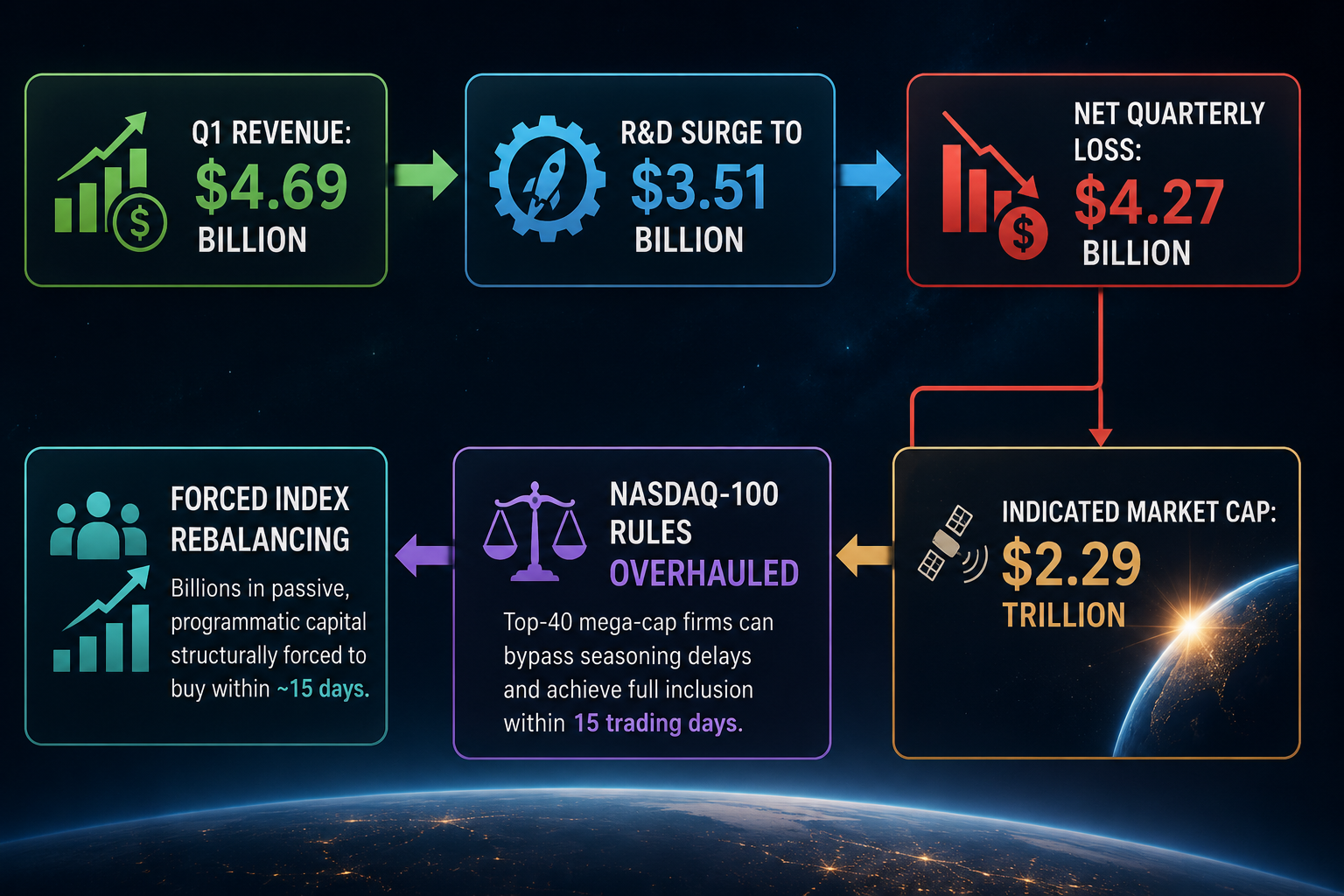
Yet, as the opening bells settled, early order-matching data from Nasdaq indicated that the stock was set to open roughly 30% higher, trading near the $174 to $175 range. This early trading surge re-rates the company’s real-time public valuation to a staggering $2.29 trillion, positioning it directly ahead of established corporate giants like JPMorgan Chase (JPM) and Berkshire Hathaway (BRK-A) on day one.
The psychological tension emerges the moment you look beneath this massive valuation layer and examine the actual financial disclosures from the latest regulatory filings. According to verified quarterly data from Google Finance and official stock prospectus registries, the company's internal cost parameters look starkly different from typical mega-cap public listings:
Q1 2026 Revenue: Managed to reach $4.69 billion, reflecting a steady 15% growth over the $4.07 billion posted in the same quarter last year.
Operating Expenses: Exploded vertically to $6.65 billion, up significantly from the $4.01 billion recorded in the previous year's period.
Research & Development: Skyrocketed from $1.56 billion to $3.51 billion in a single year, driven by the intense scaling of reusable heavy-lift platforms and next-generation satellite layers.
Net Losses: The widening operating gap resulted in a comprehensive net loss of $4.27 billion for the first quarter of 2026 alone.
Under any traditional valuation matrix, an industrial manufacturing entity trading at an implied multiple of roughly 94 times its revenue while bleeding billions of dollars a quarter would be met with severe institutional caution. Instead, it is being met with a wall of capital. This reaction reveals a profound shift in modern market behavior: institutional money is no longer allocating capital strictly based on current financial performance; it is treating public equity as a direct funding mechanism for dominant global infrastructure.
Captive Capital Flows and Index Rewriting
To truly understand why the stock is experiencing such intense day-one buying pressure despite heavy losses, you have to look past retail enthusiasm and study the plumbing of passive asset management. This is where we see the raw power of forced institutional buying.
Historically, exchange providers maintained strict waiting periods. Newly public entities were routinely forced to trade in the secondary market for up to a year to demonstrate pricing stability and float liquidity before gaining entry into elite benchmarks like the Nasdaq-100 (QQQ) or the S&P 500 (SPY).
But a trillion-dollar baseline listing entirely breaks the traditional index machinery. Because passive index-tracking funds manage trillions of dollars in retail retirement accounts, they cannot afford to remain underweight an asset of this scale without suffering severe tracking errors.
Recognizing this friction, index providers completely overhauled their playbooks ahead of the launch. Market infrastructure notes from the CME Group confirm that the Nasdaq-100 revised its listing rules to allow top-40 ranked mega-cap firms to bypass seasoning delays and achieve full inclusion within just 15 trading days.
This rule change creates a powerful psychological incentive. Institutional fund managers know that within three weeks, billions of dollars in passive, programmatic index money will be structurally forced to buy this stock, regardless of whether it loses $4 billion a quarter. Large hedge funds and active managers are aggressively front-running this guaranteed wave of passive demand, creating a self-fulfilling price pop.
The India Lens: Capital Efficiency vs. Open-Ended Cash Burn
This massive deployment of public capital on the Nasdaq offers a highly clear, strategic contrast to how alternative space tech corridors are structuring their financing models. While the Western blueprint relies on using public markets as an open-ended cash furnace to build centralized dominance, the emerging space ecosystem in India is advancing a playbook rooted in extreme capital efficiency, asset-light engineering, and structured public-private partnerships.
Coinciding with this global macro shift, the Indian National Space Promotion and Authorisation Centre (IN-SPACe) officially announced its initial strategic capital allocations. According to official reports from The Hindu, the regulator selected three private deep-tech space startups for capital distribution under its newly minted ₹500-crore Technology Adoption Fund (TAF): Astrobase Space Technologies (developing reusable LOX-LNG engines), SatSure Analytics India (scaling foundational Earth Observation AI models), and TM2SPACE Technologies (manufacturing high-precision satellite star trackers).
The underlying investment psychology here represents a total inversion of the SPCX model. Sovereign policy updates from the Press Information Bureau (PIB) confirm that India’s private space tech grid now spans more than 400 active startups. Rather than asking public investors to bankroll a centralized entity that builds everything from launch pads to consumer internet routers under one roof, India is building a distributed ecosystem.
By managing formal processes to allow private consortia to entirely absorb and commercialize ISRO's heavy-lift workhorse—the Launch Vehicle Mark-III (LVM3)—and combining it with a liberalized 100% Foreign Direct Investment (FDI) route, India is proving that you can build reliable global infrastructure through deep technology transfers and structural discipline, avoiding massive operational losses.
What Investors Are Beginning to Believe
The market behavior surrounding this historic listing forces us to confront an uncomfortable psychological reality: what are investors actually willing to pay for today?
For years, market textbooks preached that a stock's intrinsic value is the net present value of its future free cash flows. But the market's response to SPCX proves that institutional capital is increasingly willing to ignore massive near-term losses if a company possesses a genuine, un-replicable moat. Investors are choosing to prioritize absolute physical dominance over short-term balance sheet discipline, paying a premium for long-term infrastructure dominance.
Concurrently, risk desks are completely shifting their perspective on fear. Investors are no longer terrified of a company running a multi-billion-dollar quarterly loss. Instead, their primary fear has shifted to a psychological anxiety: the fear of being left behind—the worry of sitting on the sidelines while a new, multi-trillion-dollar asset class permanently alters the weightings of the global indices they are benchmarked against.
The Realization
When an asset of this magnitude transitions into the public arena, the stock exchange stops acting merely as a platform for discovering corporate value. It turns into a structural pipeline for funding global infrastructure.
Markets once existed primarily to value businesses. Increasingly, they are being used to finance civilization-scale ambitions. Investors are making a clear bet that future dominance matters far more than present profitability. The ultimate question moving forward is whether public markets can continue funding the future long before the future learns how to pay for itself.



Comments
Log in or sign up to join the conversation.