

London slipped on Tuesday, but this was a contained pullback rather than a broad risk dump, with heavy healthcare losses and weakness in Asia-facing banks outweighing better tone in housebuilders, consumer cyclicals and selected financials. The market’s safety net was geopolitics. After Israel and Iran halted attacks, investors leaned into the possibility of a U.S.-Iran peace track, helping cap the downside and easing some of the oil-shock anxiety that has dominated recent sessions. But the tape still had enough stock-specific damage to keep the benchmark in the red.
Healthcare was the main problem. GSK dropped 2.7% after agreeing to buy U.S.-listed Nuvalent for $10.6 billion. Strategically, the deal adds oncology exposure, but the market’s first reaction was simple: big cheque, big execution risk. AstraZeneca also fell nearly 2%, even though its experimental obesity pill delivered weight reductions of up to 11.8% in a mid-stage trial. That response tells you expectations were already high, and investors wanted more than a decent data point to chase the stock.Banks added another drag. Standard Chartered lost around 2.7% and HSBC fell 1.25%, keeping China and Asia-linked financial exposure under pressure. After last week’s worries around tighter offshore banking access in Hong Kong, investors remain quick to cut risk in names tied to Asian capital flows.
Elsewhere on the downside, Sage, Glencore, Mondi, Auto Trader and BP fell between 1% and 1.7%. Relx slipped about 1% despite announcing a £200 million buyback running to June 2026, suggesting the programme was not enough to offset valuation caution after a strong run. here were still clear pockets of demand. Metlen Energy & Metals jumped more than 4%, while Bunzl gained 2.7%. IG Group rose 2.4% and Croda added 2.2%. Domestically exposed names also found buyers, with Admiral, Howden Joinery, Barratt Redrow, Airtel Africa, Persimmon, M&G, Lloyds, Entain, NatWest, Berkeley, Coca-Cola HBC, Kingfisher, JD Sports, Standard Life and Spirax all up between 1% and 1.8%.
Housebuilders were a relative bright spot. Bellway rose about 3% after holding its FY26 profit outlook, giving the sector a useful confidence boost. Barratt Redrow, Persimmon and Berkeley also gained, helped by a softer geopolitical tone and evidence that the UK consumer is not rolling over completely. Mid-cap moves were livelier. Keller gained 3% after landing a $207 million contract variation order for a major U.S. highway reconstruction project. Oxford Instruments went the other way, sliding more than 6.5% despite full-year numbers coming in slightly ahead of expectations. In this market, “slightly ahead” is not enough if the outlook does not excite.
On the macro side, the British Retail Consortium delivered a headline beat. Like-for-like retail sales rose 3.7% year-on-year in May, well above expectations for 0.6% and the strongest reading since April 2025. Total sales were also up 3.7%. But the detail is less punchy than the headline. May had help from good weather and awkward bank-holiday timing, so the clean read is the three-month trend. On that basis, sales values grew about 1.6% year-on-year. With shop-price inflation running at 1.2%, real volume growth looks modest. Translation: consumers are still spending, but they are not splurging. That is broadly helpful for the Bank of England. The data do not scream recession, but they also do not point to a demand boom that would force an aggressive policy response. With geopolitical pressure easing at the margin and the labour market softening, the case for holding rates steady remains intact.
Finish Line: The FTSE 100 slipped as pharma and Asia-linked banks dragged, but peace hopes and a better bid for domestic cyclicals kept the selloff shallow. The UK consumer looks alive, not electric. For now, that is enough to support selective risk-taking, but not enough to turn the whole London tape higher.
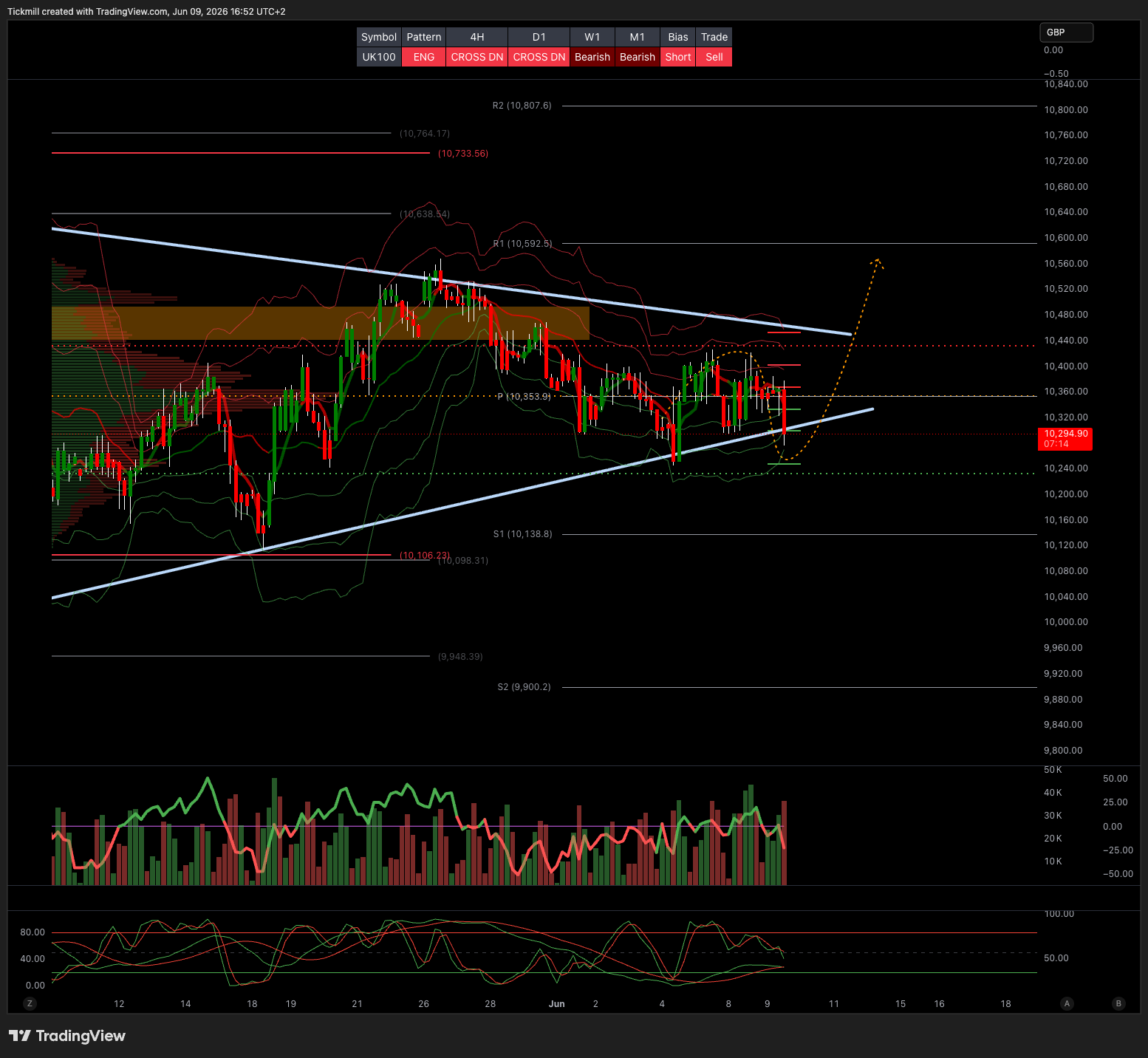
TECHNICAL & TRADE VIEW – FTSE100
Daily VWAP Bullish
Weekly VWAP Bullish
Above 10500 Target 11000
Below 10250 Target 9469


Comments
Log in or sign up to join the conversation.