

Seven-Day Streak Snaps as Hormuz Hopes Whipsaw Investors
Britain’s benchmark index fell on Thursday, with the FTSE 100 down 0.6, snapping a seven-day winning streak as renewed hostilities between the United States and Iran hit risk appetite and clouded hopes of reopening the Strait of Hormuz. The pullback marked a clear change in tone after a strong run for UK equities. Recent gains had been supported by hopes that the ceasefire could stabilise, that energy flows through Hormuz might eventually resume, and that the Bank of England’s rate path would become less restrictive. But the latest exchange of air strikes between Washington and Tehran reminded investors that the geopolitical risk premium has not disappeared — it has merely been repriced from day to day. The FTSE 250 also weakened, slipping 0.4% after recently trading near a three-month high. That move suggested that caution was not limited to internationally exposed blue chips but was also filtering into more domestically focused UK equities. Investor sentiment weakened after Iran and the United States exchanged strikes, underlining the fragile nature of negotiations aimed at preserving the ceasefire that took effect in early April., however, late reporting Stateside suggests a deal is still in the offing, dependent on Trump's sign-off. Markets have been whipsawed on headlines recently leaning on the idea that tensions could cool enough to allow progress toward reopening the Strait of Hormuz, a critical route for global energy supplies. That optimism faded on Thursday. The renewed hostilities revived concerns over oil supply stability, shipping security and the inflationary consequences of any prolonged disruption. For UK equities, that created a familiar split: the broader market sold off, while energy and defence names found support.
Among individual stocks, BT (BT.A) was the standout drag on the FTSE 100, falling around 4.7% and ranking as the benchmark’s biggest decliner. The move followed a report that the British government would oppose any attempt by Indian billionaire Sunil Bharti Mittal to increase his stake in the telecoms group. The report raised fresh questions about political oversight of strategically important UK assets, adding another layer of uncertainty around BT’s shareholder base and future ownership structure. BT’s decline added pressure to an index already struggling with a weaker global risk backdrop. Despite the broader weakness, energy and defence stocks outperformed, emerging as the market’s clearest bright spots. The renewed exchange of strikes between Iran and the United States increased concerns about global security and energy supply stability, giving support to companies exposed to oil prices, defence spending and military demand. Investors continued to monitor the Strait of Hormuz closely, given its role as a crucial gateway for global oil shipments. That sector rotation showed the market’s defensive instincts clearly: when geopolitical risk rises, investors are still willing to pay for energy security and defence visibility, even as they reduce exposure elsewhere.
In other corporate news, PPHE Hotel Group surged 23% after the hospitality real estate company said it had received a £920.9 million, or roughly $1.24 billion, takeover proposal from Israel’s Fattal Hotel Group. The sharp rise made PPHE one of the strongest performers on the London market during the session and provided a reminder that stock-specific catalysts remain capable of cutting through the broader risk-off mood. Chipmaker IQE fell 3.3% after reporting a decline in full-year adjusted core profit. The update added pressure to technology-linked names during an already weaker trading session. With investors in a more cautious mood, earnings disappointments were punished more quickly, particularly in areas exposed to cyclical demand and margin pressure. Meanwhile, ousted BP Chair Albert Manifold acknowledged that he may have pushed hard for change, but again denied any misconduct following his dismissal earlier in the week. BP shares were largely flat despite the comments, suggesting investors were more focused on the broader energy and geopolitical backdrop than on the latest leadership headlines. With oil-market risk back in focus, the stock’s near-term direction remains more tied to Hormuz developments and crude-price expectations than to boardroom fallout.
Finish Line: The FTSE’s seven-day winning streak finally broke, with the benchmark down 0.8% as renewed US-Iran hostilities knocked risk appetite and dimmed hopes of a near-term reopening of the Strait of Hormuz. BT’s 4.7% drop added a domestic political wrinkle to the selloff, while energy and defence provided the day’s only real shelter. The message from the tape was straightforward: UK equities can still rally on softer rates and better corporate news, but when Hormuz risk returns, the market quickly shifts back from “recovery trade” to “risk premium trade. ”.
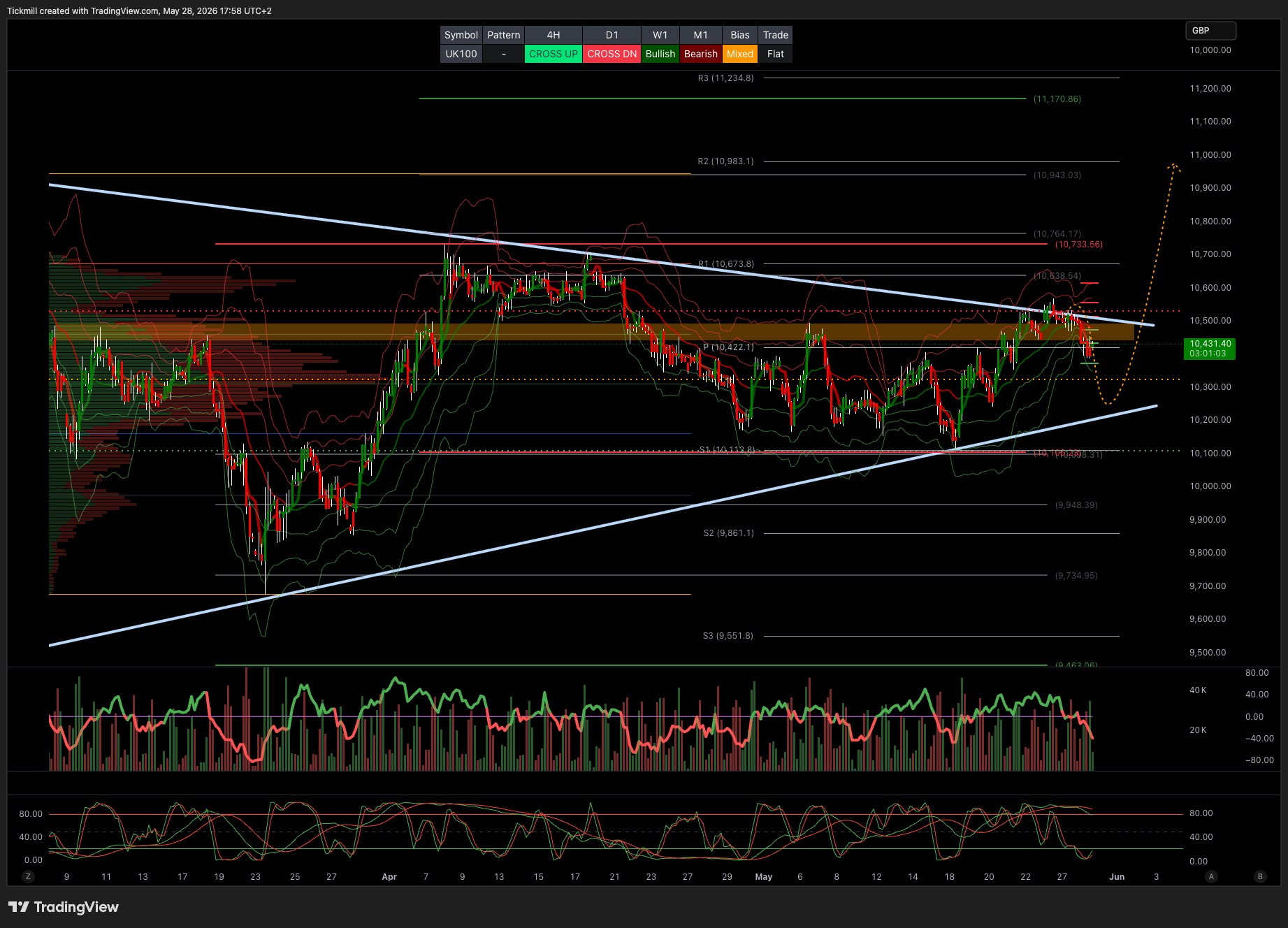
TECHNICAL & TRADE VIEW – FTSE100
Daily VWAP Bullish
Weekly VWAP Bullish
Above 10500 Target 11000
Below 10100 Target 9469
Comments
Log in or sign up to join the conversation.