

UK equities weakened on Monday, with the major indices pressured by renewed concerns that the US-Iran ceasefire could unravel, undermining broader risk appetite. Sentiment deteriorated after the US seizure of an Iranian cargo vessel and fresh disruption to shipping through the Strait of Hormuz, developments that drove crude prices more than 5% higher and weighed on cyclical sectors. The FTSE 100 was down close to 1% into the close, led lower by weakness in financials, where Barclays fell 2.3% and HSBC lost 1.2%, leaving the sector down around 1.7% on the day.
In the resources space, precious metals miners underperformed, with Fresnillo and Hochschild both down around 2%, tracking softer gold and silver prices. The sharp increase in oil prices also pressured travel-related stocks. IAG fell 2.8%, while Rolls-Royce lost 2.6%, contributing to a roughly 2% decline in the aerospace and defence segments. On the corporate side, AstraZeneca (AZN) reported positive late-stage trial results for an experimental treatment designed to reduce flare-ups in chronic obstructive pulmonary disease, although the shares still edged 1% lower on the session.
By contrast, the move in energy markets provided support for the integrated oils, with BP rising 2.8% and Shell (SHEL) gaining 2.3%. Among mid- and small-cap names, Mulberry advanced 7.5% after reporting stronger annual revenue, while Renishaw gained 6.9% after upgrading its full-year profit outlook. M&C Saatchi slipped 0.9%, with investors weighing the potential for the Middle East conflict to disrupt parts of its sports and entertainment exposure. The session reflected a classic oil-shock risk-off pattern in UK equities: banks, travel and cyclicals came under pressure, while energy outperformed. For now, direction is likely to remain closely tied to developments in the Strait of Hormuz and the extent to which higher energy prices begin to feed through into the broader macro outlook.
The UK data calendar is notably busier this week. The labour market report on Tuesday, spanning both February and March, is likely to offer only a limited view of the economy’s initial response to the recent energy shock. By contrast, March inflation data on Wednesday should provide a clearer signal, with a widening in the gap between headline and core CPI expected as higher petrol prices feed through. Attention will then turn to the March public finances release on Thursday, which will provide a provisional outturn for the 2025–26 fiscal year and may be accompanied by a modest technical revision to the DMO remit. The week concludes with March retail sales on Friday
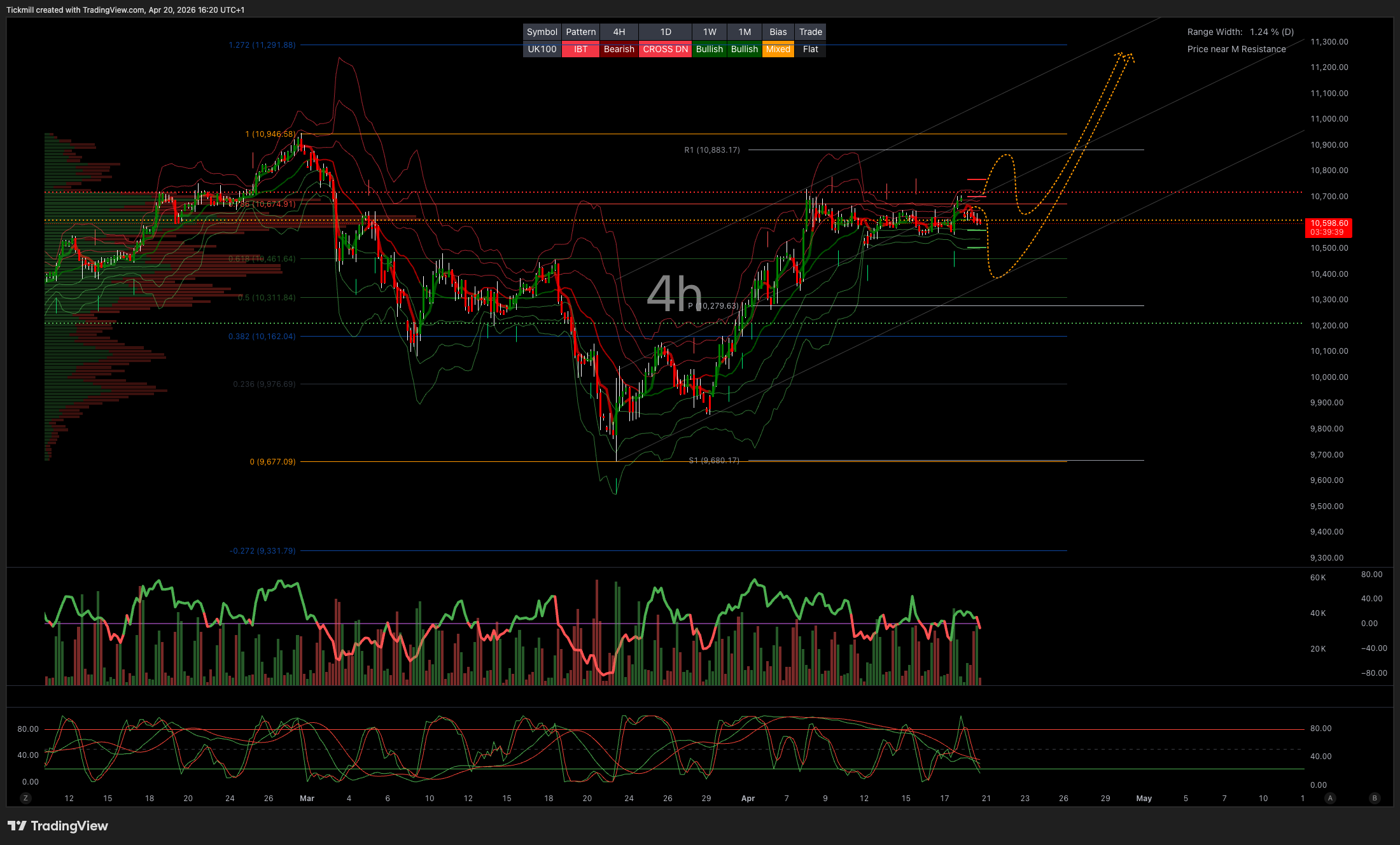
TECHNICAL & TRADE VIEW – FTSE100
Daily VWAP Bearish
Weekly VWAP Bullish
Above 10400 Target 11200
Below 10300 Target 10100


Comments
Log in or sign up to join the conversation.