

Gold and silver just had a rough week, and the reason was simple: the dollar got stronger. The U.S. Dollar Index closed Friday, November 13, near 103.4, its highest level since April 2025. Gold fell about 4% on the week to around $3,886 an ounce, and silver dropped more than 5% to about $49, a one-year low.
When that happens, it is easy to conclude the dollar is winning and the metals are losing. I think that reads the situation backward. A strong dollar on the currency charts and a strong dollar in your wallet are two very different things. To see why, it helps to look at what the Fed is doing, what prices are doing underneath it, and Gresham's law.
What the Fed is doing, and why metals are reacting
The Fed is in a tightening cycle. It raised its benchmark rate in September to a range of 3.75% to 4.00%, then held there at its October 28 meeting. Two officials, Governor Lisa Cook and Cleveland Fed President Beth Hammack, dissented in favor of another quarter-point hike, according to the Fed's implementation note and statement. Markets now expect a hike in December.
The reason is rising prices. The Bureau of Labor Statistics reported on November 10 that consumer prices rose 0.4% in October, more than economists expected, after a 0.6% jump in September. The BLS could not publish an annual rate for October because it never collected October 2025 data during last year's government shutdown, but the last available annual figure, for September, was 3.7%. Gasoline alone was up 37.4% from a year earlier.
Higher rate expectations push up Treasury yields, and the 10-year yield went above 5% this week. That pulls money into the dollar and away from assets that pay no interest. Gold and silver are priced in dollars, so a stronger dollar makes them more expensive for buyers overseas and cools demand. Silver, with more than half of its demand coming from industry, gets hit twice because higher rates also raise the odds of an economic slowdown.
That is the short-term picture, and it is real. But it is not the whole picture.
A strong dollar is not the same as a valuable dollar
The dollar index measures the dollar against other paper currencies, mostly the euro, the yen and the pound. It was set at 100 in March 1973. Today it is around 103. Over more than 50 years, the dollar has basically broken even against its peers.
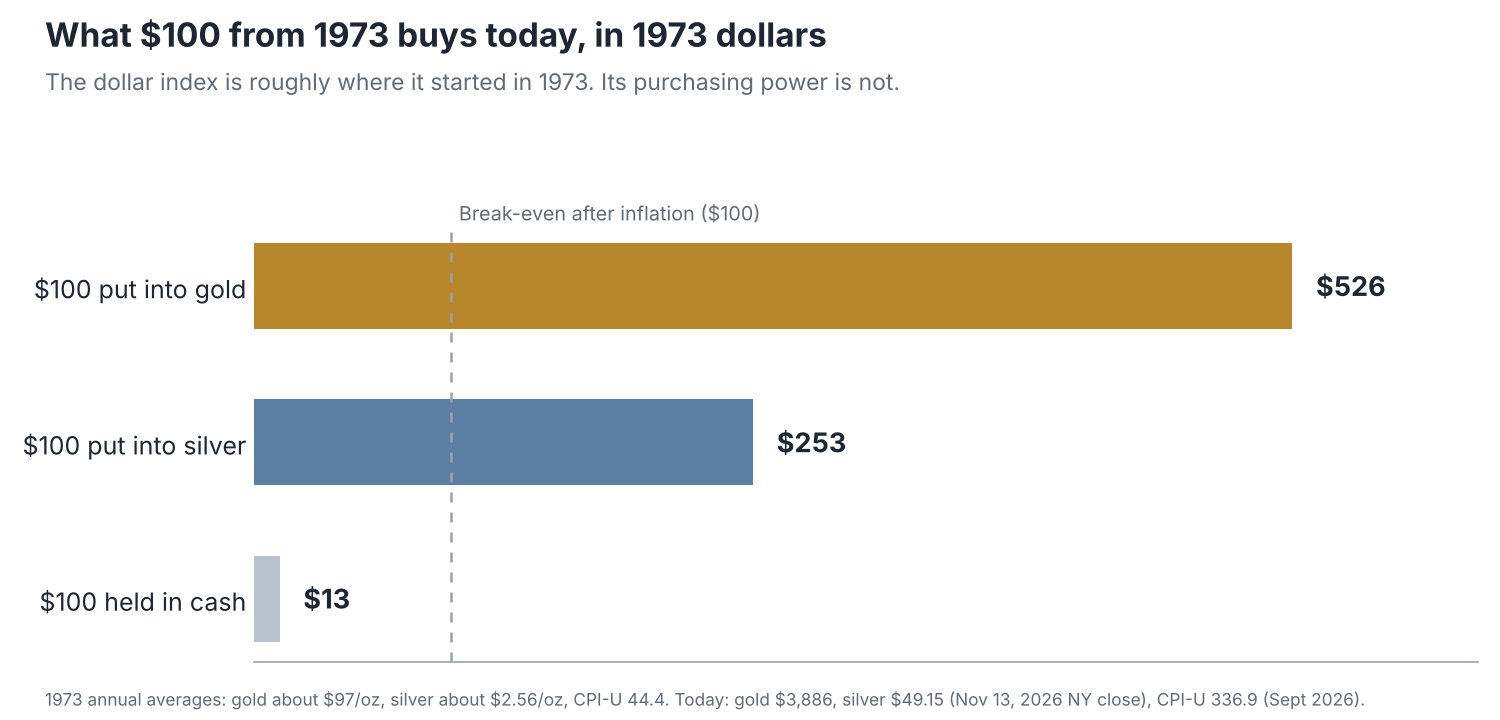
Against goods, it has lost most of its value. Consumer prices are about 7.6 times higher than they were in 1973, based on BLS data. A dollar from that year buys about 13 cents' worth of the same things today.
Meanwhile, the supply of dollars keeps growing. The broad money supply, M2, hit a record of about $23.4 trillion in September, according to Federal Reserve data published on FRED. In August it was up 5.7% from a year earlier, the fastest annual growth since mid-2022.
So when the dollar "strengthens," what is usually happening is that other currencies are losing value a little faster than the dollar is. That is a relative win, not an absolute one. Rate hikes can slow the decline for a while. They have not reversed it in any lasting way in my lifetime.
Gresham's law: bad money drives out good
Gresham's law is usually summed up as "bad money drives out good." It is named after Sir Thomas Gresham, a financier to Queen Elizabeth I, though the idea is older than he is.
The principle is straightforward. When two kinds of money must legally be accepted at the same face value, people spend the one that is worth less and hold on to the one that is worth more. The "good" money disappears from circulation, not because it is destroyed but because people keep it.
Americans watched this happen in the 1960s. As silver prices rose, the metal in a 90% silver dime or quarter started to be worth more than the coin's face value. People pulled silver coins out of circulation and kept them. By one account, about a third of the silver used in 1964 coinage never entered circulation at all. Congress responded with the Coinage Act of 1965, which removed silver from dimes and quarters. Within a few years, the silver coins had vanished from everyday change. They did not vanish from people's drawers.
That is Gresham's law in action. Everyone spent the new copper-nickel coins and saved the silver ones.
Gresham's law on a bigger scale
Today the same instinct shows up at a much larger scale. We spend dollars because we have to. Taxes, wages and bills are all in dollars. But the people and institutions who think hardest about preserving wealth are quietly holding something else.
Central banks are the clearest example. According to the World Gold Council, central banks added 321 tonnes of gold in the third quarter of 2026, up 42% from a year earlier, bringing purchases for the year to 675 tonnes through September. These are the institutions that issue paper money. They are using it to buy gold.
My view: why metals win the long game
The long-term record supports the idea that gold and silver protect purchasing power far better than cash. Gold averaged about $97 an ounce in 1973. Silver averaged about $2.56. Adjusted for inflation, $100 put into gold that year would buy about $526 worth of 1973 goods today. The same $100 in silver would buy about $253. The same $100 held in cash would buy about $13.
The ride was not smooth. Gold took until 2008 to get back above its 1980 high, and silver spent much of the 1980s and 1990s losing ground to inflation. Silver is down roughly 59% from its January record right now. Anyone who buys at a peak can wait a long time to be made whole, and investors should size their positions with that in mind.
But I think the direction is set by things the Fed cannot change. Governments run deficits. Money supply grows. Prices rise over time. Rate hikes slow that process, but they also make government debt more expensive to carry, which puts limits on how long a tightening cycle can last.
That is why I believe Gresham's law eventually wins. People will keep spending dollars and saving metal, and central banks will keep doing the same thing on a bigger scale. Strong-dollar weeks like this one say a lot about interest rates and very little about what a dollar will buy ten years from now. For patient investors who think in decades, I expect gold and silver to keep gaining purchasing power, and I expect that to make them among the best long-term stores of wealth available.
Comments
Log in or sign up to join the conversation.