

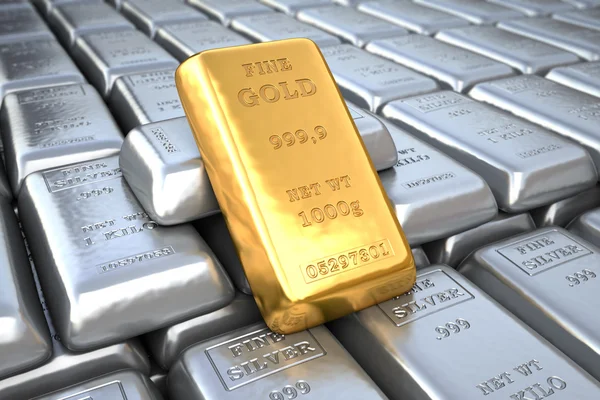
At the end of October, gold was under $4,000 an ounce and silver was under $50, and coin collectors had their best buying window of the year. It did not last long. On Wednesday, the day after the midterm elections, gold had its best session since August and jumped back above $4,000. By Thursday morning spot gold was trading around $4,130 an ounce and silver was near $52.85.
So is the window closed? I don't think so. Both metals are still a long way below where they traded at the start of the year, and the coins I like best are priced off the metal. Here is how I see the market right now, and which coins I would still be looking at.
What moved gold and silver this week
The selloff bottomed on October 30, when spot gold touched about $3,870, its lowest level in a year. The Fed had just held rates at 3.75% to 4% with two members voting for a hike, core PCE inflation was running at 3.1%, and oil was spiking after another tanker attack in the Strait of Hormuz. A non-yielding metal had a lot working against it.
The midterms changed the mood quickly. With Democrats taking both chambers, traders bet that big new fiscal spending is less likely, which means less Treasury borrowing ahead. The dollar index slipped to around 101.3, a five-week low, and the 10-year Treasury yield eased to about 4.87%. A weaker dollar and lower yields are about as friendly a backdrop as gold gets. 24/7 Wall St. reported that December gold futures settled up 3.4% on Wednesday, and gold miners rallied even harder, with the VanEck Gold Miners ETF up about 9%.
Silver followed along but did not lead. It is still down about 13% over the past month, which tells you how hard it got hit in October.
The rally has not erased the discount
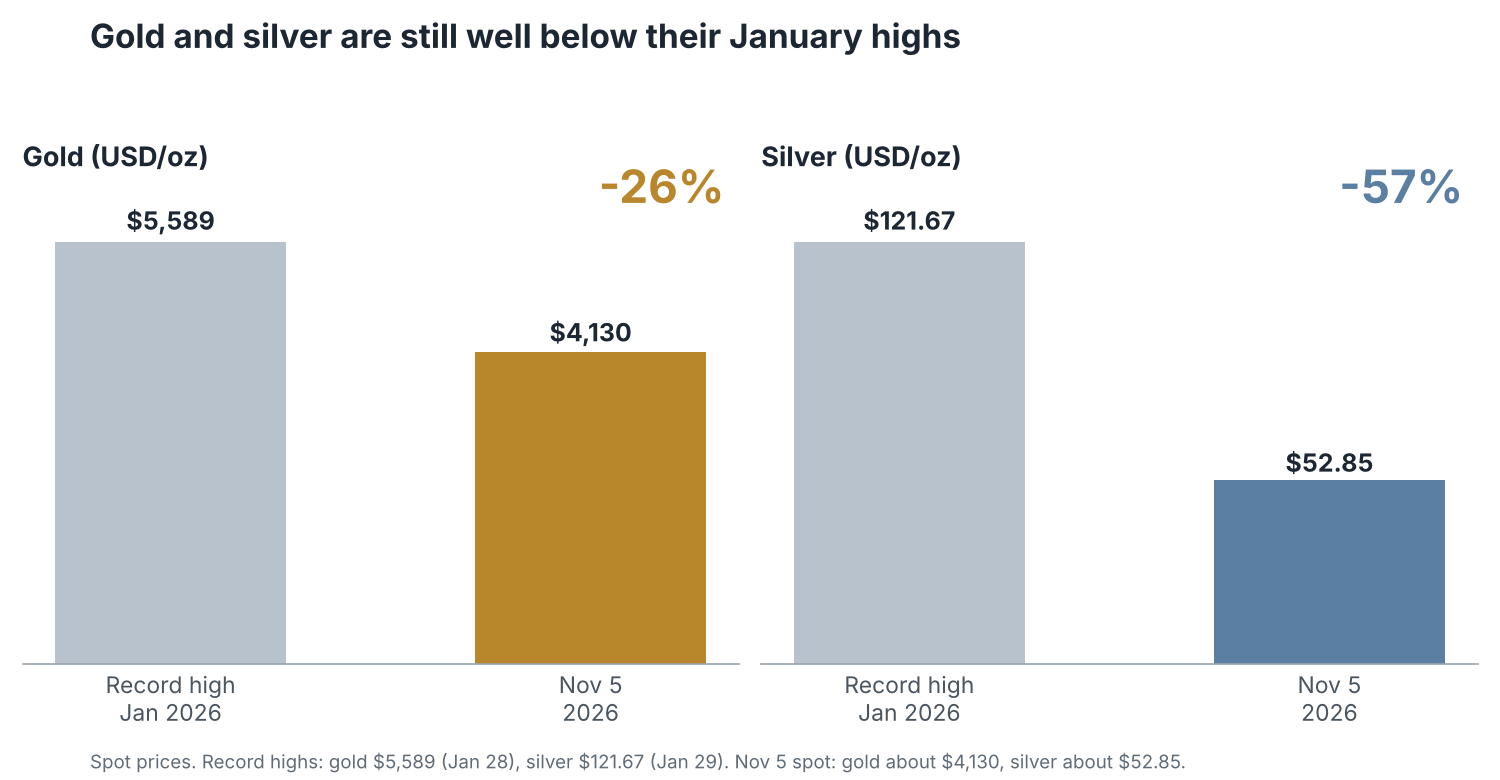
It helps to step back. Gold set its all-time high of about $5,589 on January 28. Silver peaked at $121.67 the next day. At Thursday's prices, gold is still roughly 26% below that record and silver is about 57% below.
The gold to silver ratio is sitting near 78, meaning it takes about 78 ounces of silver to buy one ounce of gold. That number has bounced around a lot over the decades, but readings in the high 70s and above have usually been taken as a sign that silver is cheap relative to gold.
None of this means prices can't fall again. The CME FedWatch tool still shows about an 82% chance of a Fed rate hike in December, and Friday's jobs report could swing that either way. A hike would raise the cost of holding gold and could push it back under $4,000. If you are buying, I would plan on buying in pieces rather than all at once.
Why I prefer classic coins over bars
If you only want price exposure, an ETF or plain bullion bars are the cheapest way to get it. I buy coins because I want physical metal I can hold for years, and older U.S. coins give me something bars do not.
A pre-1933 gold coin or a 100-year-old silver dollar has two parts to its value: the metal inside it and its worth as a collectible. The metal part moves with the spot price. The collector part is set by supply and demand among collectors, and supply only goes one direction. Coins get lost, melted, damaged or locked away in collections. Nobody is striking new 1924 Saint-Gaudens double eagles.
When metals fall hard, as they did this year, the gap between a common-date coin's price and the value of its metal can narrow. When metals recover, you get the move in the metal plus whatever the collector premium does on top. That premium does not always rise, but for common, liquid coins it has historically been fairly stable.
What the metal in classic U.S. coins is worth today
Here is the melt value of the coins I watch most closely, using Thursday morning prices of $4,130 gold and $52.85 silver. Melt is the floor under the coin, not the price you will pay.
Coin | Pure metal content | Melt value |
|---|---|---|
$20 Liberty or Saint-Gaudens double eagle | 0.9675 oz gold | $3,996 |
$10 Liberty or Indian eagle | 0.4838 oz gold | $1,998 |
$5 Liberty or Indian half eagle | 0.2419 oz gold | $999 |
$2.50 Liberty or Indian quarter eagle | 0.1209 oz gold | $499 |
American Silver Eagle | 1.0 oz silver | $52.85 |
Morgan or Peace dollar | 0.7734 oz silver | $40.88 |
90% silver half dollar (pre-1965) | 0.3617 oz silver | $19.12 |
90% silver quarter (pre-1965) | 0.1808 oz silver | $9.56 |
90% silver dime (pre-1965) | 0.0723 oz silver | $3.82 |
The coins I would be looking at
Common-date $20 gold in MS62 to MS64
Liberty Head and Saint-Gaudens double eagles are the closest thing to bullion in the collector world. They trade every day, they are easy to price, and almost a full ounce of gold sits in each one. I stick with common dates in the MS62 to MS64 range. Rare dates and high grades are a different game where the premium, not the gold, drives the price.
Smaller gold: $5 and $2.50 pieces
Not everyone wants to put $4,000 into a single coin. Indian Head half eagles and quarter eagles let you buy pre-1933 gold in smaller amounts. They usually carry a higher premium per ounce of gold than the $20 coins, so compare prices carefully before you buy.
Morgan and Peace dollars
These are among the most collected U.S. coins, and that deep base of buyers is what gives them liquidity. Common dates in MS63 and MS64 have long traded at a premium to their silver content. Before buying, I check what the same date and grade has actually sold for recently. You can see recent Morgan dollar prices by grade on Coinsel, and the PCGS CoinFacts reference is useful for mintages and population data by date.
American Silver Eagles
Silver Eagles are not old, but they are the most widely recognized silver coin in the country, and that is where I started collecting. The U.S. Mint's Silver Eagle page has the official specs. For pure metal exposure they work well, though bullion versions usually cost more over spot than generic rounds.
Pre-1965 90% silver
Old dimes, quarters and halves trade close to melt and come in small units, which makes them easy to buy a little at a time and easy to sell later. They are not exciting, but they are one of the simplest ways to add silver.
How to avoid overpaying
A few habits go a long way.
Buy certified coins from PCGS or NGC for anything beyond common circulated silver. Counterfeit gold and silver coins are a real problem, especially online. Check every holder number with the PCGS cert verification page or the NGC certification lookup before you pay.
Know the dealer spread. A coin bought at a big markup has a long way to go before you break even. Ask what the dealer would pay you for the same coin right now.
Compare against sold prices, not asking prices. Listing prices tell you what sellers hope for. Sold prices tell you what the market is. A coin price tracker that flags listings below guide value can help you spot when an asking price is out of line.
Shop in person when you can. Coin shows let you see coins in hand, compare several dealers in one room, and negotiate. My son and I go to local shows most weekends, and it is the best way I know to learn what coins really sell for. Coinsel keeps a calendar of upcoming coin shows if you want to find one near you.
The bottom line
This week's bounce is a reminder that precious metals can move fast in both directions. Gold back above $4,100 does not change the bigger picture: both metals are still far below their January highs, the Fed is still leaning toward a hike, and volatility is not going away.
For long-term buyers who want physical metal, that is a reasonable setup. Classic U.S. coins give you a metal floor plus a collector premium that has tended to hold up over time. Stick with common, liquid coins, buy certified, compare sold prices, and spread your purchases out. If prices dip again before December, you will be glad you left room to add.
Comments
Log in or sign up to join the conversation.