

In 1964, a dime would buy you a copy of The Wall Street Journal, or about a third of a gallon of gas. It was also 90% silver. Melt that same dime down today, and the silver in it is worth about $3.79.
That simple fact gets passed around a lot by silver bugs, usually as proof that silver always holds its value. The real story is more interesting than that, and more useful if you are trying to decide whether silver belongs in your portfolio. Silver has been an excellent store of value over long stretches of time. It has also been a terrible one over shorter stretches. Understanding both halves is the key to owning it well.
The math on a 1964 dime
A pre-1965 U.S. dime contains 0.07234 troy ounces of pure silver. In 1964, the Treasury was holding the silver price at about $1.29 an ounce, so the metal in a dime was worth roughly 9 cents, a little under its face value. That was by design. The coin was money first and silver second.
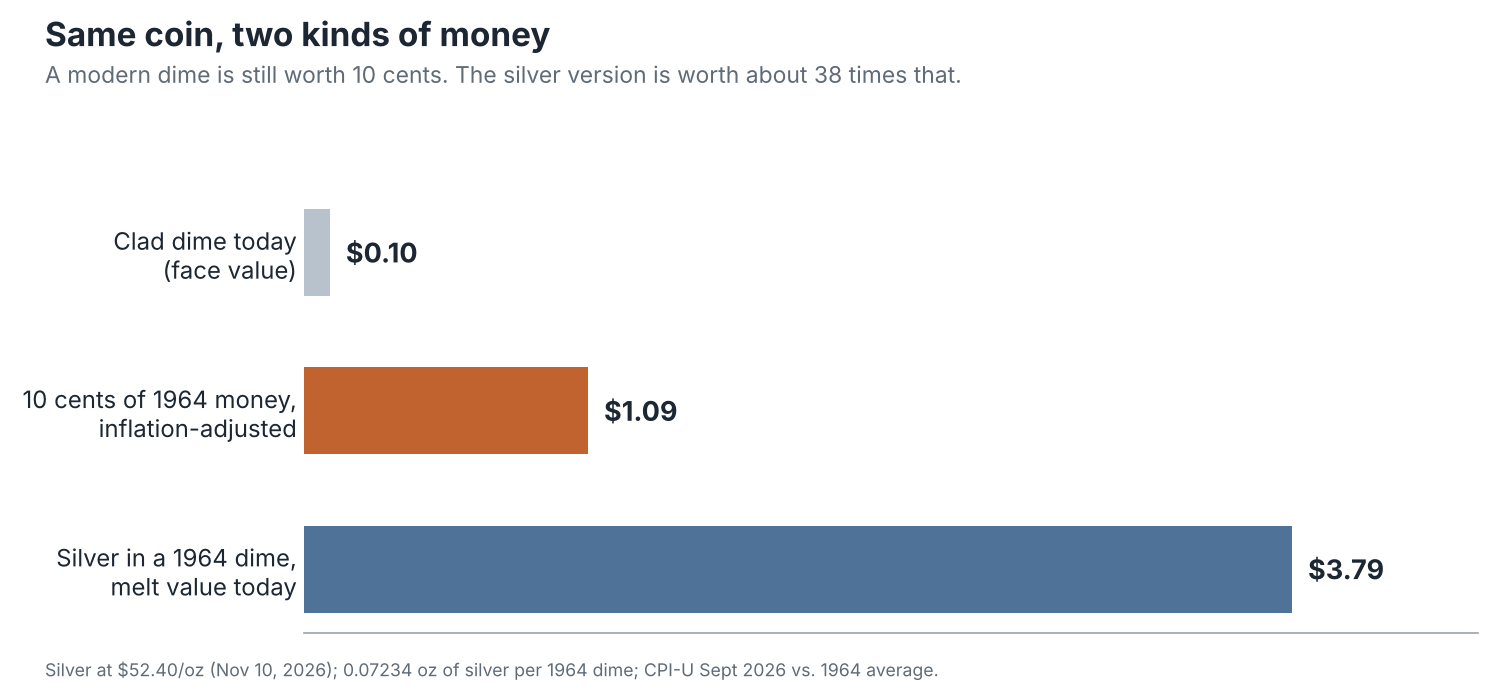
With silver at $52.40 on November 10, that same dime holds about $3.79 worth of metal.
Now compare that to inflation. According to the Bureau of Labor Statistics consumer price index, prices are about 10.9 times higher than they were in 1964. That means 10 cents of 1964 money is equal to about $1.09 today. The silver dime has not just kept pace. It is worth roughly three and a half times what inflation alone would require.
Meanwhile, a dime minted in 1965 or later is still worth exactly 10 cents. In 1964 terms, it buys about 9% of what it used to.
Gas makes the point in a way everyone can feel. In 1964, a gallon cost about 30 cents, or three silver dimes. With the national average at $3.98 according to AAA, three silver dimes now hold about $11.37 of silver, enough for nearly three gallons.
Why the Mint stopped using silver
The reason 1964 is the cutoff year tells you a lot about silver. By the early 1960s, industrial demand for the metal was climbing, and the Treasury's silver stockpile was shrinking fast. If silver rose much past about $1.38 an ounce, the metal in a dollar's worth of quarters would be worth more than a dollar. People would melt the coins.
Many Americans saw that coming and started pulling silver coins out of circulation. The Coinage Act of 1965 took silver out of dimes and quarters entirely and replaced it with the copper-nickel "clad" coins we still use. The Treasury gave up holding the $1.29 price in 1967, and by mid-1968 silver had roughly doubled.
In other words, the government swapped out the metal precisely because it was becoming worth more than the money stamped on it. That has been the pattern ever since.
The part the silver bulls leave out
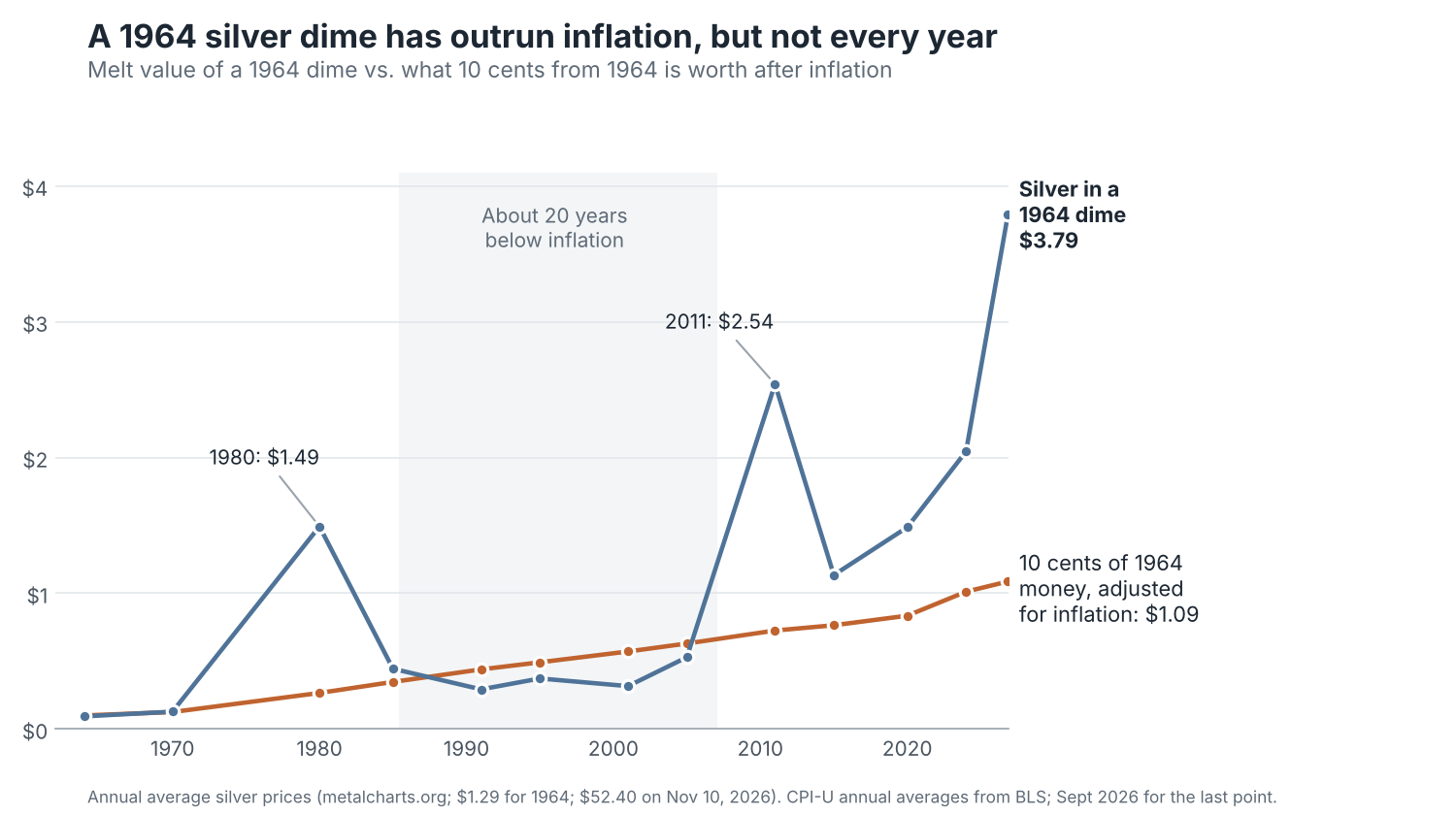
If you only look at 1964 and today, silver looks like a steady, reliable winner. It was not. Here is what the silver in a 1964 dime was worth at different points, compared with what 10 cents of 1964 money was worth after inflation.
A few things jump out.
Silver is lumpy. Most of its gains came in a few violent bursts: the late 1970s, 2010 and 2011, and 2025 into early 2026.
It can lag inflation for a very long time. From the mid-1980s to the mid-2000s, the silver dime was worth less than its inflation-adjusted value. In 2001, when silver averaged $4.37, the dime's silver was worth about 32 cents, against 57 cents for inflation. That is two decades of losing ground.
Your entry price matters enormously. Someone who bought silver at the 1980 average price of $20.63 would need about $84 an ounce today to break even after inflation. Even after this year's run, they are still behind.
The swings have not gone away. Silver hit a record $121.62 on January 29 of this year. It is now about 57% below that.
So "stable" is the wrong word if you mean the price. Silver is one of the more volatile assets you can own. What has been stable is what it can buy over very long periods. Over the roughly 62 years since 1964, silver has compounded at about 6% a year, against a little under 4% for consumer prices. That margin is real, but it came with long, frustrating stretches where it disappeared.
Why silver has held up over the long run
There are a few reasons silver keeps its purchasing power over decades even when it misbehaves over years.
It can't be printed. The supply of silver grows slowly, limited by what mines can produce and what gets recycled. The supply of dollars has no such limit, which is exactly why a clad dime buys so much less than it used to.
It gets used up. Unlike gold, which mostly sits in vaults, a large share of silver is consumed by industry in electronics, solar panels, medical uses and more. Much of it is used in such small amounts that recycling it is not worth the cost. The Silver Institute reported record industrial demand in 2024 and a fourth straight year in which total demand ran ahead of supply.
People still treat it as money. Silver has been used as money for thousands of years, and buyers still turn to it when they lose faith in paper currencies. That investment demand is a big part of why silver tends to surge during periods of high inflation or financial stress.
How to own silver without getting burned
If the long-run case makes sense to you, the history above points to a few practical rules.
Keep it a slice, not the whole pie. Silver works best as a portion of a portfolio that you are willing to hold for years. A position that would force you to sell during a 50% drawdown is too big.
Buy over time. Because the entry price matters so much, spreading purchases out over months or years takes a lot of the timing risk off the table. Buying all at once at a peak, as people did in 1980 and early 2026, is how silver investors lose money.
Pick the right form. Pre-1965 dimes, quarters, and halves, often called "junk silver," are one of the cheapest ways to own physical silver. They usually trade close to their melt value, they are easy to recognize, and they come in small units. One dollar in face value of these coins contains about 0.715 ounces of silver, or roughly $37 at today's price. You can check current values for silver Roosevelt dimes on Coinsel. American Silver Eagles and bars are easier to stack in larger amounts but often carry higher premiums. A silver ETF is the simplest option if you only want price exposure.
Watch the premiums. The price over spot that you pay when buying, and the discount you take when selling, can eat years of gains. Compare dealers, and avoid anyone selling "rare" silver at big markups on TV or over the phone.
Know the tax rules. The IRS treats physical silver as a collectible, so long-term gains can be taxed at up to 28%, higher than the rate on most stocks. IRS Topic 409 covers the details.
The bottom line
The 1964 dime is a good story because it is true. A coin that bought a newspaper then holds almost $4 of silver today, while a modern dime has lost about 90% of its purchasing power. Over six decades, silver did what paper money could not.
But the same history shows that silver rewards patience, not timing. The investors who did well were the ones who bought steadily, held through the long dry spells, and did not chase the spikes. If you can do that, a modest allocation to silver has a long track record of protecting purchasing power. If you need your money to be stable from year to year, silver is not the place for it.
Comments
Log in or sign up to join the conversation.