

Throughout the presidential election campaign, Trump put forth a slogan “America First” as he railed against U.S. trade deficits. Specially, NAFTA trade partners and China were singled out for the supposed harm they do to U.S. workers and the need to re-set trade policy for what is best for the United States. This approach totally fails to understand why the United States trade deficits have grown so large and, hence, why the “America First” trade strategy will ultimately fail.
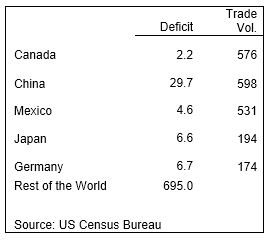
Trump obsesses on country-specific trade deficits. However, the United States has a multilateral trade problem involving over 100 countries. China accounts for about 40 per cent and NAFTA partners only for another 10 per cent of the total deficit. In fact, Japan and Germany each have greater absolute trade surpluses than either Canada or Mexico (Table 1).
Table 1 U.S. Trade Deficit in Goods, 2015 ($Billions)
A nation generating yearly trade deficits from over 100 countries must, in the words of the BOE Governor, Mark Carney, rely on the “ the kindness of strangers”. That is, the United States must attract savings from the rest of world to finance its trade deficits. This is how a nation’s external books are balanced. As Stephen Roach of Yale University has argued that the national savings rate is woefully inadequate:
This is important because it explains the pernicious trade deficits that Trump continues to rail against. Lacking in saving and wanting to grow, the United States must import surplus saving from abroad. And the only way to attract that foreign capital is by running massive current-account and trade deficits.[1]
The United States has experienced a steady decline in its net savings rate---- the sum of household, business (adjusted for depreciation) and government saving. In 2000 the rate stood at 5.8 per cent of GDP, then dropped to minus 0.9 in 2010 and for 2016 the rate is forecasted to be 2.5 per cent. As the savings fell, the trade deficit grew from an average of 1.1 per cent in the 1970-2000 period to nearly 4 per cent today. In other words, the United States is growing ever more reliant on the kindness of strangers to supply the savings necessary to finance overall economic growth.
Here is where the “America First” trade policy works against America’s best interest. Any U.S. policy that impedes the growth of savings from abroad will hurt the United States at the same time. U.S. protectionist measures will harm its trading partners and that will impede the flow of savings needed in the United States. Roach goes on to make the poignant argument that:
Even the most conservative estimates of the federal budget deficit suggest that the already-depressed net national saving rate could re-enter negative territory at some point in the 2018-2019 period. That would put renewed pressure on the current-account and trade deficits, making it extremely difficult to reverse the loss of jobs and income that politicians are quick to blame on America’s trading partners.
The “America First” trade policy must confront the fundamentals of international trade. Trying to eliminate trade deficits without providing for increased savings at home will lead only to continued poor economic performance, a far cry from making America great once again.


Comments
Log in or sign up to join the conversation.