

It is with some irony that we read so much of the rise of trade protectionism at time when world trade has been on the decline for nearly a decade. World trade grew rapidly in the two decades prior to the 2008 financial crisis, but since the start of the Great Recession trade growth has nearly halved. More worrisome, there are significant consequences for productivity and economic growth should this decline continue along present trends. This is all the more important as the political rhetoric heats up in the United States.Politicians debate the value of past and future trade agreements as they relate to jobs,income inequality and economic growth.In truth, the ground appears to be shifting under their feet, yet the rhetoric has not changed.
How Serious is the Decline in Trade
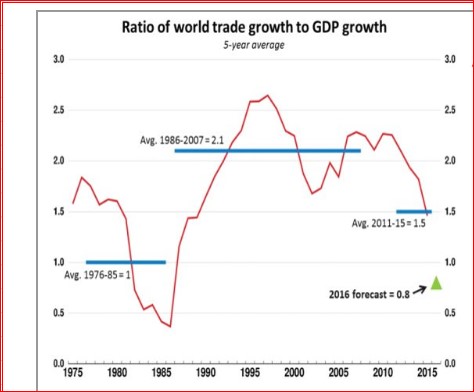
Recent data analysis prepared by the OECD [1] measures this decline (Figure 1). The trade liberalization policies instituted in the late 1980s and 1990s--- such as NAFTA and greater integration within the EU--- resulted in world trade growing at 2.5 times the rate of world GDP. Since 2011, that ratio of trade growth to GDP growth has declined significantly to 1.5. Trade experts anticipate a further decline to less than 1 per cent for this year. In other words, trade, once the engine of growth, is now lagging the growth of world GDP, which itself is eroding—a double –barrelled effect on world incomes.
Figure 1 Ratio of World Trade to GDP
What are the Contributing Factors to the Decline?
Accounting for the shift in trade volumes and patterns means looking a host of different factors, some are easily identified, while others are more difficult to quantity . The OECD research highlights the following main contributors to the slowdown in trade:
- The output gap. The Great Recession, starting with the financial crisis of 2008, continues to plague us. Estimates vary as to how much each industrialized country is operating below full industrial capacity, ranging from 2- 5 per cent below potential output. The OECDbelieves that about 40 per cent of the decline in trade is directly related to the existence of considerable excess industrial capacity;
- Weak Business Investment. Going hand-in-hand with the output gap is the worldwide drop in business capital investment. With each passing year, under investment not only diminishes economic growth in that year but adversely affects future growth and trade.
- Limits to Global Value Added Chains (GVCs). In addition to trade liberalization, the OECD research contends that trade expanded by means of “global value added chains (GVCs)”. In lay terms, globalization encourages companies to outsource different stages of production in order to take advantage of the lowest costs in each phrase of production. The OECD researchers have found that we are reaching limits to what extent companies can disperse their production facilities internationally. It seems that trade in intermediate imports is stagnating and this is contributing to the slowdown in world trade.
- Growing Protectionism. Studies reveal that about one-quarter of the slowdown in the trade from 2011-15 is related to a rise in protectionism. There are numerous instances where a nation state has intervened directly into the market place in support of specific industries .
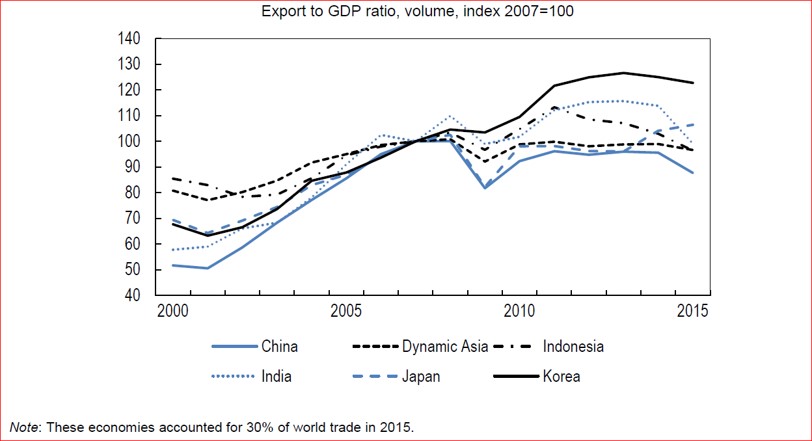
- Changing Role of China in World Trade. Once it opened its doors to international markets in the 1980s, China has played a major role in expanding globalization . Now, China occupies about 10 per cent of world trade. When other Asian countries are included, more than 30 per cent of world trade originates in Asia. Any slowdown in that region will reverberate throughout the world. Indeed, that is what has been occurring for the past half decade (Figure 2). In 2015 China’s trade expanded at only 1.5 per cent, compared to an average of 20 per cent in the decade prior to 2008.As China seeks to re-balance its economy it will rely less on exports for growth and that would likely be translated into further declines in the growth of world trade.
Figure 2 Asian Export Growth
How Likely Will Trade Start to Expand?
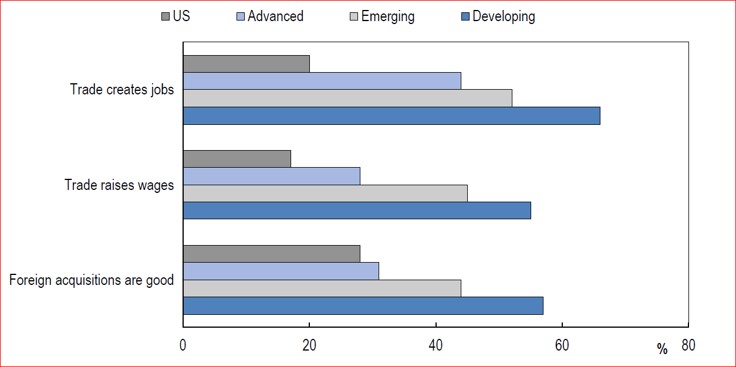
Within the industrialized nations, the biggest challenge for pro-trade advocates is political --- the need to convince the electorates of the benefits of freer trade. However, according to as a recent Pew Research Centre survey , the majority of voters are very skeptical about the benefits of trade in terms of job creation and higher wages (Figure 3). For these voters, globalization has meant income stagnation and job losses in major manufacturing industries. This attitude will hinder efforts of the United States and other industrialized countries to enter into new trade liberalization agreements.
Figure 3 Pew Study on Attitudes Toward to Trade
[1] Why Is World Trade So Weak And What Can Policy Do About It?



Comments
Log in or sign up to join the conversation.