

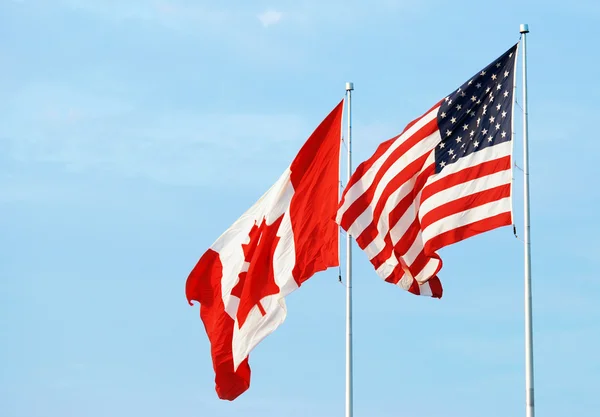
PM Carney made it abundantly clear why Canada pulled out of the recent trade negotiations with the Trump administration two days ago. Holding back nothing, the PM described why he summoned Canadian negotiators home:
“ You’re at war when you get attacked. We got attacked”.
His lack of trust in the US was expressed simply:
“ We recognize that sometimes, its signature is written in pencil."
Never in the history of the bilateral relationship has such unequivocal language been used by a Canadian PM. Triggering this statement was the US implementation of a 50% tariff on approximately US$ 28 billion of imports, including dairy, pulp and paper, and a variety of manufacturing equipment and products. The word “attack” refers to the last-minute US demand that it insists on approving any Canadian trade pact with a non-US nation. Put differently, Trump demanded that Canada yield its sovereignty on all trade matters to the US. No wonder the PM walked away. It was no longer a matter of a commercial dispute, but a frontal assault by Trump to force Canada to accept a one-sided, bad deal.
Canada is not interested in returning to the bargaining table. Recent polling gives Carney a very high approval rate. More than 75% support his decision to walk out, regardless of the economic costs. RBC calculates that these newly tariffed US imports add up to a 0.04% drop in Canadian GDP and no discernible increase in unemployment. Granted, specific industries, such as plastics, furniture, and electrical machinery, will have to accept lower profits and possible job losses.
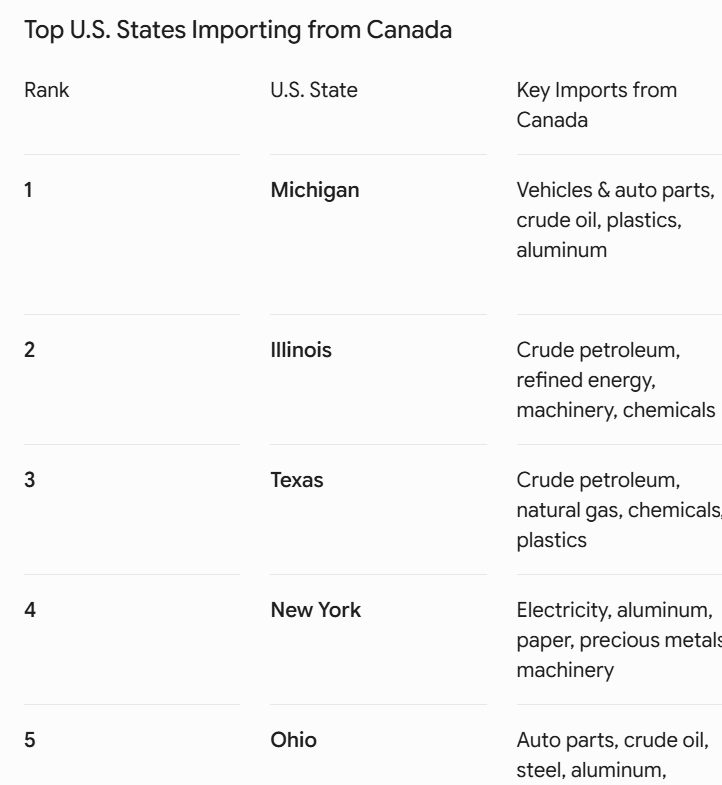
The impact of the US trade war has direct repercussions on US states heavily involved in cross-border trade. In order of magnitude, the accompanying chart reveals the top five states that do extensive business with Canada. All these products have varying degrees of US tariffs applied, even such vital products as crude oil, chemicals, car and truck parts, and basic metals.
At the same these states are either Republican dominated or are highly contested in both the Senate and House. It is hard to imagine that some races will not turn on the impact of US tariff policy on local industries or on the voting public at large. The cost of living has been tied to unpopular Trump policies, the Iranian war, and tariffs.
US tariff policy has been a gross failure. The US trade balance, globally, and bilaterally with Canada, remains deep in deficit. Tariffs have not had any measurable impact on foreign manufacturers jumping the tariff wall and setting up operations within the US. The tariffs have added to the cost of living, and inflation remains well above the Federal Reserve target. Interest rates are under pressure to rise in response to the inflationary situation.
Canada will weather the effects of US restrictive trade policies. Over 80% of the $400 billion in US imports from Canada enter duty-free under the North American free trade agreement. This will continue, awaiting its annual review. The Carney government enjoys the support of the nation as a whole; the tariff's impact is confined to specific sectors that will likely receive government assistance to offset losses; and the economy, as a whole, will continue to have positive growth.
As for the US, the tariffs continue to dog several industries, especially in auto manufacturing and basic metals. Today’s WSJ called US actions as “ the dumbest trade war revisited”. Many in the states most impacted will likely agree. Meanwhile, the US midterms are around the corner, and tariffs could play a role in determining the outcome in key states.



Comments
Log in or sign up to join the conversation.