

Canadian economists are always scratching their heads when the monthly employment data are released. And January’s numbers are no exception. Canada's labor market unexpectedly added 48,300 jobs last month and recorded an unemployment rate of 6.8 per cent. However, 32,400 or more than ⅔ were part-time jobs. This pattern of high volatility in the employment numbers is evident in Chart 1 which measures the seasonally adjusted estimates against a trend line. It is this wide variation that gives the economists headaches when trying for forecast each new month’s job performance.
Chart 1
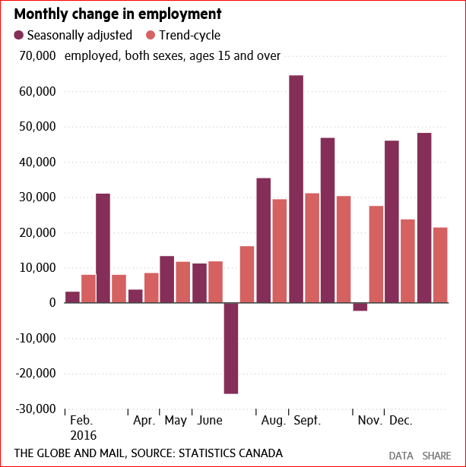
On a year-over-year basis, employment rose by 276,000 (+1.5%), with most of the increase occurring from August to January. When stacked against growth in GDP of less than 2 per cent, it is clear that the Canadian productivity performance is very weak. Most of the growth in GDP originates from population growth, rather than from productivity. This dynamic has been a constant concern to the Bank of Canada as it wrestles with the fact that there is considerable slack in the economy.
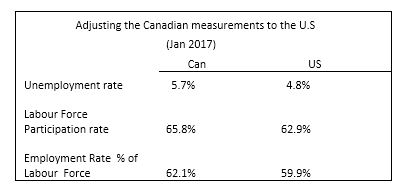
For my American readers, the Canadian job numbers are not directly comparable to those generated by the BLS. Statistics Canada provides adjustments to the Canadian numbers for comparison purposes. (Table 1). On an adjusted basis the Canadian numbers do improve considerably. The adjusted unemployment rate drops to 5.7 per cent from 6.8 per cent. In addition, Canada has both a higher labor force participation rate (65.8% vs 62,9%) and a higher employment rate (62.1% vs 59.9%)
Table 1
For those looking for signs of inflation will be greatly disappointed. Average hourly earnings increased by 1 per cent from a year earlier. Hours worked actually fell 0.8 per cent. Full-time workers have not enjoyed any increase in total income. Coupled with wage stagnation for part-time workers, the wage sector does not represent any threat to Canada`s inflation rate.
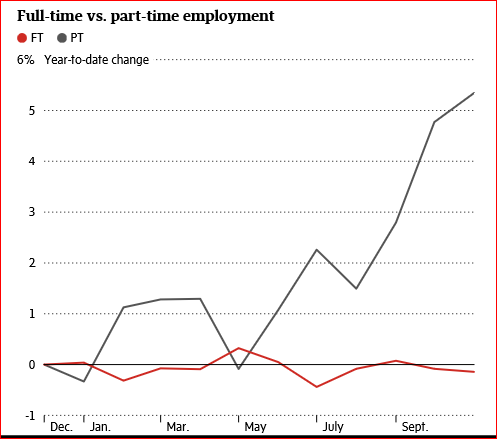
The outstanding concern with these data is the dominance of part-time workers in the growth of the labor force (Chart 2). Part-time workers usually have a weaker attachment to the workforce which prevents them from developing and maintaining higher skills needed for longer term employment. In many cases, workers are forced to accept part–time employment when they would much prefer full-time work, a further indication of the weakness in the labor market and the economy in general.
Chart 2
In sum, while the Canadian labor market remains stable, the Bank of Canada is aware of the degree of slack in the economy and need for more stimulus. Next month the Federal government tables it 2017-18 budget which should get some answers to how the government proposes to stimulate growth.



Comments
Log in or sign up to join the conversation.