

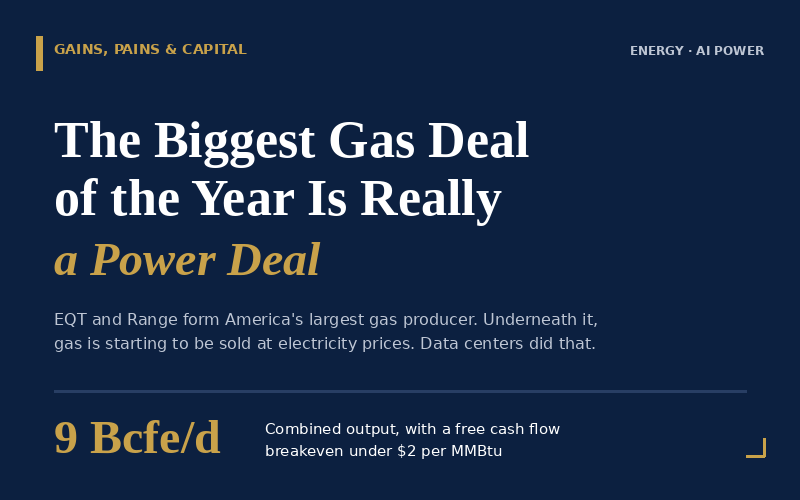
This morning EQT announced it is buying Range Resources (RRC) in an all-stock deal. The combined company will be the largest natural gas producer in the United States: more than 9 billion cubic feet equivalent a day, nearly 3 million net acres in Appalachia, 30 years of drilling inventory, 3,700 miles of pipe, and a pro forma enterprise value above $50 billion. Range holders get 0.987 EQT shares per share and end up with 27% of the company.
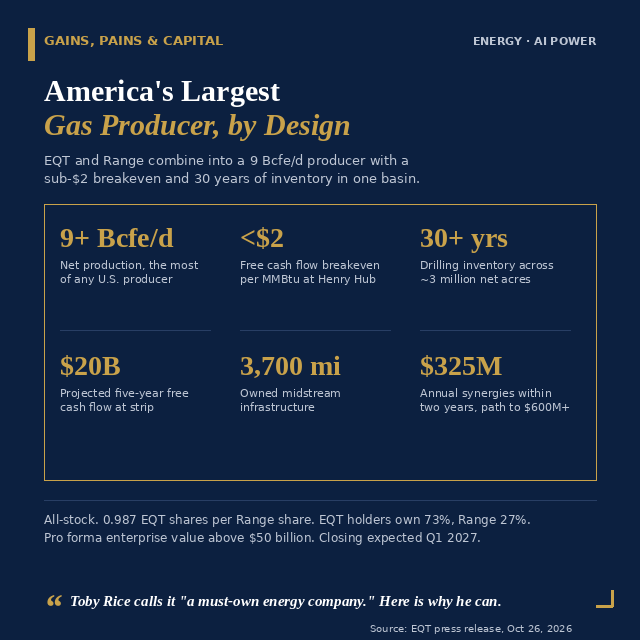
Every headline today says “largest U.S. gas producer.” That is true, and it is the least interesting thing about this deal. Scale in gas has never been worth much on its own. Appalachia has been drowning in cheap gas for 15 years, and the companies that produced it got paid Henry Hub minus a basis discount, which for long stretches meant barely enough to cover the cost of drilling.
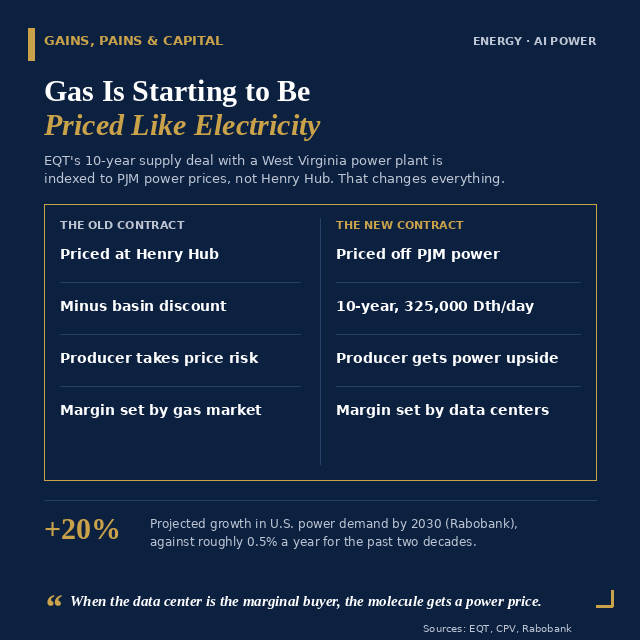
What is interesting is a number buried in the release and a contract EQT signed earlier this year. The number is the breakeven. After the deal, EQT says its unlevered free cash flow breakeven drops below $2 per million BTU. The contract is a ten-year agreement to supply 325,000 dekatherms a day to the CPV Shay Energy Center in West Virginia, a gas plant being built to serve the PJM grid. The price in that contract is not set by Henry Hub. It is linked to PJM power prices.
Put those two things together, and you see what Toby Rice is actually building. A producer whose cost of gas is under $2, selling into contracts priced off electricity. That is not a gas company anymore in the way the market has understood gas companies. It is a power company that happens to own the fuel.
Here is why that is happening now. For twenty years, U.S. electricity demand grew about half a percent a year. The grid was overbuilt, and nobody needed new generation. That ended with the data centers. Rabobank projects U.S. power demand up 20% by 2030. PJM, the grid that serves the data center corridor from Virginia through Pennsylvania and Ohio, is where the shortage is most acute, and the only fuel that can be built fast enough at scale to meet it is gas. Appalachian gas, specifically, because it is sitting underneath the demand.
So the data center has become the marginal buyer of Appalachian gas, and the marginal buyer sets the price. A data center operator does not care about Henry Hub. It cares about getting power, and it will pay the power price to get it. The producer who can offer a firm ten-year supply at a plant next door can now write a contract off that power price instead of off a commodity benchmark it has been losing to for a decade. EQT says these deals sell gas at much higher prices than the in-basin market. That is the whole game.
This is why the deal is all stock and why EQT could do it. Range brought the acreage and the inventory. EQT brought the midstream, the balance sheet, and increasingly the contracts. The combination gives them the ability to guarantee supply to anyone building a plant in the basin for the next 30 years, and the sub-$2 cost means they make money at any power price the grid is likely to see. Rice called it “a must-own energy company.” On these terms, I understand why.
Now the part that matters beyond EQT. If gas producers start getting paid off power prices, the old relationship between cheap Appalachian gas and cheap American electricity breaks. The gas that used to flow to the grid at a discount gets contracted away to the highest bidder, and the highest bidder is a hyperscaler with an unlimited budget. Everyone else on the PJM grid, which is to say 65 million people, competes for what is left. Residential power bills in the PJM states have already been rising faster than inflation for two years. This is the mechanism behind that, and it is about to have a lot more capital behind it.
That makes this an inflation story as much as an energy story. Electricity is one of the few line items in the CPI that was flat to down for most of the 2010s. It is now going the other way for structural reasons that have nothing to do with the Fed, and a deal like this one locks the structure in for a decade.
For investors, two things. First, the money in the AI buildout is moving down the stack. It started in chips, moved to the data center builders, then the power producers, and now it is reaching the fuel. The companies with low-cost gas next to the demand and the infrastructure to deliver it firm are the ones that get the power-linked contracts, and those contracts are worth a great deal more than the commodity. EQT just paid $50 billion of enterprise value to be first in line.
Second, this is a reason to keep owning the energy infrastructure trade even with oil trading on Iran headlines. The gas story does not depend on the Strait of Hormuz. It depends on a grid that is short on power and a set of buyers who will pay whatever it takes. That demand was not in anyone’s model three years ago, and it is now being contracted out for the next ten.



Comments
Log in or sign up to join the conversation.