

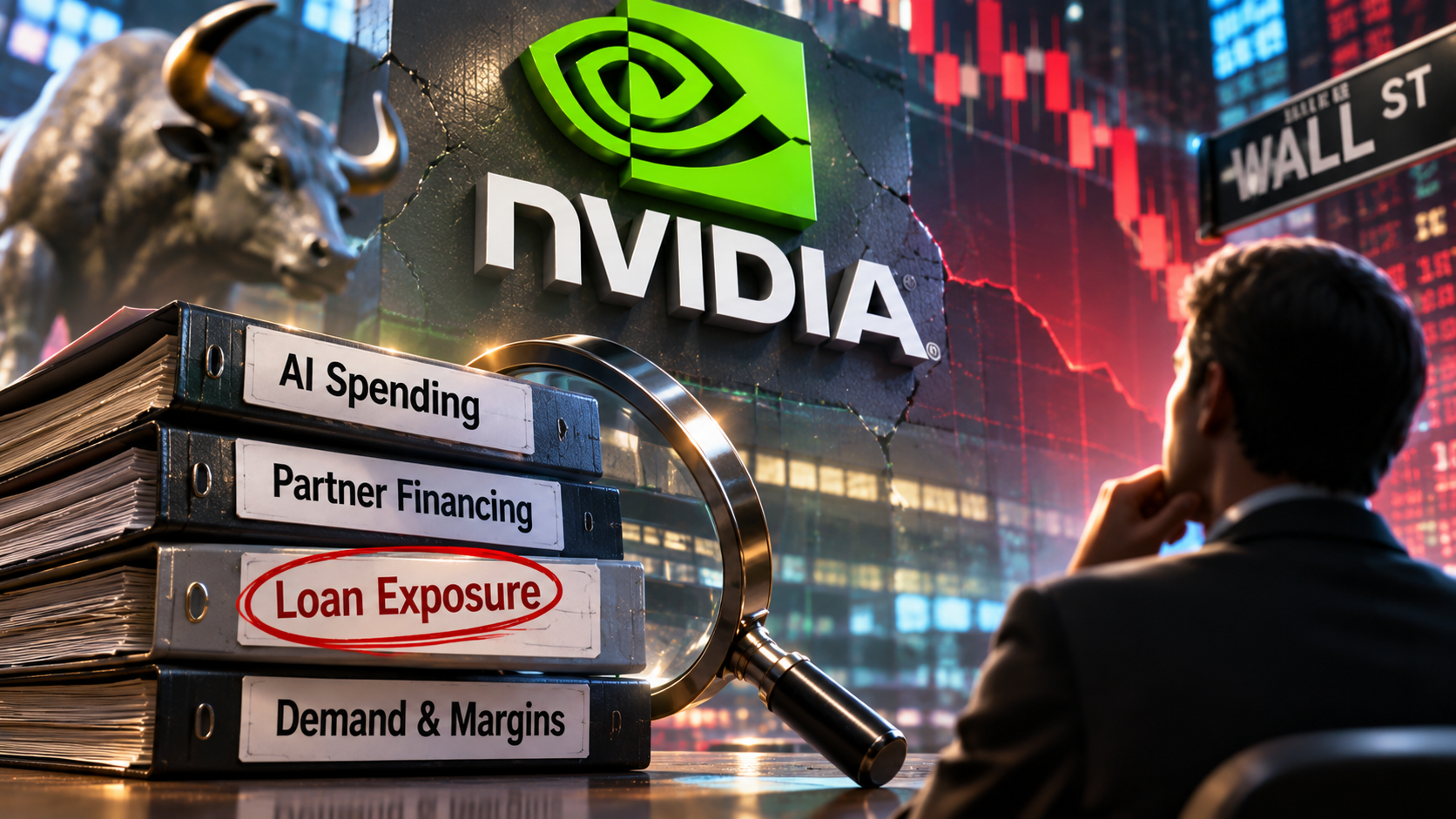
Just when Wall Street thought it might get through the week without another grenade landing in the AI complex, semiconductor shares took a 4.5% beating, Nvidia (NVDA) extended its slide, and Bitcoin (BTC.X) slipped below $70,000. Friday’s softer-than-expected producer inflation report should have offered some relief, but the bond market’s modest reprieve wasn’t enough to rescue technology shares. The bigger problem is that Jensen Huang’s departure has opened a rather uncomfortable chapter in the AI boom. For three years, Nvidia wasn’t simply selling GPUs; it was helping finance, organise and underwrite an entire ecosystem built around its own products. Now the Bank of Nvidia has lost its chairman, investors are beginning to examine the collateral, and Washington is hunting for someone to carry the can over China Spygate and the alleged failure to stop restricted American chips reaching Chinese buyers. With Treasury and Commerce already pointing fingers, the political knives are coming out just as Wall Street starts peeling back the layers of the AI financing machine.
The Bank of Nvidia Has Lost Its Chairman
I’m releasing The Weekender an hour or so before the close, so the closing number might change, but the message likely won’t.
Here’s the part of Friday’s tape that bothers me. Producer inflation came in a touch softer than expected, the front end of the Treasury curve finally caught a bid, and the semiconductor complex still got taken behind the woodshed. When a market refuses to rally on news that ought to help it, I tend to stop listening to the endless stream of happy talk on business television and start paying closer attention to who’s trying to get out.
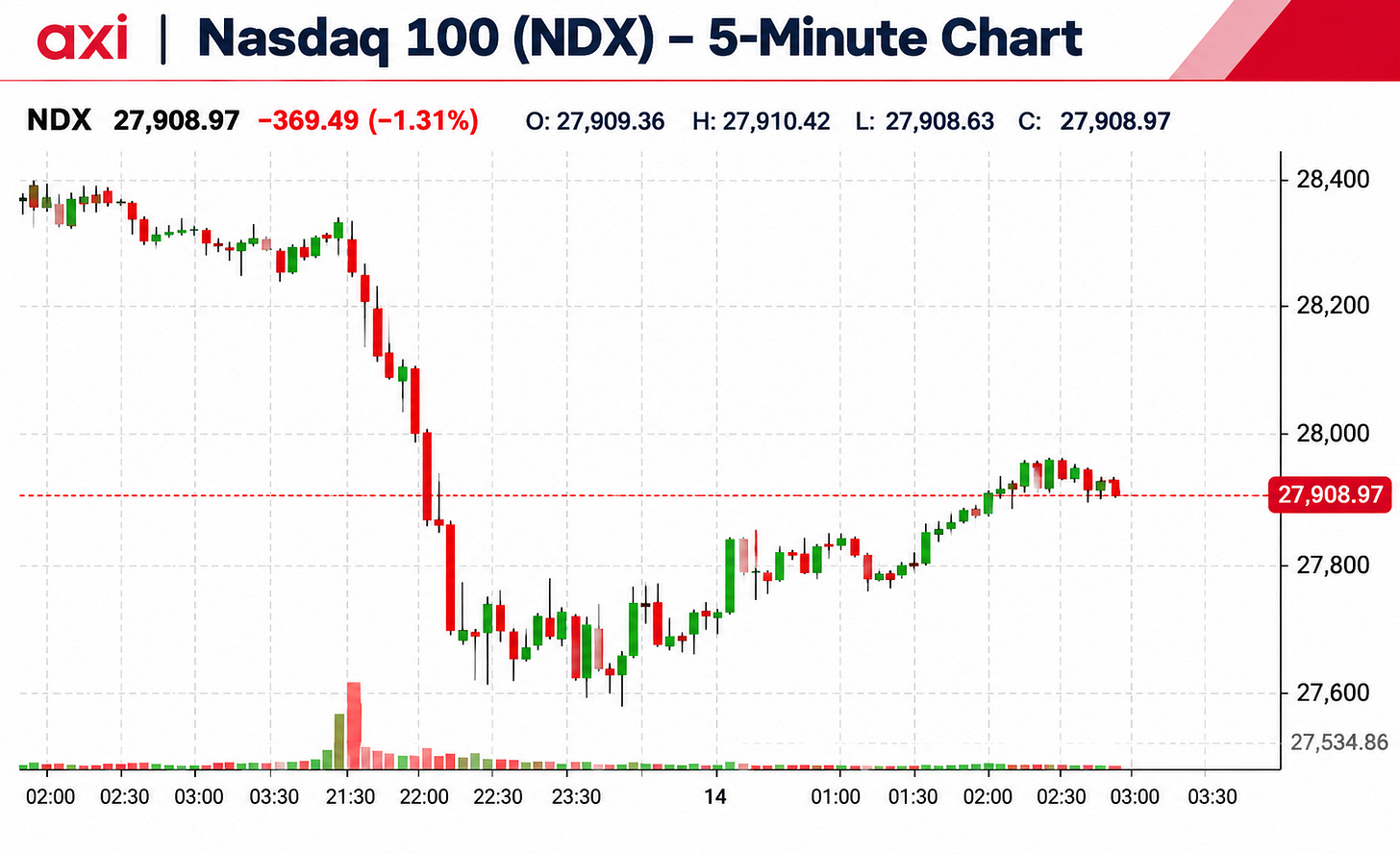
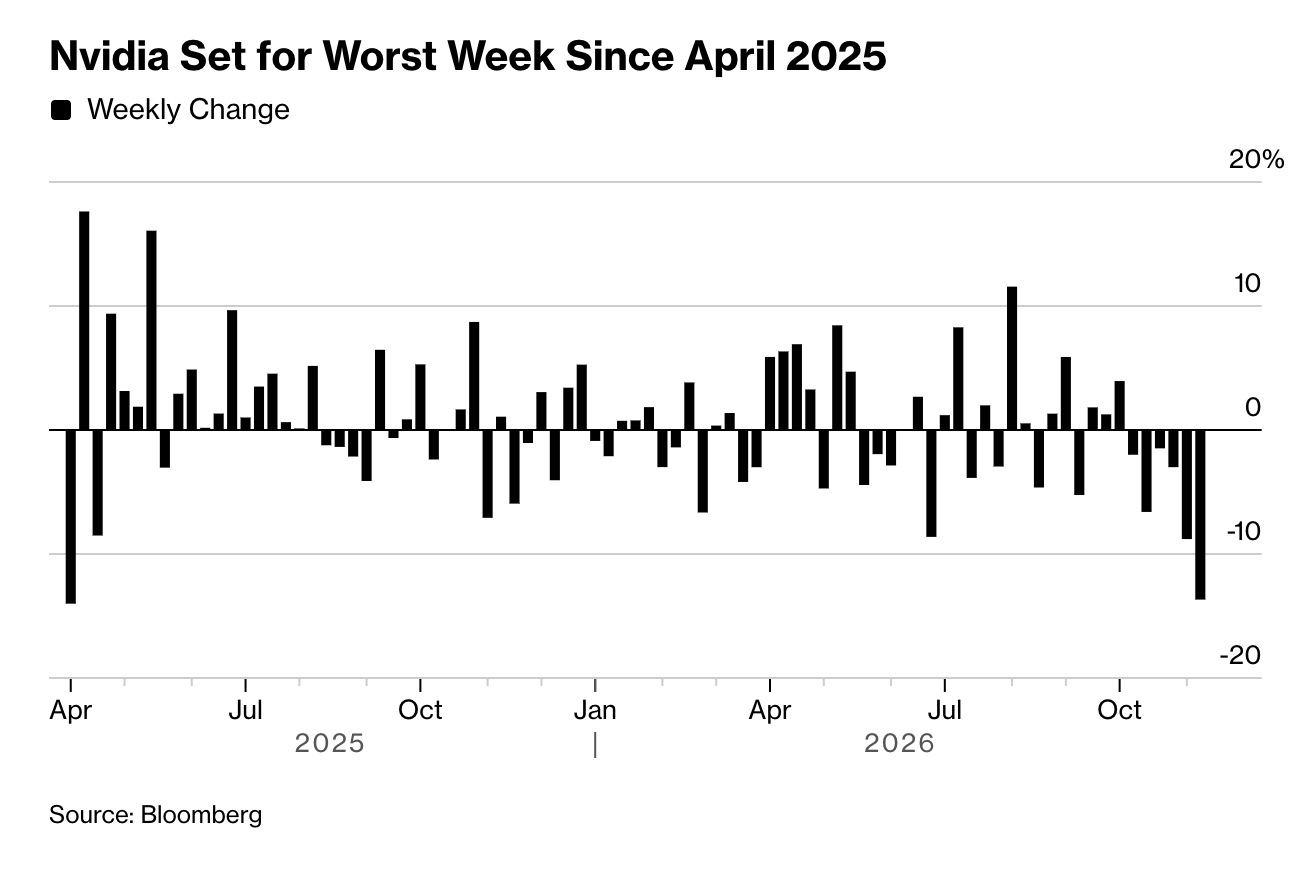
The chip sector sank 4.5%, the Nasdaq 100 lost 1.5% at its worst point) , and Nvidia extended its decline to roughly 14% since the previous Friday, putting the stock on course for its worst week since April 2025. Bitcoin slipping below $70,000 added another unpleasant flourish to a week in which the speculative crowd discovered that dip buying isn’t always the financial equivalent of picking up money off the pavement.
And the timing could hardly have been worse.
There is never a particularly convenient moment for one of the world’s wealthiest men and the most recognisable figure in artificial intelligence to become embroiled in a scandal involving a woman suspected by US intelligence of working for China. But after a month of rising debt costs, growing doubts about AI profitability and increasingly hostile political scrutiny, Jensen Huang’s departure arrived like somebody pulling a load-bearing beam out of an already expensive construction project.
The personal scandal may have supplied the headlines, but the market is only beginning to peel back the more interesting layers of the onion.
For three years, Nvidia operated as something resembling the lender of last resort to the AI ecosystem, except instead of printing money, it supplied GPUs, strategic investments, commercial relationships and the credibility needed to persuade investors that another multibillion-dollar data-centre project was worth financing.
Call it the Bank of Nvidia, where the collateral was computing power, the borrowers were building tomorrow’s infrastructure, and the chairman happened to be the most influential salesman in the industry.
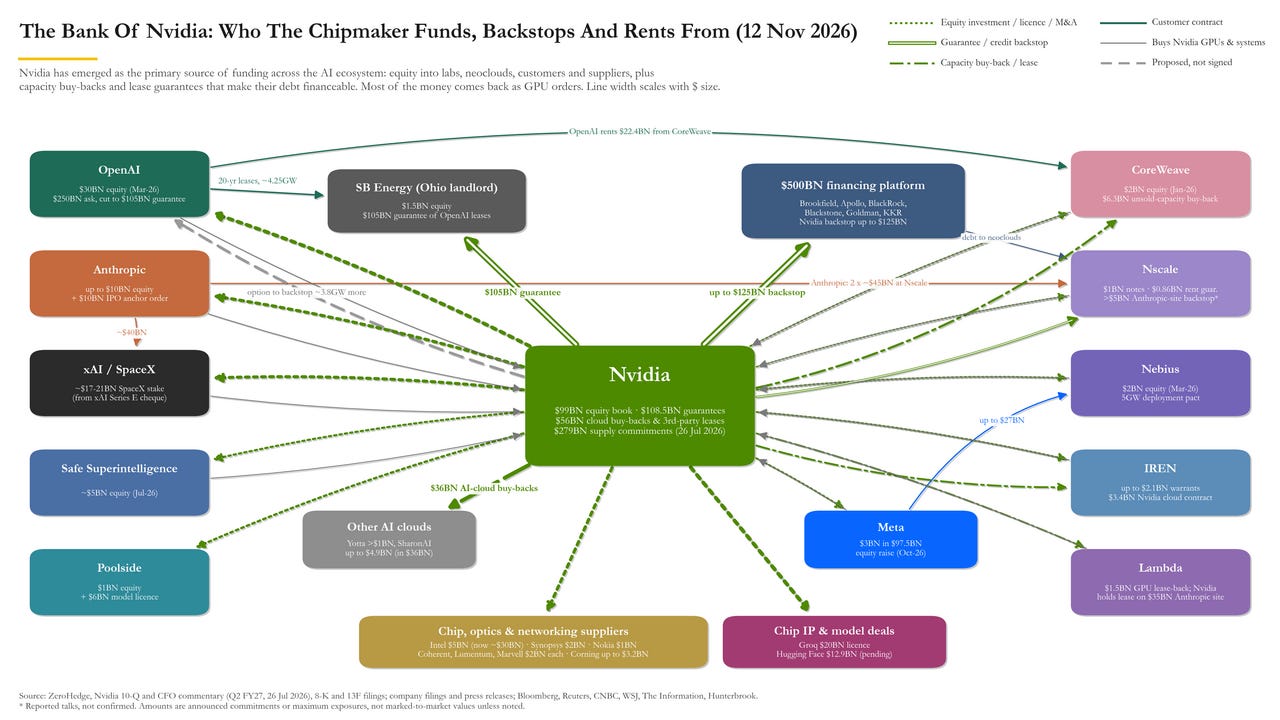
It’s a terrific business arrangement when chips are scarce, customers are queuing around the block and investors are treating every additional gigawatt of computing capacity as a licence to print money. Nvidia supplies the hardware, invests in selected participants, helps assemble the commercial ecosystem and benefits from the demand created by the resulting expansion.
But there’s an awkward distinction between financing an industry because its customers are generating extraordinary end-user demand and financing an ecosystem whose participants are increasingly dependent on one another to keep the spending cycle moving.
That doesn’t make the business illegitimate, nor does it mean the demand is imaginary. It does mean investors should understand exactly who is funding whom, how much leverage is embedded in the structure, and what happens when the assumptions supporting those financing arrangements begin to change.
And that’s where Huang’s departure becomes more significant than the immediate damage to Nvidia’s share price.
The company can keep manufacturing chips without him. Its engineering talent hasn’t evaporated, the CUDA ecosystem remains deeply embedded, and the hyperscalers aren’t suddenly going to cancel their infrastructure plans because the man in the leather jacket has left the building.
But Huang was also the industry’s principal dealmaker, the fellow capable of bringing together customers, governments, suppliers and capital providers around an extraordinarily ambitious vision of the future.
Replacing that influence is considerably more difficult than replacing a chief executive’s name on the office door.
Next Tuesday’s earnings report will therefore be about much more than whether Nvidia delivers another spectacular revenue figure. Interim CEO Colette Kress has the unenviable task of convincing investors that the machine can continue operating without the man who spent 33 years assembling it.
And while Wall Street will undoubtedly pore over margins, order books and product guidance, I’d be paying particular attention to what management says about strategic investments, customer commitments and the future of Nvidia’s role in financing the broader ecosystem.
The chips still work. The question is whether the financial machinery surrounding them works quite as smoothly without the fellow who helped put it together.
Washington’s China Spygate: Everyone’s Looking for a Fall Guy
If Nvidia’s corporate problems weren’t enough, Washington has now discovered an entirely separate reason to start sharpening the knives.
The allegations involving Huang’s relationship with Alice Huang, a businesswoman associated with Singapore-based Megaspeed, have brought renewed attention to questions surrounding possible violations of US semiconductor export restrictions.
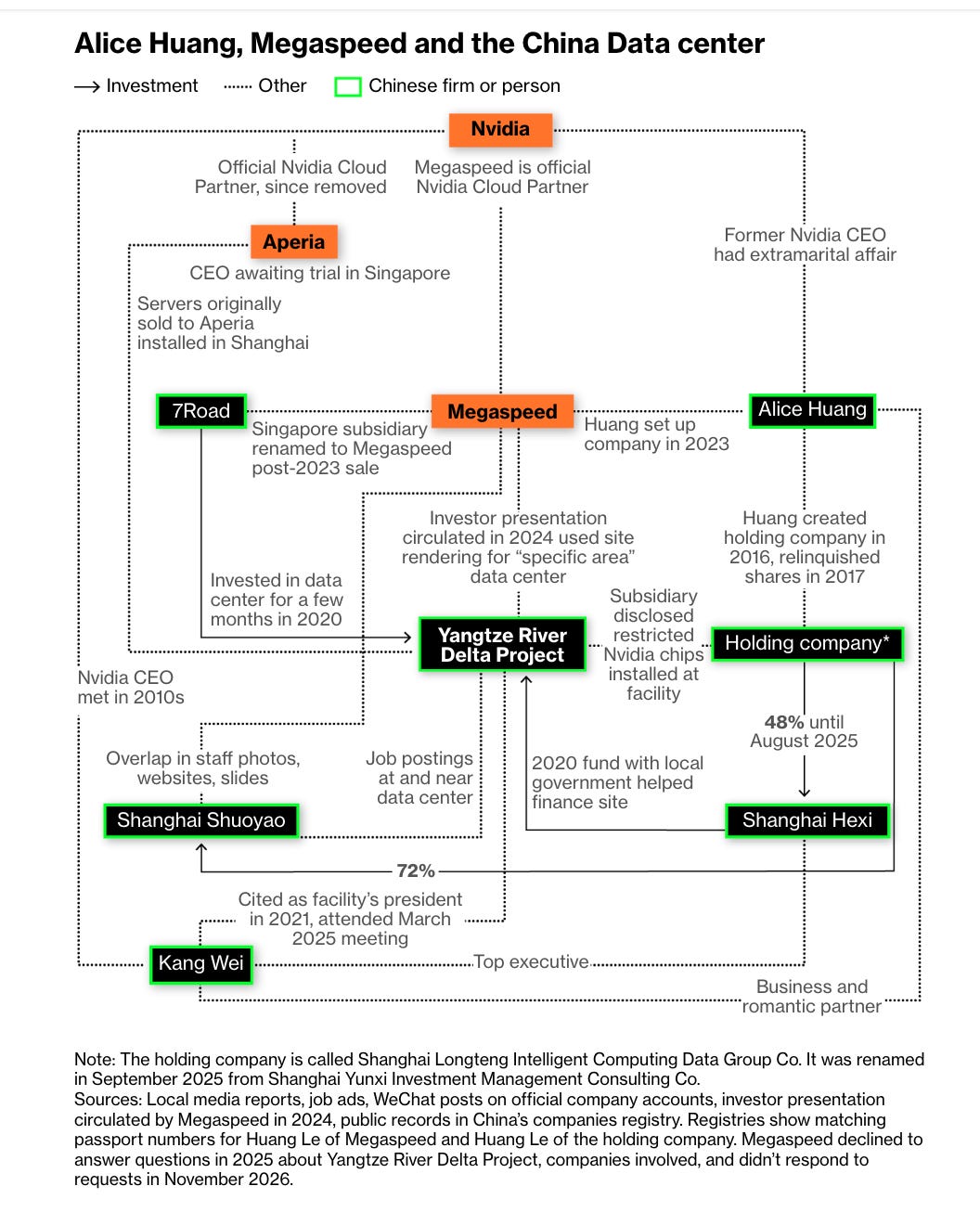
Reports have alleged that companies connected to Megaspeed helped facilitate billions of dollars in Nvidia chip shipments ultimately destined for Chinese customers. Nvidia says it has no reason to believe company secrets or American national security were compromised, while Megaspeed has denied wrongdoing.
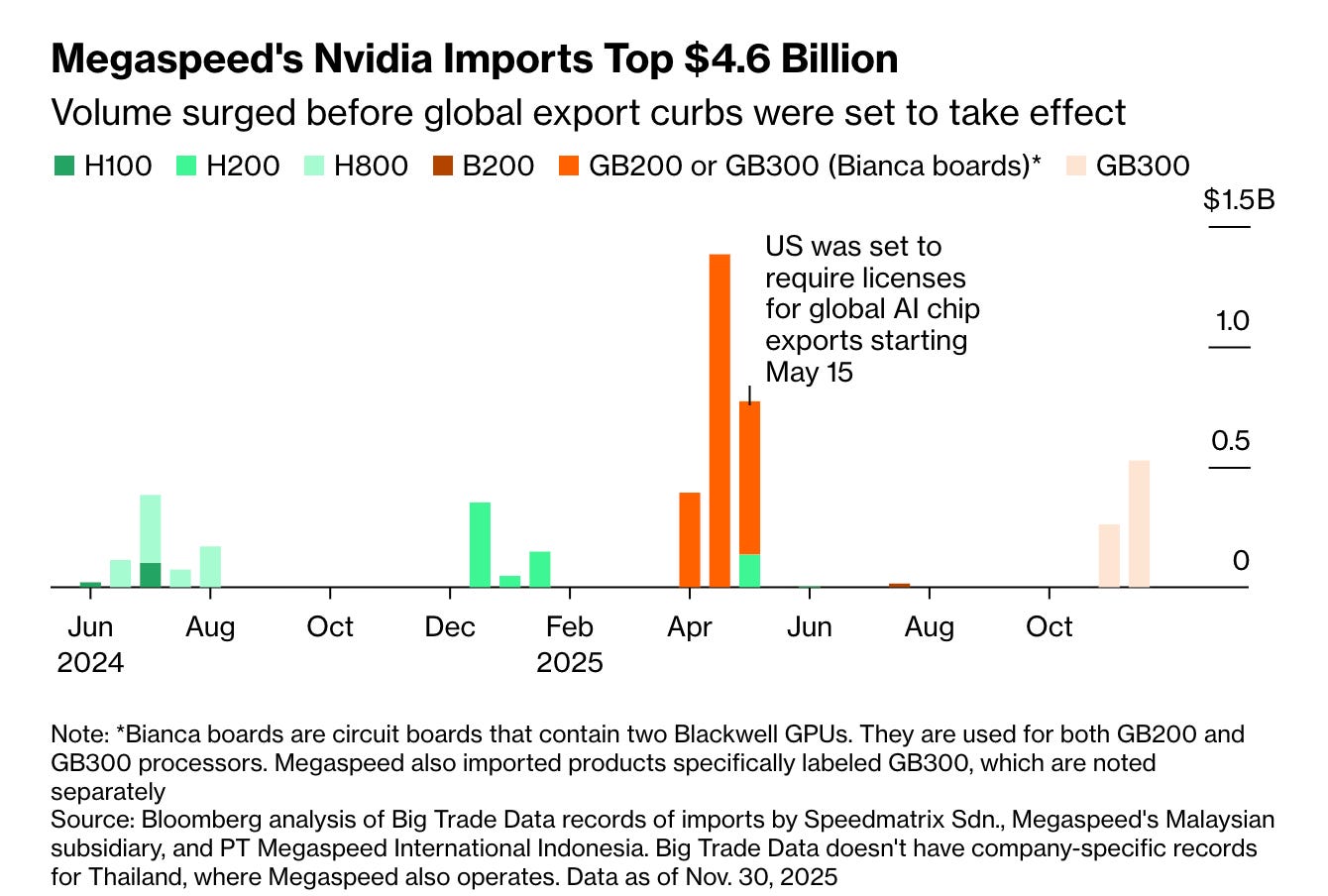
Those distinctions matter. Allegations of intelligence activity and unlawful chip diversion remain subject to investigation, and the evidence shouldn’t be stretched simply because the political theatre has become particularly entertaining.
But Washington’s emerging blame game isn’t really about Huang’s personal conduct.
It’s about whether US export controls were adequately enforced, who knew about potential loopholes and why restricted American technology may have reached customers it wasn’t supposed to reach.
And suddenly everybody seems rather interested in locating the person who had responsibility for the paperwork.
Treasury Secretary Scott Bessent made the disagreement unusually public on Friday, arguing that Treasury, the US Trade Representative’s office and the State Department had supported placing Megaspeed on the Entity List for months, while the Commerce Department retained the authority to act.
In other words, Treasury says Commerce had the pen, Commerce is now discovering how uncomfortable that pen can become, and Howard Lutnick appears to be facing the sort of political scrutiny that usually arrives shortly before everybody starts insisting the decisions were somebody else’s responsibility.
Nobody seems particularly eager to claim ownership of the alleged enforcement failures.
Reports suggest Lutnick has already become increasingly marginalised within parts of the administration, although predictions of his departure have circulated before and he’s still sitting in the chair. I’d be careful about declaring him the designated fall guy just yet, but the direction of the finger-pointing is becoming difficult to miss.
What makes this particularly awkward is that the dispute cuts directly across Trump’s relationship with Huang and the administration’s broader efforts to balance American technological dominance against concerns over Chinese access to advanced computing power.
And with congressional scrutiny intensifying, the consequences could extend far beyond one cabinet official.
More restrictive export rules, additional customer investigations and heightened scrutiny of overseas data-centre arrangements could complicate the very commercial relationships that helped Nvidia build its extraordinary franchise.
It’s one thing for the AI industry to negotiate with customers over the price of computing capacity. It’s another to discover that Washington may have something to say about who is allowed to buy it, where it can be installed and which foreign companies are permitted to benefit from it.
That introduces a layer of political risk that doesn’t fit particularly neatly into the usual discounted cash-flow spreadsheet.
The AI industry spent years building an extraordinary commercial empire. Washington is now asking who left the back gate open.
And judging by the increasingly public exchange of accusations, the investigation may become considerably more uncomfortable before anybody gets around to closing it.
The AI Loan Book Meets the Bond Market
For all the turmoil, the broader equity market has held together surprisingly well.
The S&P 500 remained only around 3% below its recent record entering Friday, despite Nvidia having surrendered nearly $2 trillion in market capitalisation since its October peak. That’s an extraordinary amount of wealth to disappear without dragging the entire index into a much deeper correction.
Some of the resilience reflects investors rotating into healthcare, consumer staples and other defensive sectors, while selected semiconductor competitors have attracted buying from accounts seeking to diversify their AI exposure.
But don’t confuse a relatively stable index with an entirely healthy market underneath.
Money can remain invested in equities while abandoning the companies that previously supplied the leadership. And when the dominant stock in an investment theme loses almost a third of its value in little more than a month, the rest of the ecosystem doesn’t simply carry on as though nothing has happened.
CoreWeave (CRWV) provides a particularly colourful example.
The highly leveraged neocloud operator enjoyed a spectacular midweek rebound after reporting stronger third-quarter results and offering investors fresh evidence that demand for computing capacity remains substantial. Management’s outlook pointed toward profitability in the first half of 2028, a welcome development for a company whose shares had already been punished during the recent AI selloff.
But the celebrations didn’t last.
The company’s dependence on Nvidia’s technology and commercial ecosystem quickly returned to the spotlight as Huang’s departure raised questions about the relationships supporting the broader infrastructure buildout.
And then there’s the small matter of financing.
CoreWeave has accumulated an enormous debt burden while investing aggressively in additional computing capacity. That’s a perfectly workable strategy if customers remain committed, the chips retain sufficient economic value and financing remains available at terms that allow the projects to generate acceptable returns.
The difficulty is that all three assumptions become more demanding when interest rates rise.
I’ve seen plenty of companies produce spectacular revenue growth without generating nearly enough cash to satisfy the people who lent them the money to achieve it. The income statement can look like a champagne reception while the balance sheet resembles the morning after.
That’s the increasingly uncomfortable distinction between the hyperscalers and the more leveraged infrastructure providers.
Microsoft (MSFT), Amazon (AMZN), Alphabet (GOOGL) and Meta (META) have enormous existing cash flows supporting their spending commitments. CoreWeave and its peers are much more dependent on the willingness of lenders and customers to keep financing the expansion.
And after this week’s inflation numbers, the cost of that money remains anything but settled.
Tuesday’s October CPI report showed headline inflation rising 0.4% and core prices advancing 0.3%, enough to revive speculation that the Federal Reserve may need to accelerate tightening. Christopher Waller’s suggestion that a 50-basis-point December hike should be considered helped send short-dated Treasury yields sharply higher and left the dollar trading near a nineteen-month high.
Friday’s producer-price figures offered a somewhat more encouraging picture. Although annual PPI inflation reached its fastest pace since 2022, the report came in slightly below expectations, while several components feeding into the Fed’s preferred PCE measure were softer than feared.
That should give the more cautious members of the committee something to work with.
Waller has gone from discussing rate cuts to entertaining a jumbo hike in less than a year, which is quite a journey around the monetary-policy roundabout. But after Friday’s softer PPI components, I’m still inclined to think the Fed delivers a quarter point in December rather than reaching immediately for the 50-basis-point hammer.
The distinction matters because the market has spent the week pricing the threat, not necessarily the outcome.
A quarter-point move followed by another increase if inflation demands it remains entirely consistent with a central bank determined to restore price stability without unnecessarily strangling an economy already dealing with expensive energy and tightening financial conditions.
For the AI complex, however, even a gradual tightening cycle is hardly ideal when much of the industry’s infrastructure expansion depends on enormous financing commitments.
You can have the best technology in the world, but if the cost of funding it keeps rising, eventually somebody has to explain where the cash flow comes from.
And unlike another bullish presentation about the future of artificial intelligence, that’s a question creditors generally expect to have answered in dollars.
Oil, Inflation and the Next Test of Wall Street’s Nerves
The inflation debate is becoming even more complicated because the oil market is once again trading two entirely different futures.
Crude has fallen roughly 18% from its recent peak as investors contemplate the possibility that Washington and Tehran may eventually reach an arrangement capable of restoring more normal energy flows through the Gulf.
Brent has recovered toward $96, but the broader decline in prices has encouraged discussion of a potential supply surplus if disrupted production and shipping routes return to normal.
That’s the optimistic version.
The less comfortable interpretation is that the current lull in military activity remains a long way from an actual peace settlement.
Tankers are still being struck or disabled around the Strait of Hormuz, regional energy infrastructure remains vulnerable, and the political gulf between Washington and Tehran has hardly disappeared simply because the shooting has become less intense.
I’ve never particularly liked treating a temporary pause in hostilities as though somebody has signed a durable peace treaty.
Oil remains the truth serum of the macro market. Politicians can spend all afternoon explaining why a deal is imminent, but when the tankers stop moving or the refineries start burning, traders tend to pay more attention to barrels than press conferences.
For the Fed, lower energy prices would be a welcome development, particularly after months of stubborn inflation. They could ease pressure on transportation costs, consumer spending and broader inflation expectations, potentially giving policymakers more flexibility over the pace of tightening.
But renewed disruption in the Gulf would quickly complicate that calculation.
And with the AI infrastructure industry already confronting higher financing costs, another sustained rise in oil would be about as welcome as discovering the bank has increased your mortgage rate just as the electricity company sends through another spectacular bill.
That leaves investors facing an unusually complicated set of crosscurrents heading into next week.
Nvidia reports on November 17, when Kress will have an opportunity to reassure shareholders that the company’s technology road map, customer commitments and strategic relationships remain intact. Frankly, Anthropic’s IPO pricing might well be the new litmus test for whether investors are still prepared to assign extraordinary valuations to companies building businesses around rapidly expanding AI demand.
Both events will attract enormous attention, but they’ll be answering rather different questions.
Anthropic will test how much investors are willing to pay for the next generation of AI growth. Nvidia will test how much confidence remains in the machinery supporting the current generation.
Meanwhile, the Fed must decide whether October’s hotter CPI or Friday’s somewhat softer producer-price details provide the better indication of where inflation is heading.
And hovering over the entire discussion is an oil market that could either deliver some welcome disinflationary relief or throw another geopolitical spanner into the monetary-policy works.
I wouldn’t declare the AI bull market finished on the strength of one dreadful week in semiconductors. Demand for computing power remains substantial, the hyperscalers continue committing enormous capital, and Nvidia’s technological advantages haven’t evaporated because Huang is no longer running the company.
But neither would I dismiss the recent selloff as another routine opportunity to buy the dip.
The market is finally beginning to distinguish between the extraordinary growth of artificial intelligence and the financial arrangements required to turn that growth into acceptable investment returns.
For years, investors were content to admire the revenue forecasts, applaud the capital expenditure announcements and assume that somebody would eventually work out how all the financing came together.
Now the cost of money is rising, Washington is investigating the flow of restricted technology, and the most influential figure in the AI industry has departed under circumstances that could make an already complicated political environment considerably more hostile.
The Bank of Nvidia has lost its chairman, and Wall Street is finally examining the loan book instead of admiring the building.
The chips still work, the customers still need computing power, and the AI revolution hasn’t been cancelled. But the days of treating every dollar of infrastructure spending as a guaranteed dollar of future value are becoming harder to justify.
Next week, we’ll find out whether Nvidia can reassure investors that the machinery is still running smoothly. What we won’t learn from one earnings call is whether the entire ecosystem can keep expanding at the same extraordinary pace once the lenders start reading the fine print.
And in my experience, that’s usually when the really interesting trading begins.



Comments
Log in or sign up to join the conversation.