


Wall Street had every reason to head for the exits. Jensen Huang is out at Nvidia (NVDA), oil is back on the boil, Treasury yields have punched through 5.10%, and the Fed seems increasingly inclined to keep its foot on the monetary brake. Yet the Nasdaq clawed its way back from an early 1.5% tumble to finish down just 0.4%, with AMD and Broadcom (AVGO) attracting money that might otherwise have fled the AI trade altogether. I’d file that under stirred but not shaken at the index level. The AI boom hasn’t been cancelled; Wall Street is simply rearranging the seating plan after the king lost his throne. The bigger headache may be developing away from Silicon Valley, where rising oil prices, sticky inflation and an increasingly unforgiving bond market are threatening to make the next leg of the technology rally considerably more expensive.
Unless you spent Thursday drinking margaritas on a beach with your phone abandoned back at the hotel, you’ll know Jensen Huang’s extraordinary 33-year reign at Nvidia has come to an abrupt and rather spectacular end.
The man who helped turn a graphics-chip company into the engine room of the global AI boom has left the building, and Wall Street suddenly finds itself confronting the awkward possibility that even its most celebrated corporate monarchs aren’t quite as indispensable as their share prices once suggested.
Finance chief Colette Kress has been handed the interim CEO role while Nvidia’s board searches for a permanent replacement. Given Huang’s famously unconventional views on succession planning, that’s a rather uncomfortable moment for the directors to discover whether three decades of extraordinary leadership also produced somebody capable of taking over the controls.
Nvidia initially plunged as much as 14%, and for a brief moment it looked as though somebody had pulled the emergency brake on the entire AI express. But the retail dip-buying brigade came charging in, apparently convinced that losing the man who built the company was simply another opportunity to pick up the stock at a discount.
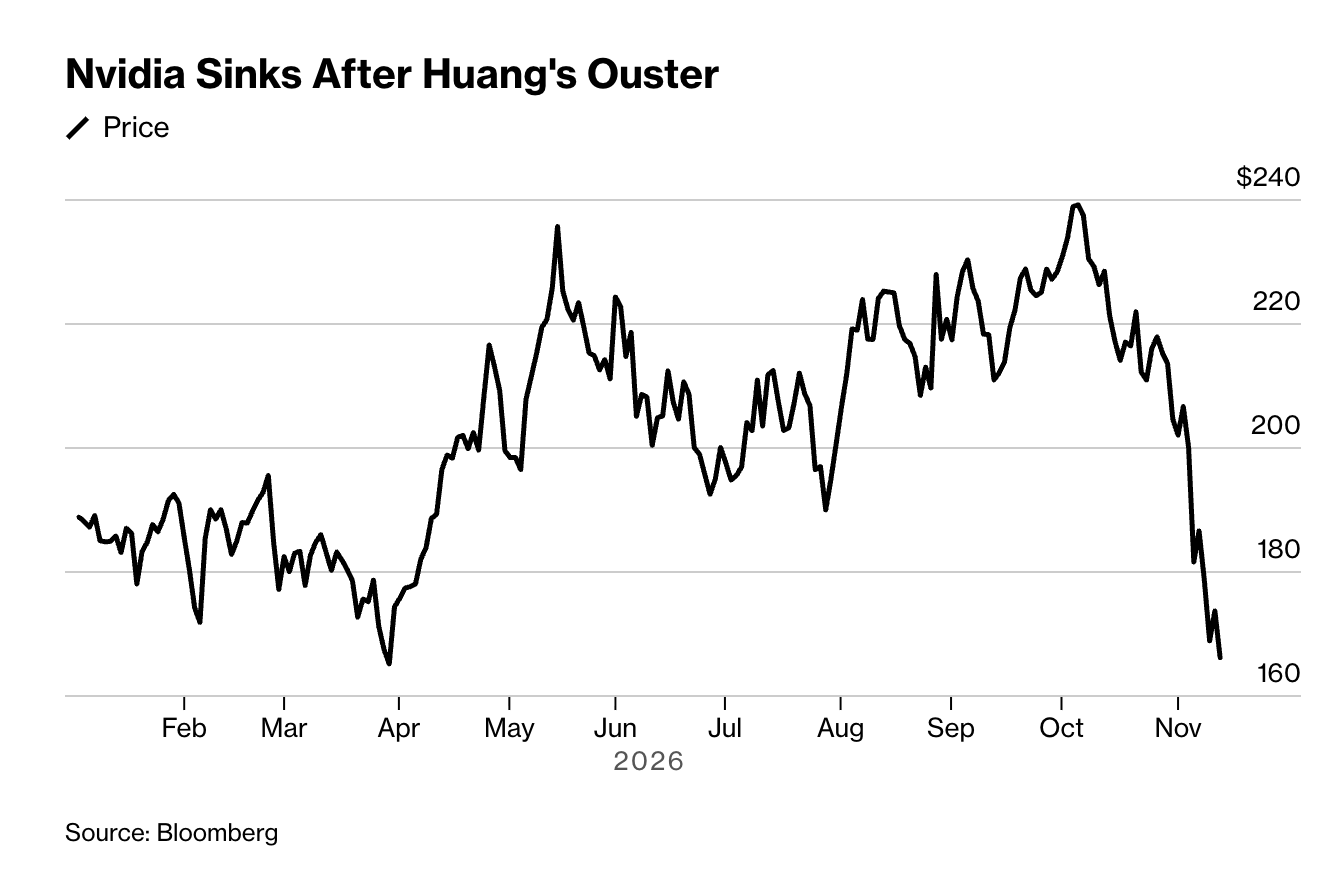
By the closing bell, Nvidia had pared its losses to approximately 4.3%, while the Nasdaq recovered from an early 1.5% tumble to finish down just 0.4%. The S&P 500 slipped 0.4%, and the Dow gave up 0.3%.
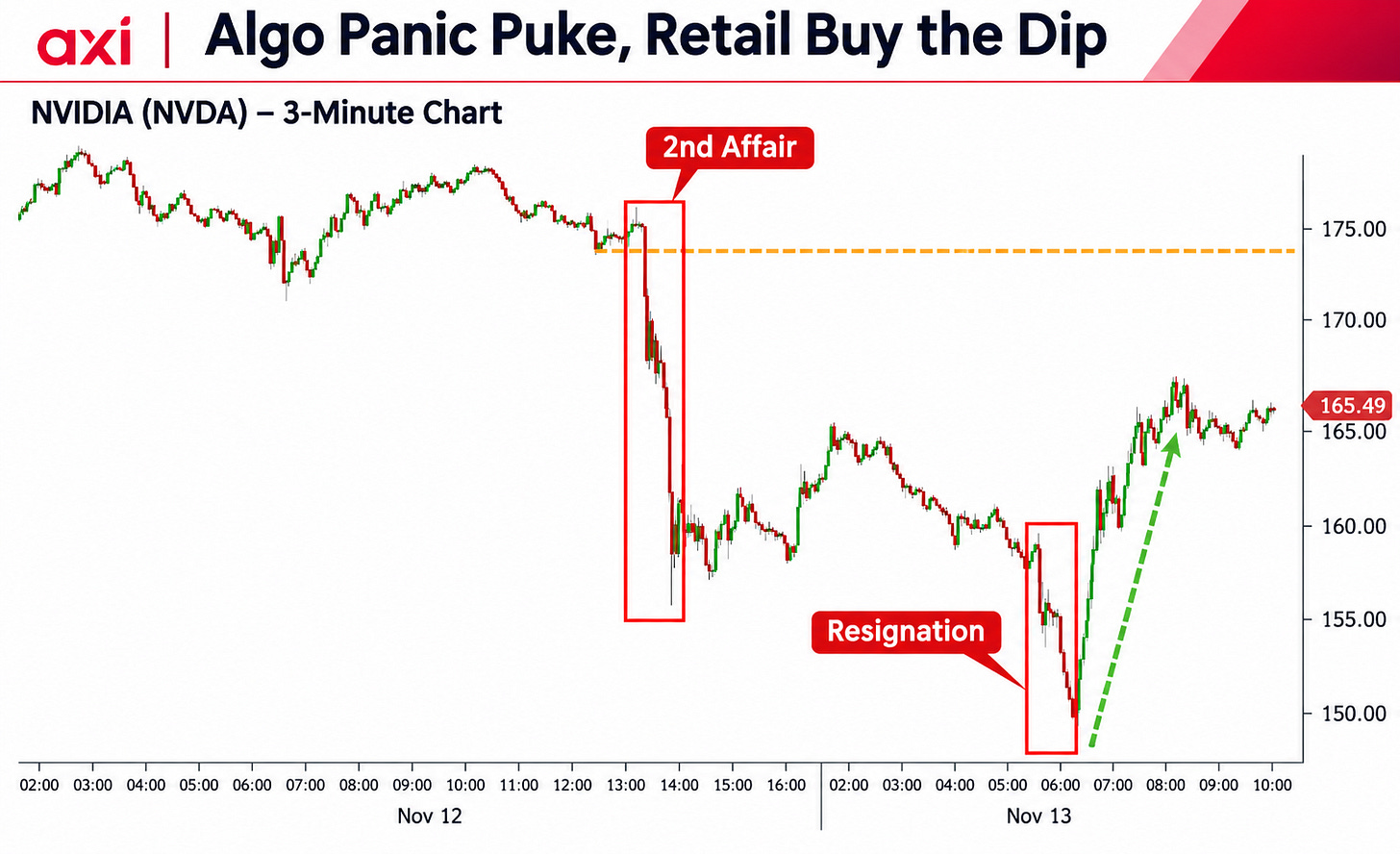
Now, here’s where things get interesting.
While business television wheeled out its usual parade of AI evangelists and Wall Street research desks produced another seemingly endless stream of happy talk about how the AI revolution would carry on regardless, the actual tape was telling us something considerably more useful.
AMD and Broadcom attracted buyers, with their combined gains nearly offsetting Nvidia’s drag on the S&P 500. Micron (MU) and CoreWeave (CRWV) weren’t nearly as fortunate, but the broader semiconductor complex refused to follow Nvidia over the cliff.
In other words, money wasn’t abandoning the AI trade. It was simply finding another seat at the table.
And frankly, that strikes me as a more important development than another hour of television pundits explaining why everything is going to be just fine.
The hyperscalers aren’t about to cancel their data-centre construction programmes because Nvidia needs a new chief executive, and customers aren’t suddenly going to stop ordering computing power. But there’s a substantial difference between believing the AI infrastructure boom will continue and believing Nvidia deserves every last ounce of the valuation premium investors previously assigned to Huang’s leadership.
Competitors may even find themselves with an unexpected opportunity. When the supplier dominating your technology road map suddenly loses its chief executive, diversifying your chip purchases starts looking less like a theoretical risk-management exercise and more like common sense.
From where I sit, this still belongs firmly in the stirred but not shaken drawer at the index level. The AI trade hasn’t been shot; it’s simply discovered that its most famous gunslinger can be replaced, even if nobody is quite sure who gets to wear the holster.
And while Wall Street debates that particular succession drama, the bigger macro threat may be developing somewhere considerably less glamorous: the oil market and the long end of the Treasury curve.
The Steve Jobs Playbook: Same Movie, Different Set of Problems
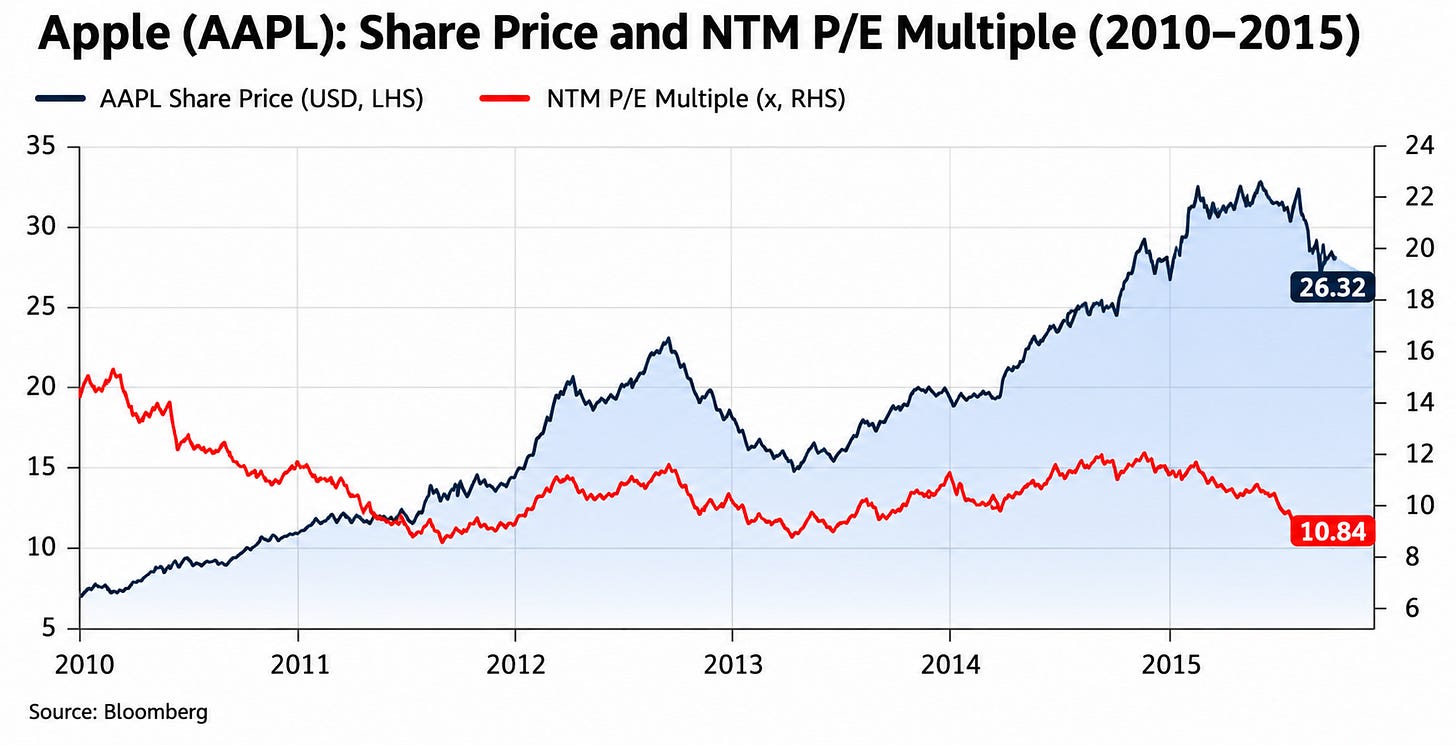
Goldman Sachs sees favourable risk-reward in Nvidia, citing an obvious historical comparison worth dusting off, which takes us back to Apple (AAPL) in the final years of Steve Jobs.
When Jobs went on medical leave in January 2011 and subsequently passed away that October, investors faced an uncomfortable question about how much of Apple’s extraordinary success was tied to the man who had built its product vision and corporate culture. The iPhone was already a commercial juggernaut, the ecosystem was becoming increasingly difficult for competitors to penetrate, and Tim Cook was waiting in the wings. Yet Wall Street still had to figure out what the company was worth without Jobs steering the ship.
Over roughly the 18 months surrounding that transition, Apple’s forward earnings multiple compressed from approximately 17 times to 12 times, eventually falling toward nine times in 2013 before recovering to around 15 times as investors gained confidence that the product machine could keep delivering.
Now here’s where the comparison becomes interesting.
Nvidia is already trading around ten times estimated 2027 earnings, depending on whose forecasts you use, putting it remarkably close to the valuation territory where Apple eventually found its footing. On the surface, that suggests much of the leadership discount may already have been applied.
But I’d be careful about getting too clever with the analogy. Apple didn’t experience its entire multiple compression because Jobs departed. Growth expectations were changing, the business was maturing, and investors were gradually reassessing how much they were prepared to pay for the next generation of iPhone earnings. And Tim Cook wasn’t some unfamiliar executive suddenly handed the keys after a boardroom explosion. He had already been running much of the operation.
Nvidia, by contrast, is attempting to replace a founder whose relationships extend from Silicon Valley to Washington, Beijing and just about every major AI infrastructure customer on the planet, while simultaneously navigating uncomfortable governance questions and regulatory scrutiny.
The underlying business hasn’t suddenly evaporated. Nvidia still possesses an extraordinary engineering and talent franchise, its CUDA software ecosystem remains deeply embedded across the industry, and the Rubin Ultra and Feynman development programmes haven’t disappeared because Huang is no longer running the company.
But strategy, culture and customer confidence aren’t always transferable assets. Sometimes the machinery keeps humming after the founder leaves. Sometimes you discover that the fellow in the corner office was doing considerably more than turning up at conferences wearing an expensive leather jacket.
And that’s where the valuation arithmetic starts getting uncomfortable.
You can leave Nvidia’s earnings forecasts completely unchanged and still produce a substantially lower share price simply by reducing the multiple investors are prepared to pay. Take a hypothetical $10 of earnings and a 30-times multiple, and you have a $300 stock. Reduce the multiple to 22 times and those same earnings are suddenly worth $220.
Not one dollar of projected profit has disappeared, yet the share price has taken a sizeable haircut.
Sometimes the E stays exactly where it is while Wall Street takes a carving knife to the P/E.
The Apple experience tells us that exceptional businesses can survive the departure of extraordinary founders. What it doesn’t provide is a convenient timetable for when investors regain confidence, or how much they’ll be prepared to pay once that confidence returns.
For Nvidia, next week’s earnings will provide an important first examination. Strong results may reassure investors that the demand story remains intact, but the board still has to demonstrate that the company can navigate its next chapter without the man who wrote the previous thirty-three.
Same AI Casino, Different Tables
The broader semiconductor response was arguably more revealing than Nvidia’s own intraday recovery, because it exposed a market becoming increasingly selective about where it wants to own AI risk.
AMD and Broadcom found buyers, while Micron, CoreWeave and several of the more speculative infrastructure names took another beating. The Russell 2000 also struggled, and most S&P 500 constituents finished lower despite the indices avoiding a much more serious decline.
That’s hardly a ringing endorsement of everything connected to artificial intelligence.
What it suggests is that investors remain committed to the spending cycle while becoming considerably less forgiving about the financial structure of the companies participating in it.
The hyperscalers still have extraordinary cash-generating businesses to finance their infrastructure commitments. Established semiconductor suppliers possess valuable intellectual property, customer relationships and, in some cases, an opportunity to benefit from procurement diversification following Nvidia’s leadership crisis.
The neocloud operators are playing a different game, often funding expansion through enormous borrowing programmes and customer prepayments while betting that demand for computing capacity remains strong enough to justify the investment.
And with Treasury yields climbing, that’s becoming a rather expensive bet.
It’s one thing to finance growth when capital is plentiful, borrowing costs are manageable and investors are happy to treat every additional gigawatt of computing capacity as money in the bank. It’s quite another when the Fed is contemplating faster tightening and creditors are beginning to ask more difficult questions about repayment schedules and the residual value of ageing GPUs.
There’s also the small matter of technical resistance.
BTIG’s Jonathan Krinsky has highlighted the $150–$155 area in the iShares Semiconductor ETF (SOXX), SOXX, as an important zone of overhead supply following what he regards as a confirmed six-month top. Thursday’s recovery brought the ETF back toward that region, with its 200-day moving average sitting around $160.
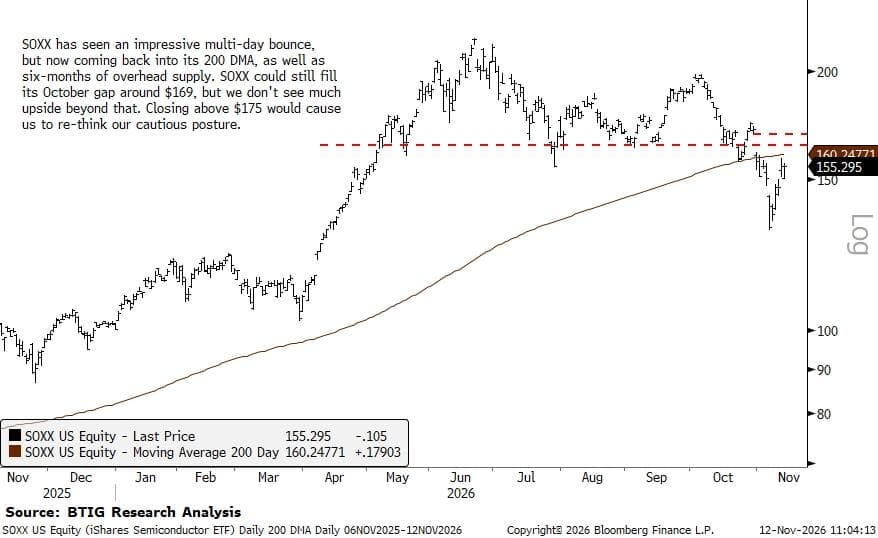
The argument is familiar to anyone who has spent time trading markets after a violent liquidation. Investors who bought during the previous six months and subsequently found themselves underwater may be delighted to sell into a rebound that gets them somewhere near their original entry price.
That creates a natural supply ceiling, even when the fundamental news is improving.
A move toward the October gap around $169 remains possible, but Krinsky sees a sustained break above $175 as the sort of development that would challenge his cautious technical outlook.
I wouldn’t treat those levels as sacred scripture, but after the damage inflicted on semiconductors recently, there’s a decent argument for letting the market prove it can chew through the overhead supply before declaring another uninterrupted march higher.
The AI trade is still alive, but the days when investors could throw darts at a list of anything remotely connected to GPUs and expect to make money are becoming considerably less reliable.
The market is separating genuine earnings power from financial engineering, and that distinction matters a great deal when the price of money is moving higher.
Oil Lights the Fuse, and the Bond Market Supplies the Dynamite
While everyone was busy dissecting Nvidia’s palace coup, the oil market was quietly preparing another headache for Wall Street.
Trump’s declaration that Washington no longer needed a deal with Iran abruptly cooled the diplomatic optimism that had helped send crude lower earlier in the week. Then came Iranian claims that two oil tankers had struck mines east of the Strait of Hormuz, once again reminding energy traders that the world’s most important maritime oil corridor remains vulnerable to another ugly disruption.
The tanker claims were not independently established in the supplied reporting, but the headlines were enough to restore some of the geopolitical premium that crude had recently surrendered.
WTI climbed toward $89, brushing aside bearish US inventory data as traders reassessed the possibility that a negotiated end to the conflict might be considerably further away than the market had been hoping.
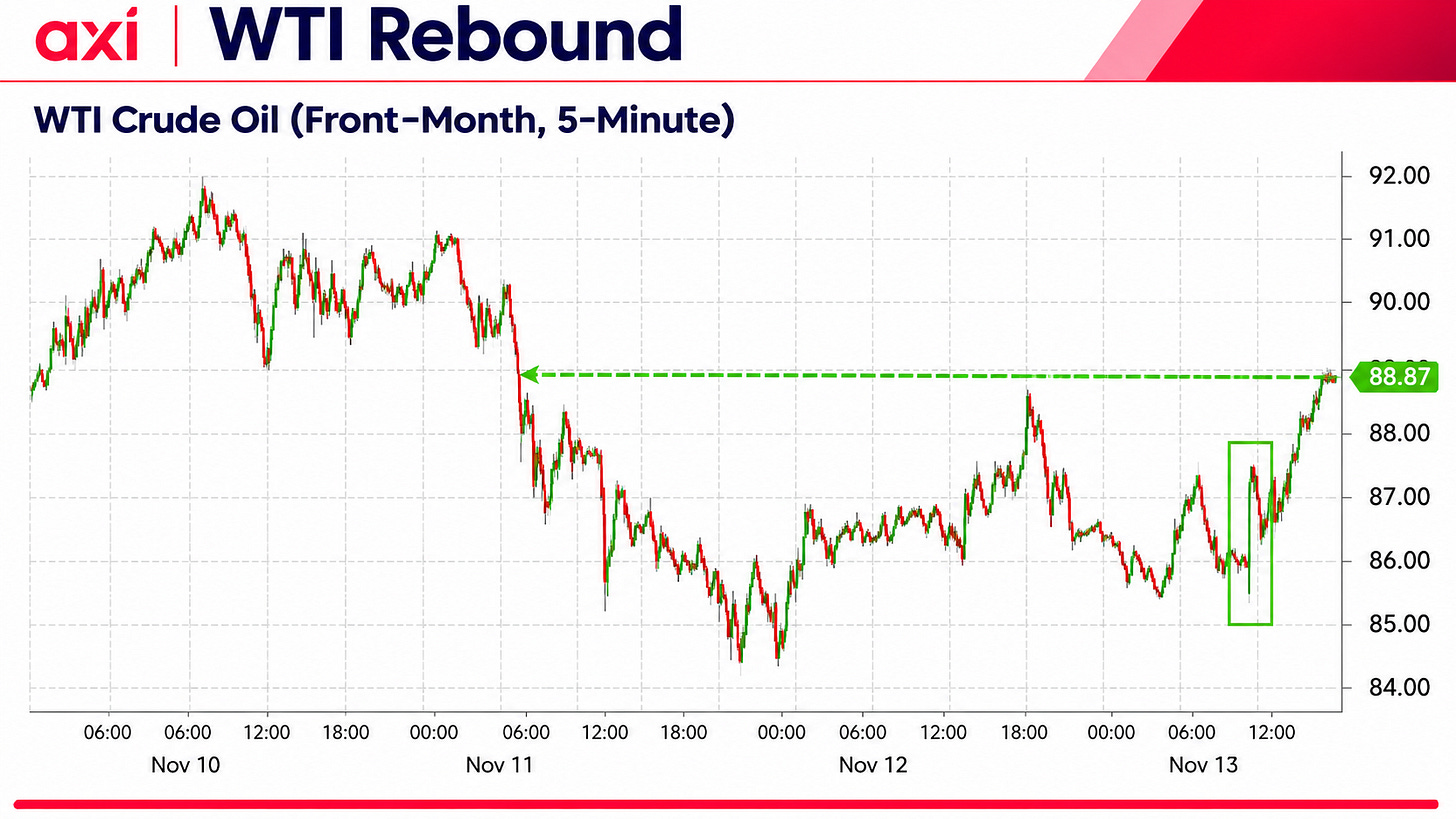
I’ve said it often enough over the years: oil is the truth serum of the macro market. You can spin the political headlines, polish the diplomatic language and promise that peace is just around the corner, but when crude starts climbing, the bond market tends to stop listening to the public-relations department.
And Thursday was particularly uncomfortable for anyone carrying duration.
Tuesday’s hotter-than-expected CPI report had already forced traders to reconsider whether the Fed’s gradual approach to tightening was sufficiently aggressive. Cleveland Fed President Beth Hammack added to the pressure by reiterating that monetary policy needed to move into restrictive territory, while markets assigned roughly a 15% probability to a 50-basis-point December increase and a growing likelihood of another hike in January.
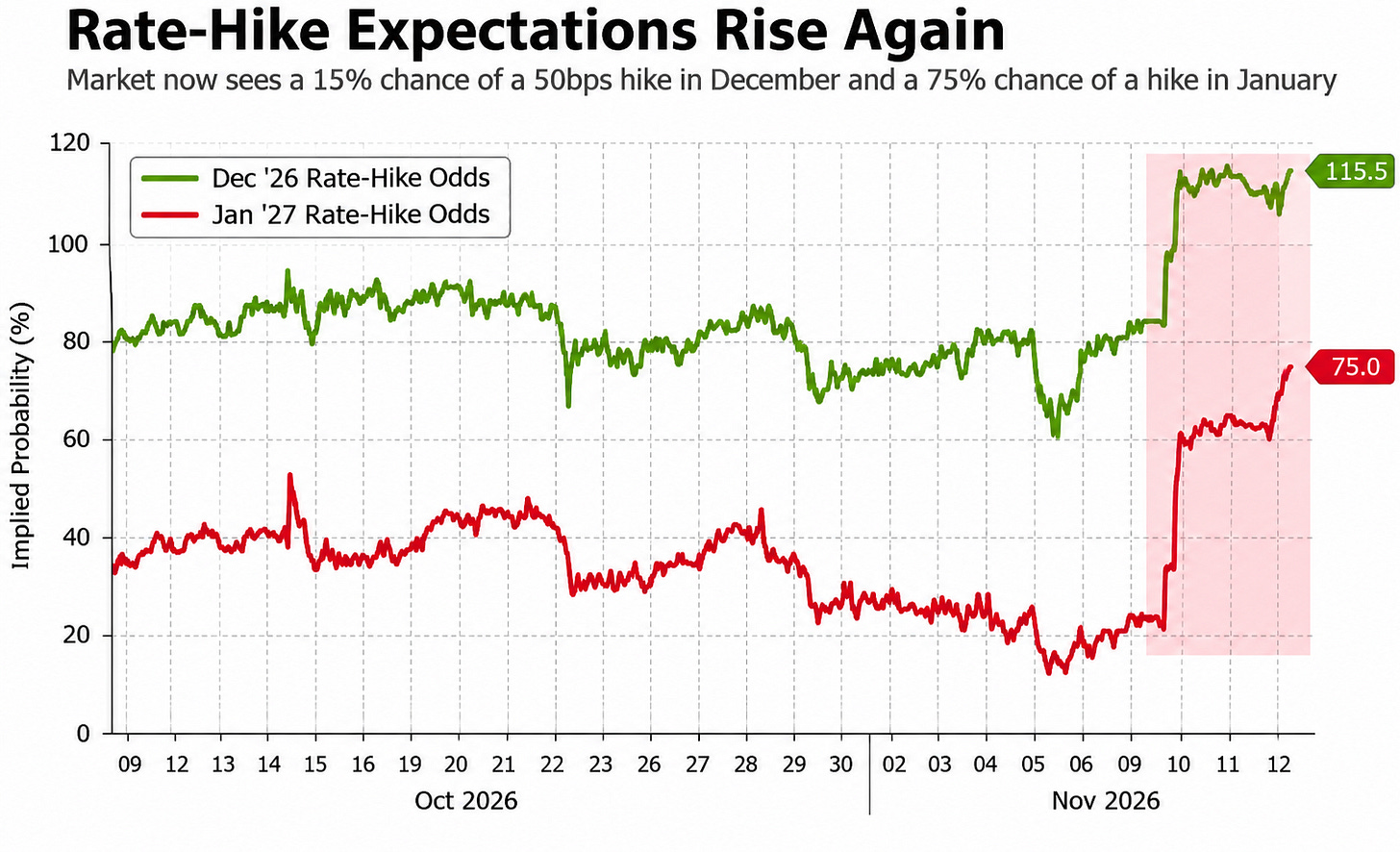
Then oil joined the party.
Treasury yields surged, with the ten-year pushing above 5.10%, while a poorly received 30-year auction added another shove. Real yields also continued climbing, extending their advance and leaving the ten-year inflation-adjusted yield approximately 90 basis points higher for the year.
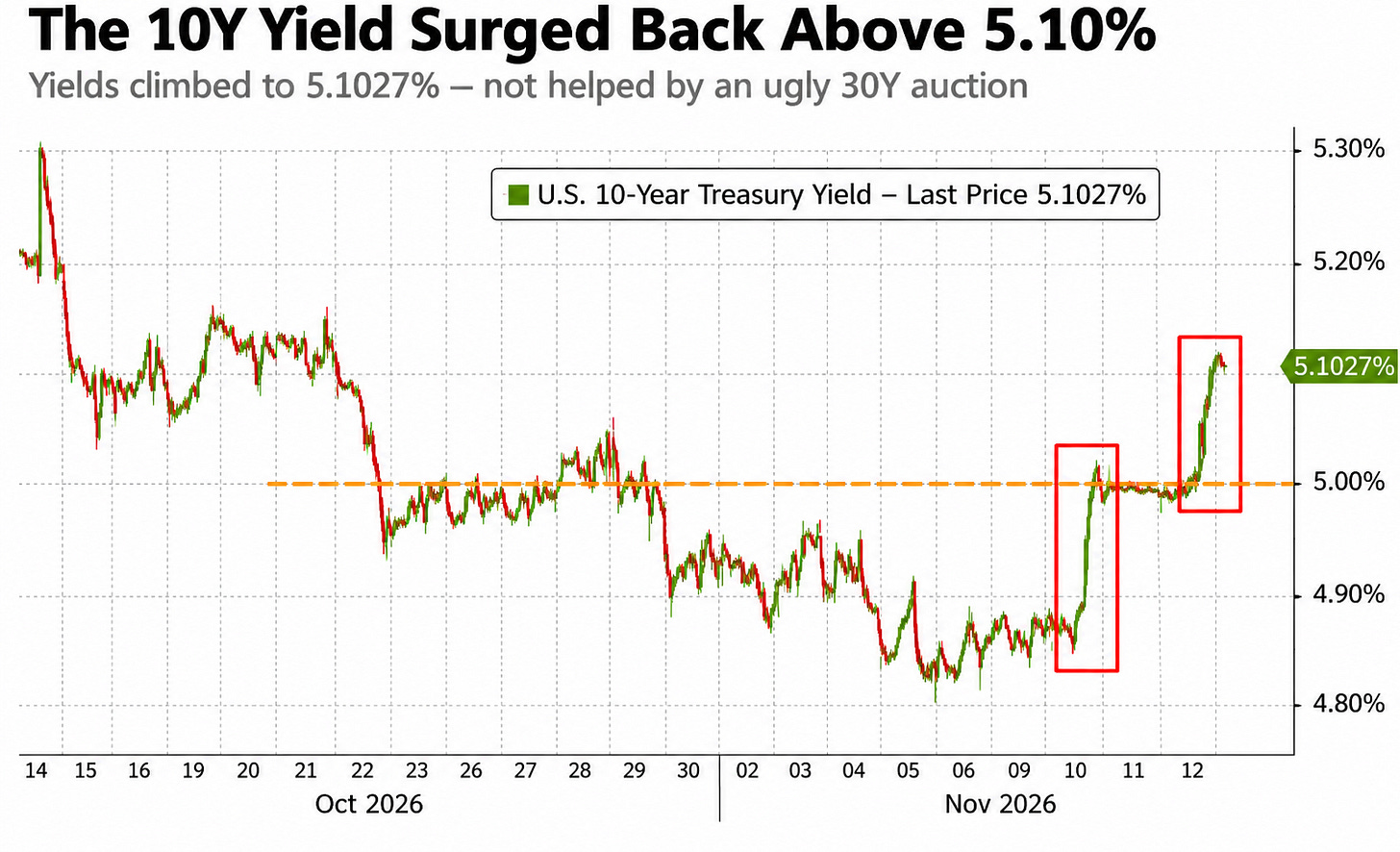
That last development is considerably more important than another round of television speculation about Nvidia’s next chief executive.
When real yields rise, investors are dealing with genuinely tighter financial conditions rather than merely demanding additional compensation for inflation. Future earnings become less valuable in present terms, borrowing costs increase, and businesses dependent on repeated visits to the financing window begin to look considerably less attractive.
It’s a particularly unpleasant combination for the more leveraged corners of the AI infrastructure trade.
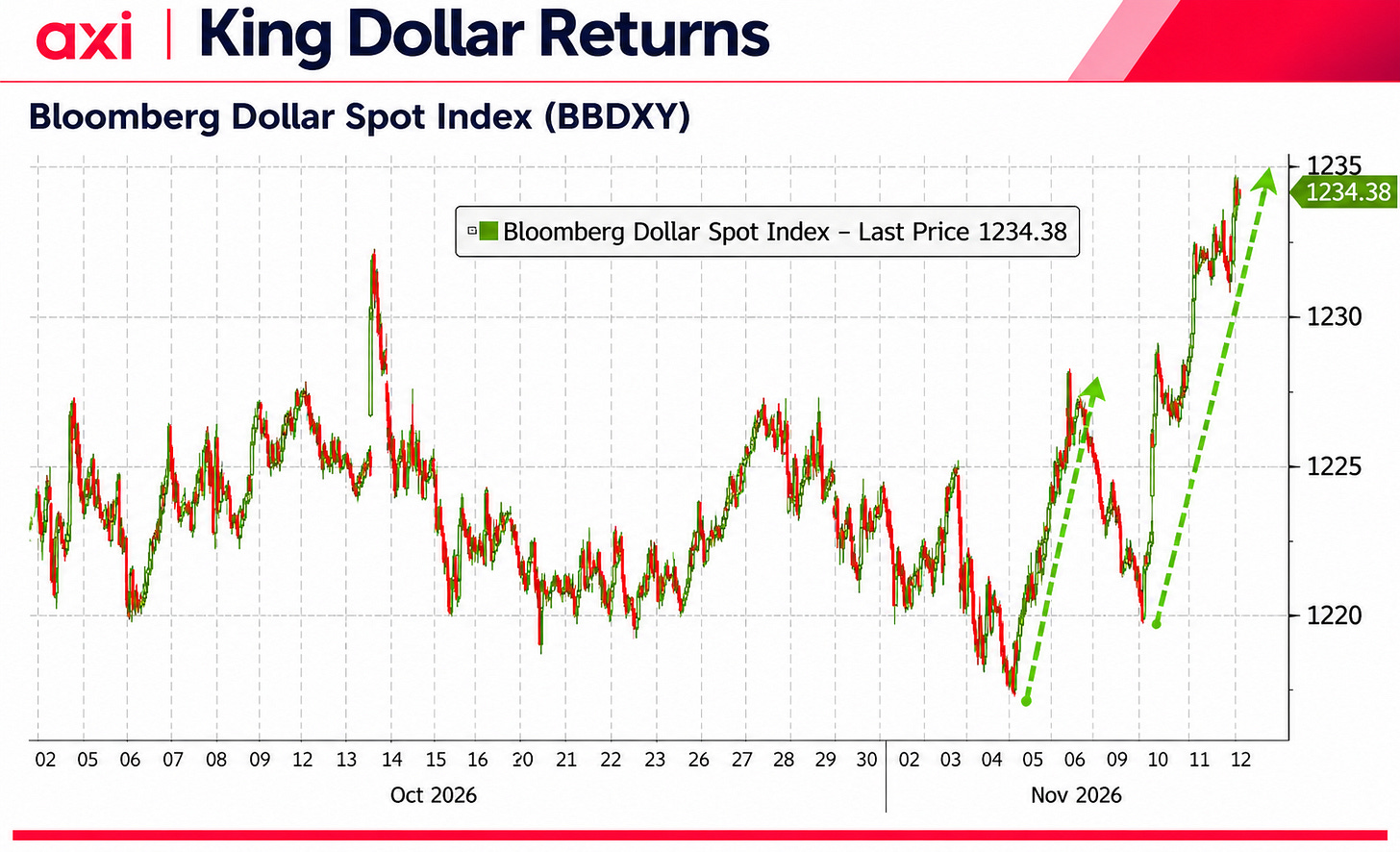
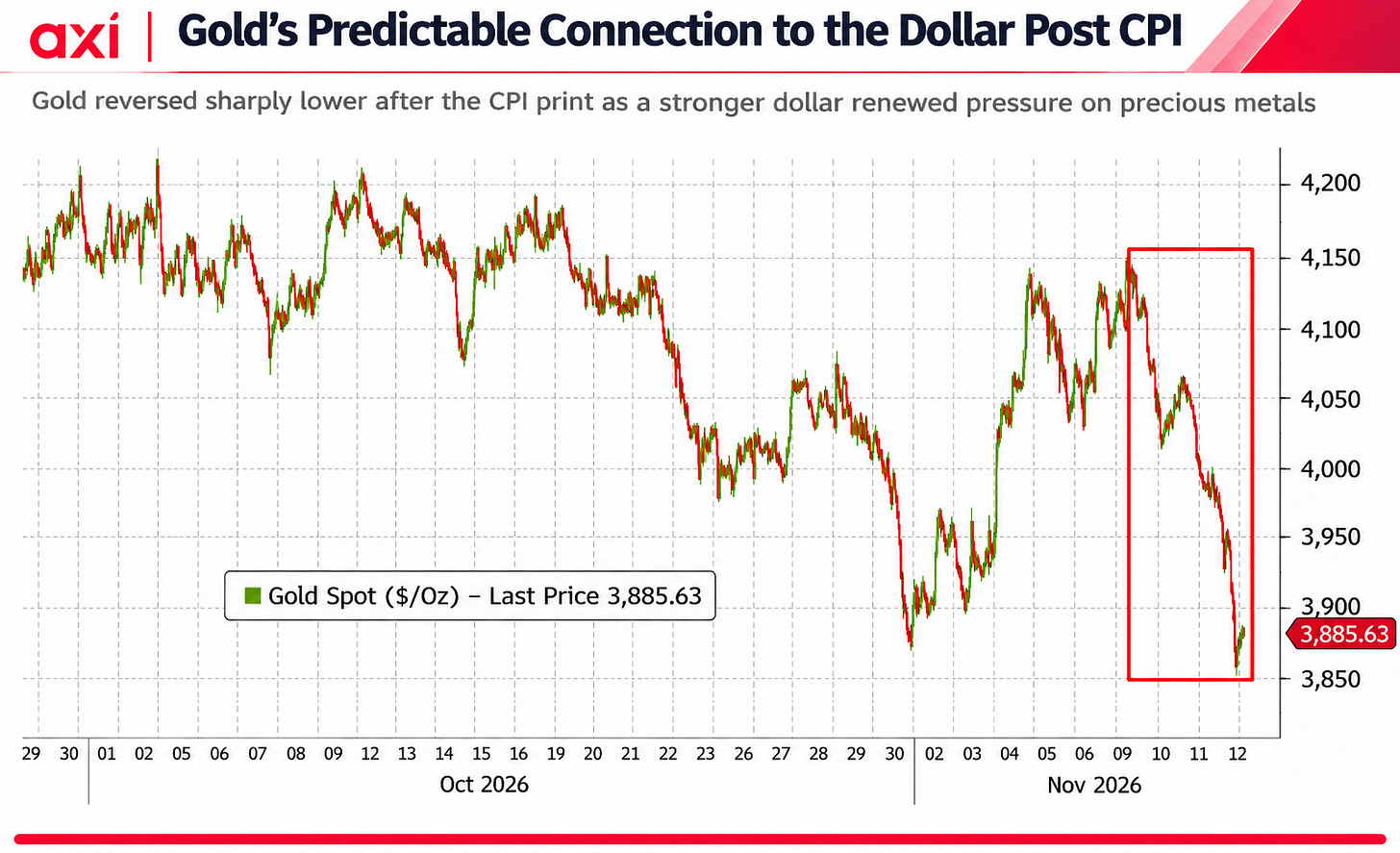
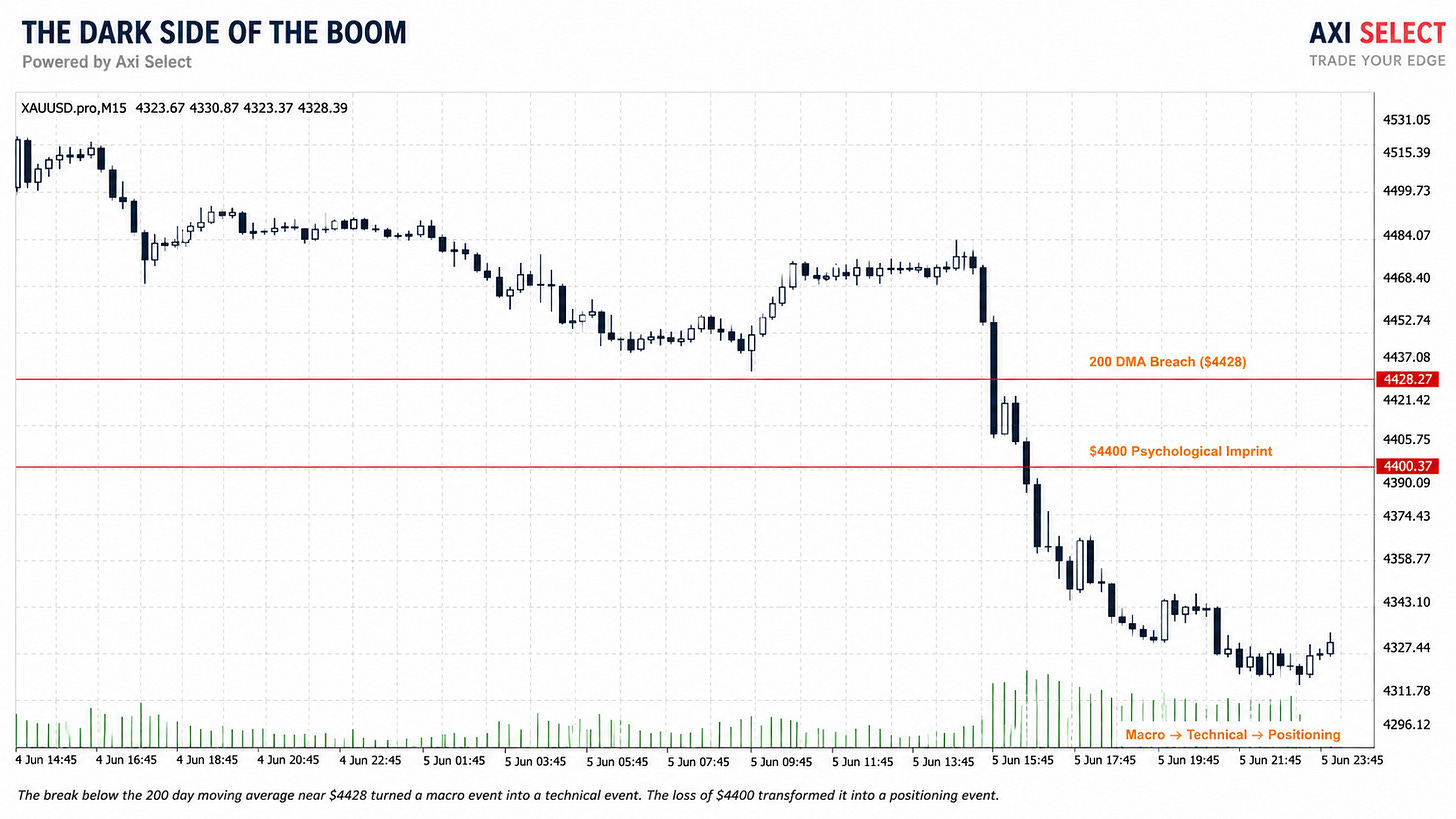
The dollar continued strengthening as US interest-rate expectations moved higher, while gold was knocked back under the weight of rising real yields and an increasingly expensive greenback. Bitcoin (BTC.X) fared little better, sliding to its lowest level since August as investors reduced exposure to speculative assets.
Gold’s $4,000 Moment: The Bulls Are Running Out of Friends
Slippery Banana Peels Everywhere
There was an almost comical contrast between the two halves of the market.
Equity investors were debating whether Jensen Huang’s departure created an opportunity to buy rival chipmakers, while bond traders were staring at sticky inflation, higher oil prices and another potentially accelerated Fed tightening cycle.
Different trading floors, entirely different headaches.
But make no mistake, if real yields keep climbing, those conversations will eventually meet. And when they do, the equity market may discover that an extraordinary AI earnings story doesn’t grant permanent immunity from the arithmetic of higher discount rates.
Stirred, Not Shaken — But the Cost of Admission Keeps Rising
Thursday provided a useful stress test of the broader equity market.
The most influential figure in the AI industry departed under extraordinary circumstances, Nvidia suffered another sharp decline, crude oil rallied, Treasury yields surged, and the dollar extended its advance. Yet the Nasdaq recovered most of its early losses, while the S&P 500 finished down only around 0.4%.
That’s not the price action I’d normally associate with a market preparing to abandon its central investment theme.
The AI spending cycle remains intact, the hyperscalers still need enormous quantities of computing power, and investors are discovering opportunities beyond Nvidia’s increasingly complicated corporate story. The fact that AMD and Broadcom could attract money while Nvidia was being sold tells us considerably more about the durability of the trade than another reassuring appearance on business television.
I’d still file the index response under stirred but not shaken.
But the headline resilience shouldn’t obscure what’s happening underneath. Smaller companies and leveraged infrastructure operators are taking considerably more punishment, semiconductor investors are confronting meaningful overhead supply, and the macro backdrop is becoming less accommodating by the day.
The hyperscalers have demonstrated an impressive ability to withstand higher interest rates, largely because their enormous cash flows allow them to fund ambitious capital expenditure programmes without depending entirely on creditors. The same cannot be said for every company collecting those infrastructure cheques.
And with the Fed increasingly inclined to tighten rather than provide an easy-money backstop, the next phase of the AI boom may demand considerably more financial discipline than the previous one.
The most immediate question isn’t whether Nvidia can keep selling GPUs without Jensen Huang. The company’s technology, customer base and extraordinary commercial momentum suggest it can, provided the leadership transition doesn’t become an exercise in corporate self-destruction.
The bigger question is whether Wall Street can continue paying premium valuations for the broader AI ecosystem when real yields are climbing, the dollar is strengthening and oil is threatening to put inflation back in the driver’s seat.
Nvidia has lost its king, but the AI casino is still open and the customers are finding new tables. The problem is that the Fed keeps raising the price of admission while oil threatens to send the electricity bill through the roof.
For now, the market has absorbed the leadership shock remarkably well. But I’d keep one eye on the next Nvidia headline and the other firmly on oil and real yields. The former may dictate who gets the crown. The latter could decide how much the entire kingdom is worth.

Comments
Log in or sign up to join the conversation.