

Although late to the game of quantitative easing, the Bank of Canada (BoC) is undertaking a full-court press as it expands its balance sheet. Other central banks have and continue to conduct very aggressive strategies in buying government debt, investment-grade bonds, mortgage-backed securities, and most recently, sub-investment grade debt. Until the advent of the COVID-19 induced economic collapse, the BoC has not felt the need for such direct involvement in the financial markets. Now it has expanded its involvement in the financial markets in the most aggressive fashion as the balance sheet has swelled three-fold since March (figure 1).
(Click on image to enlarge)
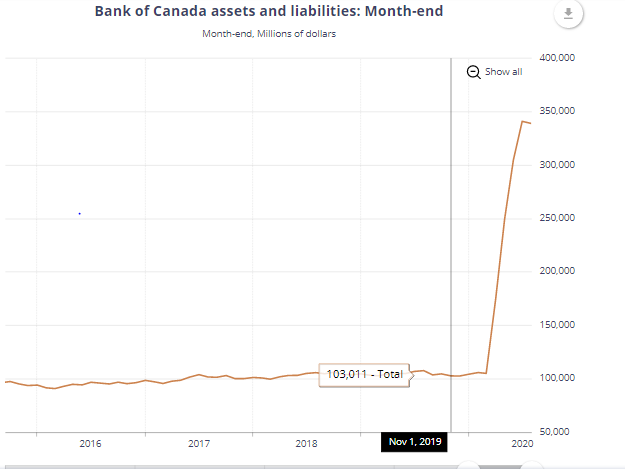
Figure 1
The BoC's largest purchases are dominated by the Canadian government bonds along with a very nascent involvement in purchases of MBSs and selective corporate debt. (In relative terms, Canada has a very small MBS and corporate bond market, especially compared to the United States.)In its most recent policy statement, the BoC re-iterated that its QE program will continue until the recovery is well underway with no specific time horizon.
In sum, its QE program is going to be a permanent feature of bank policy for a very long time. Although the Canadian economy has experienced a bounce up from the horrendous first quarter of 2020, the BoC is taking a very realistic approach when it states that “despite these positive signs, we expect a slow and choppy recovery”. Business confidence and investment have sunk, and there is much uncertainty about the course of recovery. The BoC states that “such conditions reinforce the need for a sustained policy of government purchases to support low-interest rates for several years” Like the Federal Reserve, the BoC does not have any rate increases on the horizon.
(Click on image to enlarge)
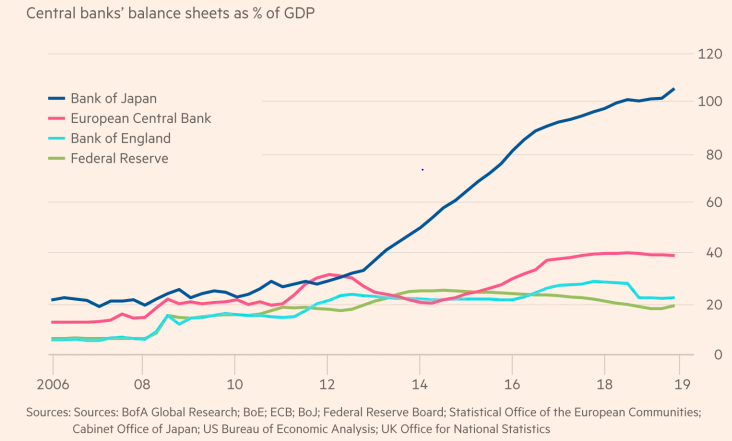
Figure 2
The BoC purchases are approximately 20% of Canadian GDP. By comparison, the Bank of Japan’s balance sheet equals 100% of GDP, the European Central Bank, 40%, and the Federal Reserve and the Bank of England, 20% each. This is by no means the end of central bank expansion. Forecasters in the US anticipate that the Fed balance sheet will approach 50% by 2020 year-end. Neither the ECB nor the BoJ have indicated any slowdown in the expansion of their respective balance sheets. The BoC has joined the crowd that will “do whatever it takes” to restore economic growth.



Comments
Log in or sign up to join the conversation.