

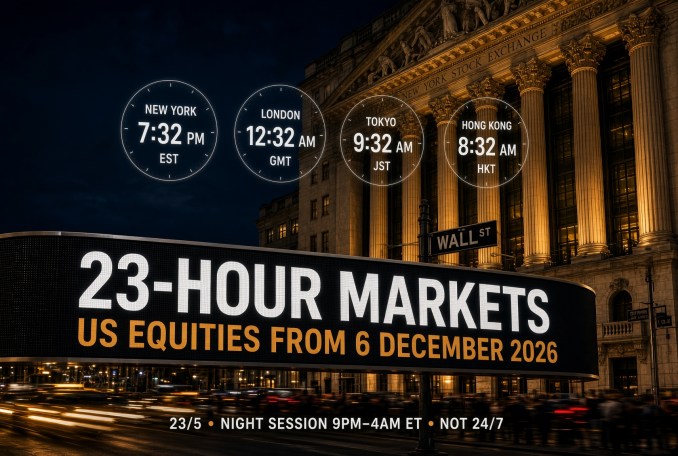
On Sunday 6 December 2026, the US equity tape will stop looking like a 9:30 am–4:00 pm club with a couple of extra rooms attached. From that evening, the Securities Information Processors will run almost around the clock on weekdays. Trading will begin at 9:00 pm ET on Sunday and continue, with a single one-hour pause each night, until 8:00 pm ET on Friday. That is the official start of exchange-level 23/5 trading. It is not 24/7. Weekends stay closed. A nightly maintenance window still exists. But it is the biggest change to the US cash equity calendar in a generation, and it will rearrange how price discovery, risk and access work.
What the new day actually looks like: 23-hour market
Think of four blocks rather than one “market” and two “extended” sessions.
Night session: 9:00 pm–4:00 am ET. This is the new piece. It is designed for Asia and early Europe.
Existing pre-market: roughly 4:00 am–9:30 am ET. This stays.
Regular hours: 9:30 am–4:00 pm ET. Unchanged in structure, still the liquidity centre of gravity.
Existing after-hours: 4:00 pm–8:00 pm ET. Still there, then the 8:00–9:00 pm pause.
So yes, there will still be a “pre-market.” It does not disappear. What changes is that pre-market will no longer be the first place news can trade after the US close. By 4:00 am, Asia will already have had a full session in US names. The old idea that “nothing happens until pre-market” is finished. Trade dates also shift to a futures-style convention. Activity from 9:00 pm Sunday belongs to Monday’s session. Prints between 9:00 pm and midnight count on the next calendar date for volume and stats. That sounds technical. It matters for settlement, corporate actions and anyone who still thinks in “today’s close.”Limit-up/limit-down is being extended into the overnight window. That is a genuine improvement on today’s ATS overnight market, which has often run with weaker protections.
Will every broker offer it: 23-hour market?
No. Exchanges will list the hours. Brokers decide whether to open them to clients, which symbols they allow, which order types work, and whether they staff overnight risk and support. Today a split already exists. Interactive Brokers, Charles Schwab (SCHW) (thinkorswim), Robinhood (HOOD) and Firstrade already give retail overnight access on hundreds to thousands of names via ATSs such as Blue Ocean. Fidelity and E*TRADE have been slower on true overnight. After December, the same pattern will repeat at exchange level: some platforms will route into the new night session from day one; others will wait, restrict it to active traders, or offer only a subset of S&P 500 / Nasdaq (NDAQ)-100 names. Clearing firms also have a veto. Some broker-dealers will need extra approval to participate. Retail should assume “the market is open” does not mean “my app is open for every stock at 2:00 am.”
The real risk: thin books, wide spreads, fake liquidity
This is the part that matters more than the timetable. Even now, after years of broker overnight products, extended-hours trading in NMS stocks is still a tiny slice of total volume — well under 1% on the ATS overnight venues and heavily concentrated in mega-caps and a handful of news names. Pre-market and after-hours together have grown, but they are still a fraction of the regular session, and the overnight slice within that is even thinner.
December does not magically create depth. It creates a public, consolidated tape in hours that used to be dark or fragmented. That is better for transparency. It does not guarantee two-sided markets in mid-caps, small-caps or most ETFs at 11:30pm.What retail will meet in the first months:
Wide spreads. A stock that is a penny wide at 11:00 am can be 20–50 cents wide at 1:00 am.
Gap risk. A headline in Tokyo or a tweet at midnight can move a name 3–5% on a few thousand shares.
Partial fills and no size. Marketable orders will walk the book.
Session confusion. An order marked for “extended” may or may not work across night, pre-market and regular hours depending on the broker.
Stop orders that do not behave as people expect. Many overnight venues have historically limited or banned stops.
The danger is not that 23/5 exists. The danger is treating a 23-hour tape like a 6.5-hour tape. People who size positions as if the open is always a few hours away will get hurt. There is also operational risk. Corporate actions, halt logic, erroneous prints and systems that were built for a US workday now have to survive a Sunday-night Asia open. The 8:00–9:00 pm pause exists because the industry still needs a reset. That pause will itself become a focal point for positioning.
The opportunity
The bull case is straightforward.US equities are a global product. Foreign holdings are enormous. Asia and Europe have been trading the economic exposure through ADRs, futures, CFDs and tokenised lookalikes because the cash market was asleep. A real exchange session in their morning is a competitive response to that leakage. For traders, the opportunities are:
Reacting to non-US news in the actual listing, not a derivative.
Earnings and M&A that break after the US close no longer wait until 4:00 am or 9:30 am.
Cross-asset hedging against FX, rates and crypto that already trade overnight.
A cleaner official print instead of a patchwork of ATS dark prints.
Over time, if market makers and banks put capital on the night book, spreads should compress in the most liquid names first — the same pattern we saw when after-hours grew up. Mega-caps and the big ETFs will get a usable overnight market. Everything else will lag.The US franchise also offers a structural opportunity. If the listing venue is open when the world is awake, more price discovery stays on-exchange and on-tape instead of migrating to London, crypto rails or tokenised copies. That is why Nasdaq and NYSE are doing this, and why the SEC is treating 23/5 as a stepping stone rather than the end state.
How institutions will actually behave
Do not expect the buy-side to flood the night session on 7 December. Most large asset managers have no mandate to trade thin books for a few basis points. Fiduciary language still cares about best execution. Overnight spreads will often fail that test. Many shops will treat the night session as a risk window to monitor, not a venue to work a 2% portfolio rebalance. What will show up first:
Market makers and high-frequency firms that already warehouse overnight risk in futures and ETFs.
Banks covering Asia client flow.
Hedge funds that live on event risk and can size small.
Index and ETF desks that must keep creation/redemption and hedge ratios from drifting while Asia trades.
Staffing is the hidden constraint. A 23-hour cash market means operations, compliance, risk and surveillance cannot go home at 5:30 pm. Some firms will rotate desks through London and Hong Kong. Some will simply not participate until volume justifies the cost. That is why early volume will stay concentrated: the people with 24-hour infrastructure already have it; everyone else will wait.
In the longer term, institutions will be pulled in whether they like it or not. If a stock gaps 4% in Tokyo hours and the official tape now prints that move, the 9:30 am open is no longer the first fair price. Benchmarks, NAV calculations and “we don’t trade overnight” policies will come under pressure. One comment at the SEC roundtable put it cleanly: at some point, choosing not to trade overnight may stop being an acceptable fiduciary default if the liquidity is there and the client is harmed by delay.
Retail gift or institutional feast?
Both, in different ways — and not equally at the start. Retail already forced this. Robinhood’s 2023 overnight product, then Schwab, IBKR and others, proved there was demand. Exchanges are now catching up, so flow doesn’t live forever on ATSs. For a retail trader in California, London or Singapore who wants to act on a headline without waiting, December is a real upgrade: better tape, better protections, more symbols over time. The catch is skill and tools. Overnight is a professional microstructure game. Spreads, queue priority and inventory risk favour firms that quote two-sided markets for a living. Retail market orders in a 400-share book are food. Limit orders, smaller size, and the discipline to stand down when the book is empty are the only defences.
The “big boys” win the infrastructure war. They can internalise, warehouse, hedge in futures and options, and decide when to show size. They also win if 23/5 eventually becomes 24/7 and tokenised or on-chain venues start competing for the same shares — NYSE is already talking about a separate 24/7 tokenised book. Retail gets access. Institutions get the plumbing and the optionality. So the honest ranking for the first year is:
Global retail who already trade events and can use limits.
Market makers and multi-asset desks.
US retail who treat overnight like regular hours.
Traditional long-only institutions, who will arrive last and only in size when the books thicken.
What to watch after 6 December
Night-session share of total volume in SPY, QQQ, AAPL, NVDA, TSLA. If it stays tiny, the session is a convenience product. If it climbs, the open will change.
Spread widening versus regular hours in names outside the top 50.
Which brokers actually turn the session on for ordinary accounts, and with which order types.
Whether the 8:00–9:00 pm pause becomes a volatility event of its own.
How quickly LULD and halt procedures get tested by a real overnight shock.
The SEC’s next step toward true 24/7. December is the dress rehearsal.
Bottom line
6 December 2026 does not turn Wall Street into Binance. It turns the cash equity market into something closer to the FX and futures world: almost always on during the week, still closed at the weekend, still with a daily reset, and still with most of the real liquidity packed into the old New York afternoon. Pre-market survives. Not every broker will offer the new hours. Thin volume is the central risk. The opportunity is global access and faster reaction to news. Institutions will watch first, then trade. Retail gets the door opened; the people who already run 24-hour books get the better prices. Treat it as a new session with its own rules, not as “the market, but longer.” That is the difference between using the change and being used by it.



Comments
Log in or sign up to join the conversation.