

The Art of the Wait: Why Aurora Innovation (AUR) Demands Patience at a 4-Year Crossroads
As traders, patience is the rarest commodity. We love action, often chasing immediate breakouts without using multiple timeframes. But if we look at the markets through the lens of Volume Price Analysis (VPA) and structural chart history, the most profitable skill we can develop isn’t knowing when to pull the trigger—it is knowing when to sit on our hands. Right now, Aurora Innovation, Inc. (Nasdaq: AUR) is presenting market participants with a textbook masterclass in the art of the wait.
After a massive structural journey over the last four years, the autonomous trucking pioneer has reached a definitive, high-stakes inflexion point. While the company’s long-term macro fundamentals continue to generate massive buzz, a close look at the weekly price-and-volume relationship tells a cautionary story. The chart signals a structural anomaly that demands absolute patience—a discipline we, as traders, can struggle to maintain.
The Structural Blueprint: A 4-Year S/R Flip Zone
To understand why the current price action is so critical, we have to zoom out to the weekly macro framework and look at the chart’s historical anatomy. The stock market has a memory, and major institutional battlegrounds leave footprints that remain relevant for years.
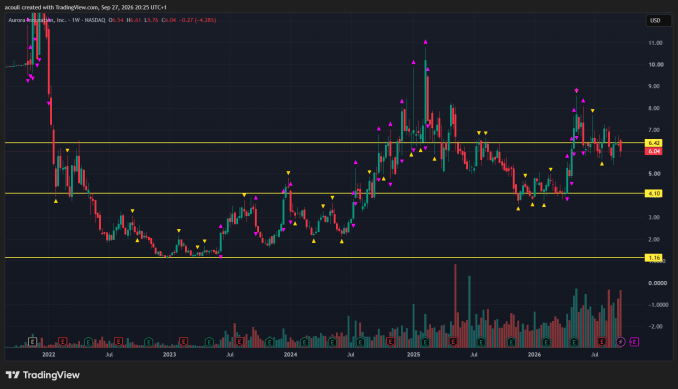
For Aurora Innovation, that master pivot line sits right around $6.42.
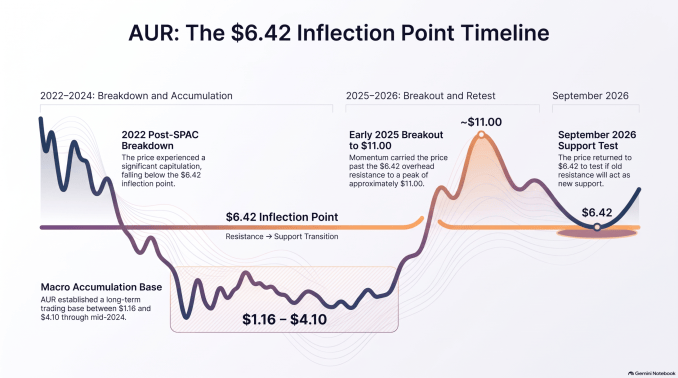
Looking back to the post-IPO and SPAC capitulation phase of early 2022, the stock fell to a low of $4.10, then consolidated and traded sideways between that level and a high of $6.42. The failure to break this high resulted in a retest of the $4.10 support. Failure to hold this floor led Aurora to break through and plunge into a deep two-year accumulation phase, with price bouncing between $1.16 and $4.10.
When the stock finally began its macro markup phase out of that multi-year base in late 2024, the $6.42 level once again came into play, acting as a rigid ceiling of overhead resistance for months. It required immense institutional effort to finally clear that barrier before making a highly volatile run toward the $11.00 peak.
Today, the cycle has come full circle. Aurora has pulled back sharply and is now trading at $6.04, sitting right in the pocket of this historical pivot. In classic technical analysis, old resistance should become new support. However, VPA dictates that a level is only as good as the volume validating it.
The Core VPA Problem: Falling Volume on Green Candles
This is where the thesis gets interesting—and where eager bulls need to exercise extreme caution.
When evaluating the recent cluster of weekly candles bouncing around this $6.42 pivot zone, we notice a massive influx of trading volume entering the stock over the summer months. On the surface, heavy volume is exactly what you want to see when a stock is trying to establish a macro floor. It indicates that the asset is liquid, active, and drawing eyes.
However, applying Richard Wyckoff’s core principle of Effort vs Result reveals a serious structural divergence: recent upward price moves on green weekly candles have occurred on steadily declining volume.
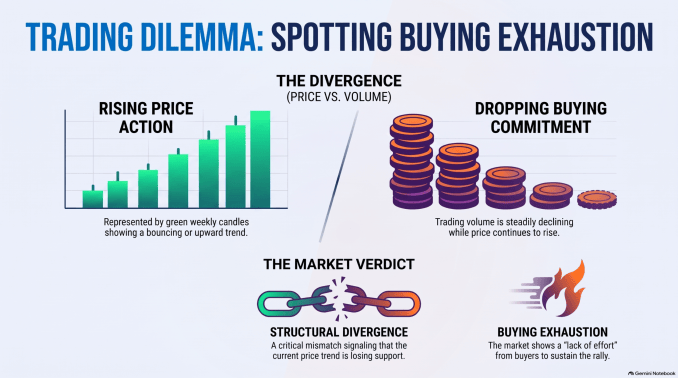
In a healthy institutional campaign, a genuine re-accumulation breakout must be accompanied by expanding volume on up-days and up-weeks. Rising volume on green candles proves that “smart money” is aggressively chasing prices, absorbing overhead supply, and actively driving the market higher. It shows true commitment.
When the price drifts upward or bounces on falling volume, the internal mechanics tell a completely opposite story. It reveals a distinct lack of buying enthusiasm. The price isn’t rising because institutions are aggressively accumulating shares at these levels; it is rising simply because it is a vacuum move, not a power move.
In VPA terms, this is a clear signature of buying exhaustion. Rallies that lack institutional effort are structurally weak, hollow, and highly susceptible to sharp reversals the moment a fresh wave of supply hits the open market.
The Tactical Game Plan: Sitting on Your Hands
Because eager traders are hardwired to look for immediate action, many will see a green weekly bounce off a historical level and immediately chase the position, terrified of missing the next leg up. But given the current volume divergence, chasing these bounces is a low-probability trap. Instead, the current technical picture demands a highly disciplined strategy divided into two patient scenarios:
Scenario A: The Ultimate Retest of the Macro Base
Because the low-volume green candles demonstrate a lack of institutional commitment to hold the current line, the market will likely feel the structural need to test deeper demand pools below. Eager investors should step aside and let the price drift.
The ultimate, ironclad structural support sits lower down, toward the $4.10 macro base ceiling—the top of the original two-year accumulation zone. If Aurora drifts back to this lower platform and prints a dramatic buying climax on massive volume that immediately reverses, or conversely, hits that shelf on completely dried-up, non-existent volume, it will offer an incredibly safe, low-risk, and structurally sound entry point.
Scenario B: Waiting for the True Volume Confirmation
If the bulls are truly going to defend the $6.42 pivot and launch higher from here, they must prove it with volume. Eager traders should avoid buying a weak rally into the $6.15–$6.30 pocket.
Instead, wait for the market to print a definitive Volume Signature. The trigger to watch is a strong daily or weekly close decisively above the $6.42–$6.50 resistance cluster on a massive, undeniable volume expansion on above average. That volume surge is the literal signature of smart money stepping back to move Aurora higher and start a new campaign.
Conclusion: Patience is the Ultimate Edge
Aurora Innovation is sitting at a multi-year crossroads. The long-term narrative for autonomous trucking is compelling, but the tape suggests institutions are playing chess, not checkers. They are letting retail traders fight it out over minor price ticks while the volume dries up.
For retail traders, the hardest trade to execute right now is no trade at all. But in a market landscape characterised by low-volume rallies and heavy historical overhead resistance, patience is your ultimate edge. Let the market show its hand. Let the volume confirm the move. Until insiders reveal their hand, the smartest move is to watch, wait, and let the market come to you.



Comments
Log in or sign up to join the conversation.