

✨ Takeaways by Dark Side of the Boom
• Equity markets remain focused on AI-driven earnings growth, while energy markets remain focused on physical supply risk.
• The existence of negotiations is currently more important than the outcome because investors are pricing a pathway to peace.
• Oil traders understand that infrastructure damage and supply disruptions can outlast any ceasefire announcement.
• Internal political strains inside Iran may be growing, but pressure does not necessarily translate into capitulation.
• The greatest market risk may be complacency as investors increasingly price the ending before the story has fully unfolded.
Stocks Keep Buying the Future
Global markets are beginning the week with the calm confidence of a ship captain staring at dark clouds on the horizon while still keeping full sail. Oil is higher, the dollar is a touch firmer, and geopolitical headlines remain as tangled as ever, yet equities continue to trade as though the destination is already visible. Global stocks remain near record highs, with South Korea, sitting at the crossroads of the semiconductor supply chain that powers the AI revolution, surging 2.5%, while Nasdaq 100 futures gained 0.4% after Wall Street benchmarks closed at fresh records on Friday. Investors continue to embrace the AI boom while assigning a higher probability to an eventual agreement between Washington and Tehran. The reason is simple. Artificial intelligence remains the dominant engine of market psychology, and as long as Washington and Tehran continue to exchange draft proposals rather than missiles, investors appear willing to give diplomacy the benefit of the doubt. Markets do not require certainty. They require a pathway. Right now, however narrow or fragile, negotiations to extend the ceasefire and reopen the Strait of Hormuz still represent a pathway.
Yet beneath the market’s calm exterior sits an uncomfortable contradiction. Brent crude opened nearly 2% higher despite equity markets largely looking through a weekend filled with seemingly escalatory headlines. The oil market remains focused on physical risk, while the stock market focuses on future earnings. They are watching the same movie through entirely different lenses. Crude traders see a region where a U.S. airbase in Kuwait was attacked, where American personnel were injured by falling debris from intercepted missiles, where Israeli operations continue to expand in Lebanon, and where the security architecture of the Gulf remains under strain. Equity traders, meanwhile, see something else entirely. They see negotiators still passing documents back and forth. They see no collapse in talks. They see no closure of Hormuz. Most importantly, they see no interruption to the AI investment cycle that continues to dominate earnings expectations and capital flows.
The result is a growing divergence in how markets are processing risk. Oil remains suspended between fear and relief, constantly repricing every headline that threatens physical supply. Equities remain caught between momentum and complacency, increasingly willing to assume that diplomacy will eventually solve problems that energy traders know can linger long after the shooting stops. One market is trading today’s risks while the other is trading tomorrow’s possibilities.
The latest reports suggest Washington has toughened the terms of a potential agreement after Tehran refused to compromise on the issue of its remaining nuclear material. President Donald Trump appears increasingly unwilling to repeat what he views as the mistakes of previous agreements, particularly regarding unfrozen Iranian funds. The negotiations now resemble a high stakes poker game in which both players continue adding chips to the table while insisting they are prepared to walk away. The challenge for markets is that nobody truly knows whether the negotiators are erasing red lines or simply redrawing them. The existence of negotiations matters more than their content because the market is currently pricing probability rather than certainty.
What makes the situation even more intriguing is the growing evidence of internal stress within Iran itself. Reports that President Masoud Pezeshkian has offered his resignation after allegedly being marginalized from major decision-making add another layer of uncertainty to an already opaque political landscape. Whether those reports prove significant or not, they reinforce the broader perception that power inside Iran may be becoming increasingly fragmented just as negotiations enter a critical stage. President Donald Trump has repeatedly described the regime as fractured, and the latest developments will only reinforce that perception among Western policymakers.
Yet traders should be careful not to confuse internal pressure with imminent capitulation. History teaches that governments under pressure often become less predictable rather than more accommodating. Tehran continues to insist that it will not surrender control over its highly enriched uranium and continues to reject what it views as externally imposed conditions. Publicly, Iranian officials maintain that ongoing discussions remain speculative until a formal agreement is reached. That leaves markets in an uncomfortable middle ground where optimism and uncertainty coexist.
Meanwhile, the economic pressure campaign continues to tighten. Treasury Secretary Scott Bessent’s weekend comments offered perhaps the clearest glimpse into Washington’s strategy. Financial restrictions, frozen accounts, disrupted shipping routes, and pressure on Iran’s export infrastructure are all designed to squeeze the regime’s economic breathing room. The significance of these measures extends far beyond politics. Energy traders understand that prolonged disruptions to export facilities create consequences that cannot simply be reversed overnight. Wells shut down under pressure do not instantly return to full production. Shipping networks disrupted by conflict do not magically resume normal operations.
The physical oil market moves at the speed of infrastructure rebuilding, while financial markets move at the lightning speed of AI expectations.
That distinction may ultimately become one of the most important themes of the summer. Equity investors are increasingly pricing the end of the conflict. The oil market is still wrestling with the plumbing left behind after the shooting stops. Peace can be announced with a signature. Supply chains require months to heal. Tankers must return. Insurance markets must normalize. Inventories must be rebuilt. Production systems must stabilize. Financial markets can reprice risk in minutes. Physical energy markets operate on a far slower clock.
Israel’s expanding operations in Lebanon further complicate the picture. The occupation of Beaufort Castle and the subsequent expansion of military activity illustrate that while one front may be moving toward diplomacy, another remains active. Geopolitical risk rarely disappears. More often it migrates. As with squeezing one end of a balloon, pressure relieved in one location often resurfaces elsewhere.
For now, however, none of this appears capable of dislodging the market’s primary obsession. Artificial intelligence remains the gravitational center of global risk appetite. It is the giant locomotive pulling the broader equity market uphill. Every geopolitical headline is being weighed against a much larger narrative centred on productivity gains, infrastructure spending, data center investment, and future earnings growth. As long as that engine remains intact, investors appear willing to look through an extraordinary amount of uncertainty.
That does not mean risks have disappeared. It simply means they are being discounted differently. Markets are acting like a theatre audience, focused on the final scene, while geopolitical events continue to unfold backstage. The danger is not necessarily that negotiations fail tomorrow. The danger is that investors become so convinced of the ending that they stop paying attention to the plot twists still unfolding along the way.
The week ahead may therefore be less about whether a deal is signed and more about whether the flow of headlines continues moving in the right direction. For now, drafts are still being exchanged, diplomats are still talking, and the Strait of Hormuz remains open. In a market dominated by AI enthusiasm and record equity highs, that appears to be enough.
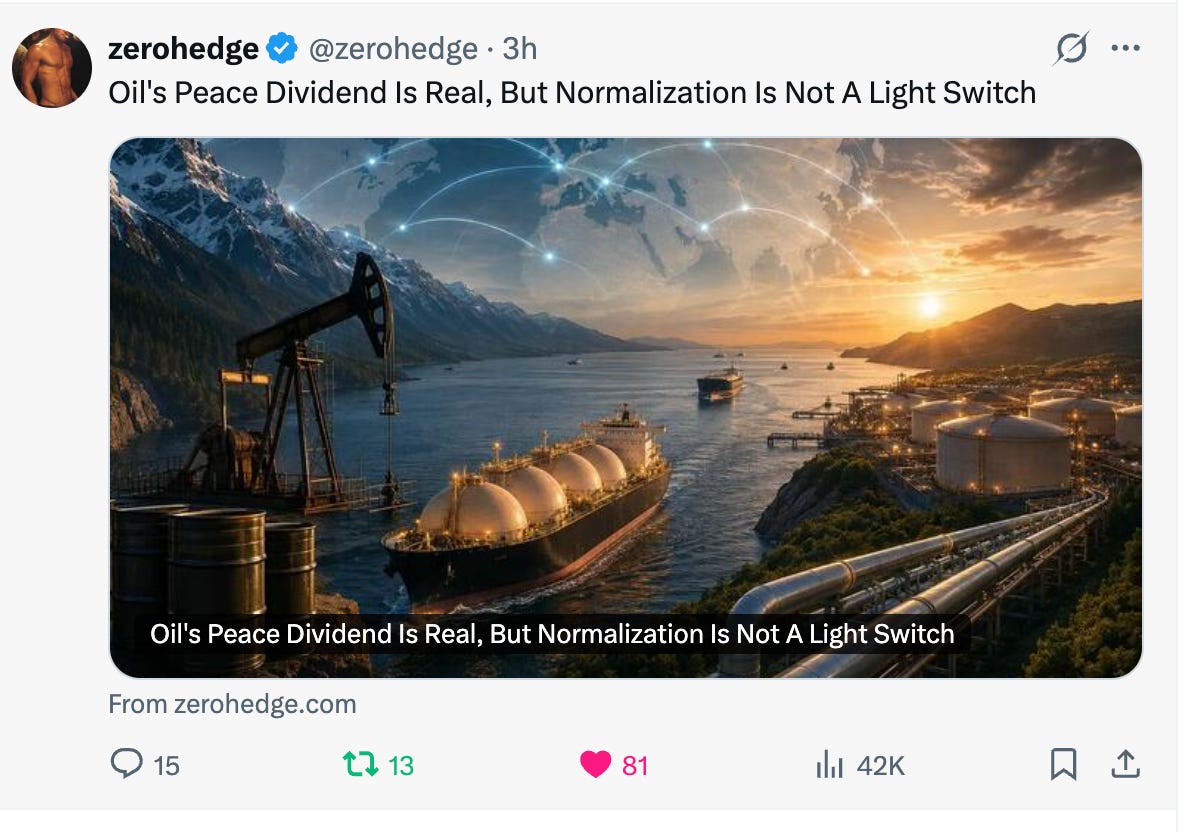
Oil’s Peace Dividend Is Real, But Normalization Is Not a Light Switch 👇
Published on @zerohedge , one of X’s best independent news and market intelligence sources
Just a reminder: you can trade AI proxies WTI or Brent with our partner, Axi.com or Axi Select.
Click the banner to create a trading account and support The Dark Side of the Boom 💥. ( or click here )

What We Know So Far About the Reported US–Iran Memorandum of Understanding
While markets continue to trade increasingly as though the war is moving toward its final chapter, it is important to separate confirmed facts from emerging reports. According to Al Jazeera, citing Axios and officials familiar with the negotiations, the United States and Iran have reached a preliminary memorandum of understanding that would extend the current ceasefire for another 60 days and establish a framework for broader peace negotiations. However, as of now, neither Washington nor Tehran has formally confirmed the agreement, and Iranian officials have indicated that the text has not yet been finalized.
If the reported framework ultimately receives approval, the most important development for markets would be the reopening of the Strait of Hormuz. Reports suggest the agreement would guarantee unrestricted commercial shipping through the waterway, eliminate transit tolls, and require Iran to remove maritime mines over a 30-day period. In return, the United States would gradually lift its naval blockade on Iranian ports and begin easing certain sanctions, allowing Iran to resume oil exports more freely. For energy traders, this is the centrepiece of the entire discussion because Hormuz remains the single most important chokepoint in the global oil system. Roughly one-fifth of global oil and LNG flows pass through the corridor during normal conditions.
The second major pillar reportedly centers on Iran’s nuclear program. According to the reports, Iran would commit not to pursue nuclear weapons while negotiations focus on the future of its enriched uranium stockpile. This remains one of the most difficult issues because Tehran has historically resisted transferring enriched uranium outside the country, while Washington has pushed for stronger safeguards and verification mechanisms. Exactly how that gap is bridged could determine whether a temporary ceasefire evolves into a durable settlement.
The framework is also said to include provisions for humanitarian assistance, discussions surrounding sanctions relief, and the possible unfreezing of Iranian assets held abroad. For Iran’s economy, which has been operating under decades of sanctions pressure, these measures could represent a meaningful economic lifeline if negotiations progress.
Another potentially significant element involves Lebanon. Reports indicate the agreement could include efforts to wind down hostilities involving Hezbollah and reduce military activity along the Israeli-Lebanese front. While details remain sparse, any broad regional de-escalation would likely reinforce the market narrative that the Middle East risk premium is beginning to fade.
From a market perspective, investors appear increasingly willing to price the possibility of peace before the paperwork is signed. Oil has already surrendered a substantial portion of its wartime risk premium, volatility has eased, and risk assets are behaving as though the probability of a prolonged disruption is falling. Whether that optimism proves justified will depend on what happens next. The reported MOU is not a peace treaty. At best, it is a framework designed to buy 60 days of negotiating time. The real test will come when both sides move from discussing ceasefires to tackling the far more difficult issues of nuclear enrichment, sanctions relief, regional security arrangements, and the future balance of power in the Gulf.
For now, what we know is simple: serious negotiations appear to be underway, markets are increasingly leaning toward a peaceful outcome, and the direction of travel is encouraging. What we do not yet know is whether the political leadership on either side is prepared to make the concessions required to turn a temporary pause into a lasting peace.
Gold’s Weak Hands Dumped, But the Strong Hands Never Left 👇
Published on Ross Nomans Metals Daily, one of the best sources for gold news and precious metals trading insights
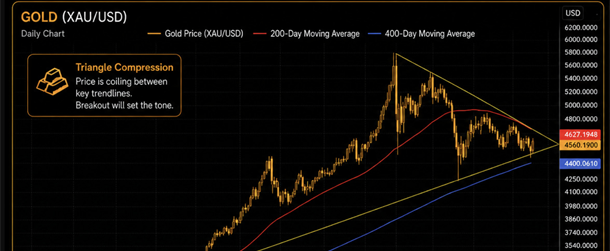
Test the waters by trading gold at sub-9 cents with your choice of maximum leverage: 500? 1000? On one of Axi's platforms, then take the next step toward a fully funded trading account with Axi Select.
Click the banner to create a trading account and support The Dark Side of the Boom 💥. ( or click here )


Comments
Log in or sign up to join the conversation.