

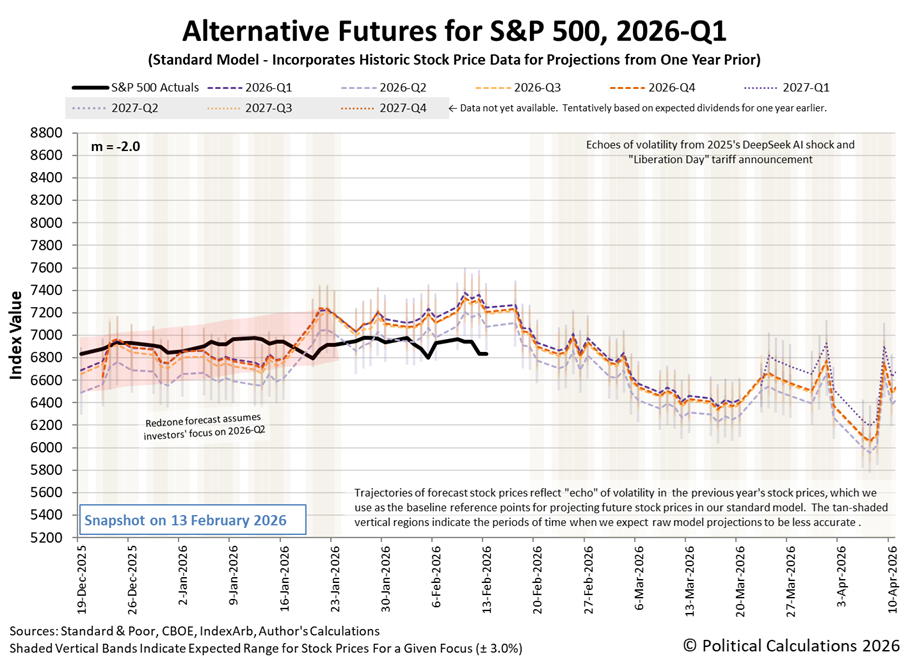
Despite ongoing carnage affecting companies with exposure to AI technology development costs, the S&P 500 (Index: SPX) managed to eke out a small gain in the trading week ending on Friday, 13 February 2026. The index closed out the week at 6,836.17, down 96.13 points or 1.39% from the preceding week.
But the market wasn't down evenly among all stocks. Stocks for firms either making big investments in building out their AI-technology infrastructure saw big declines, joined by firms either financing them or at risk of having their businesses disrupted by the implementation of AI technologies.
Meanwhile, firms without that kind of exposure gained, as investors rotated their holdings into small cap and value stocks. If it weren't for that rotation, the index would have fallen further.
Together, these factors put the trajectory of the S&P 500 at the lower end of the range it would be expected to be for investors focusing on the upcoming future quarter of 2026-Q2. The latest update of the alternative futures chart shows the effect of investors moving away from the big cap tech stocks that have dominated the S&P 500 in the last few years.
The market moving headlines capture some of the rolling whackage, to coin a phrase, afflicting the stocks of companies with high AI exposure risks.
Monday, 9 February 2026
Signs and portents for the U.S. economy:
Fed minions not worrying about dollar, U.S. Treasury Secretary not worrying about Fed's balance sheet:
Bigger stimulus developing in China:
Growth signs developing in Japan:
ECB minions sees potential growth opportunity for themselves:
Wall Street advances as tech bounces further off of recent losses
Tuesday, 10 February 2026
Signs and portents for the U.S. economy:
Fed minions shrug off job hiring data, think their monetary policies are perfectly set:
Bigger trouble, stimulus developing in China:
Stronger yen developing in Japan after elections:
ECB minions worried about tariff inflation in Eurozone, bigger trouble developing in the Eurozone:
S&P 500, Nasdaq end lower after the latest retail sales data
Wednesday, 11 February 2026
Signs and portents for the U.S. economy:
Fed minions expected to hold interest rates steady for now, to finally get around to dealing with troubled banks, not sure productivity will improve enough to lower inflation from the level they haven't admitted they've been targeting:
Bigger trouble, less deflation developing in China:
BOJ minions laying out their plans for interest rate hikes and inflation slows and yen strengthens:
Bigger trouble developing in the Eurozone:
Wall Street ends muted after strong jobs data nibbles at Fed rate cut bet
Thursday, 12 February 2026
Signs and portents for the U.S. economy:
Fed minions expected to deliver rate cuts in mid-year:
China fighting deflation, dealing with trade restrictions and crop shortfalls:
Bigger trouble developing in Japan:
ECB minions gearing up to leave Eurozone interest rates unchanged for longer, ready to grow their bailout business:
Nasdaq ended lower by 2% as Wall Street slid ahead of upcoming inflation data
Friday, 13 February 2026
Signs and portents for the U.S. economy:
Fed minions expected to cut U.S. interest rates in June 2026 after favorable inflation data:
Bigger trouble developing in China:
BOJ minions get better inflation data, still planning to hike Japan's interest rates:
ECB minions say Eurozone minions should have more power over financiers:
The CME Group's FedWatch Tool continued projecting the Fed will keep holding the Federal Funds Rate steady until 17 June (2026-Q2) when it gives an 87% probability of a quarter point rate cut. The tool also continues to anticipate the next quarter point reduction will take place on 16 September (2026-Q3). While these expectations have been stable over the past several weeks, what's new this week is that there is now a greater than even probability of a third rate cut in the offing, coming on 9 December (2026-Q4), thanks to the lower-than-expected inflation reported for January 2026.
The Atlanta Fed's GDPNow toolestimates real GDP growth in the U.S. during 2025-Q4 declined to $3.7% from the +4.2% growth expected in the prior week.
Comments
Log in or sign up to join the conversation.