


The S&P 500 (Index: SPX) fell a little under 0.7% during the trading week ending on Friday, 24 July 2026. The index ended the week at 7,408.70, which is 201.08 points (or 2.6%) below its all time record high of 7,609.78 from 2 June 2026.
The past week didn't see a single catalyst to weigh on stock prices, but rather three of them. Oil prices briefly shot up over $100 per barrel with the Iran war's disruption to oil shipping in the Middle East. The risk of higher inflation prompted the second catalyst of the specter of higher interest rates to rear its ugly head.
But the third catalyst was perhaps the most significant. Outsized capital expenditures by AI tech giants like Alphabet (Nasdaq: GOOGL and GOOG) and speculated for firms like Meta Platforms sent their stock prices sharply lower from where they closed the previous week. That action pulled the S&P 500 lower overall thanks to their outsized shares of the total valuation of all the stocks within the market cap-weighted index.
Overall, the S&P 500's trajectory ticked down to toward the lower end of the redzone forecast range on the latest update of the alternative futures chart.
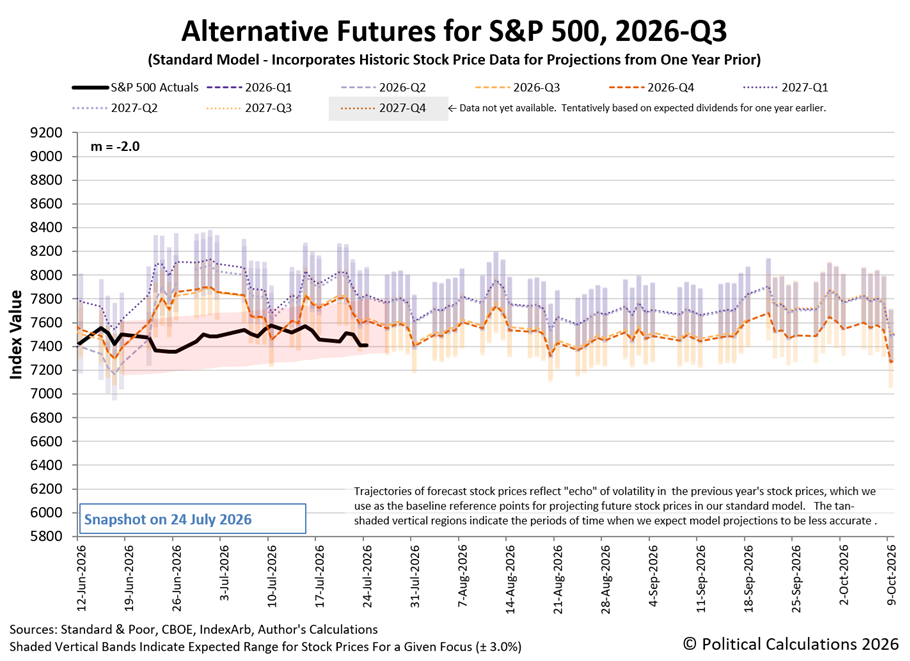
As we're reaching the end of the redzone forecast range, we find the level of the index is consistent with investors fixing their attention on either the current quarter of 2026-Q3 or the more distant future quarter of 2026-Q4. Investors have reason to focus on each of these quarters thanks to their status as quarters in which the Federal Reserve will most likely hike short term interest rates in the U.S. The CME Group (CME)'s FedWatch Tool now projects two quarter point rate hikes in the months ahead. The first would occur after the Fed meets on 16 September (2026-Q3) and the second would take place on 9 December (2026-Q4). The FedWatch tool's projections are biased toward potential additional rate hikes in 2027 with the most likely timing in the first half of the year.
If, when, and by how much the Fed might change interest rates however will be affected by the random onset of new information. Here are the market moving headlines from the trading week ending on Friday, 24 July 2026:
Monday, 20 July 2026
Signs and portents for the U.S. economy:
Bigger bailout developing in China:
ECB minions relieved to see oil price surge isn't causing Eurozone wage growth, but still getting excited to hike interest rates:
Wall Street ends lower as oil prices rise, investors await big tech earnings
Tuesday, 21 July 2026
Signs and portents for the U.S. economy:
Economists think Fed minions won't hike U.S. interest rates in 2026, but think there's a chance they will:
Bigger trouble developing in China:
ECB minions clamp down on Eurozone credit:
Dow gains nearly 400 points; S&P 500 snaps 3-day losing run as chip stocks rise
Wednesday, 22 July 2026
Signs and portents for the U.S. economy:
BOJ minions fear yen's decline will continue, standing by to hike interest rates to prop up Japan's currency:
ECB minions standing by to hike Eurozone interest rates later:
Wall Street ends red as U.S. stocks struggle ahead of Tesla, Alphabet results
Thursday, 23 July 2026
Signs and portents for the U.S. economy:
Fed minions keeping mum, including the hawkish ones who want to hike interest rates:
BOJ minions / Bigger trouble developing in Japan:
ECB minions worrying about rising oil prices again, but strangely choose to leave Eurozone interest rates unchanged if they really believe inflationary shock is coming:
ECB minions also thinking about other things:
U.S. stocks end lower as oil reaches $100/bbl; investors assess tech results
Friday, 24 July 2026
Signs and portents for the U.S. economy:
Fed minions being told by markets how to set interest rates:
BOJ minions live up to expectations as bigger trouble develops in Japan:
ECB minions get data indicating no changes in Eurozone inflation outlook:
S&P 500 posts weekly loss while defensive sectors outperform
The Atlanta Fed's GDPNow tool's estimate of real GDP growth for the U.S. economy in the current quarter of 2026-Q2 was unchanged at +1.7%, with no updates in the past week.
Comments
Log in or sign up to join the conversation.