

South Korea is being tugged in opposing directions: AI-driven growth is gaining traction, while oil shocks are stoking inflation and weighing on domestic activity. Growth should ease in the near term before regaining momentum later in the year. But widening imbalances and energy pressures are set to complicate policymaking.
Exports should serve as a primary growth engine in 2026 and beyond
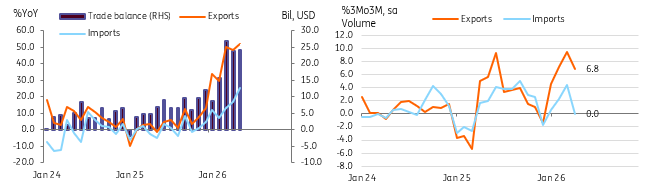
So far, the Middle East conflict has had a limited negative impact on South Korea’s exports, as the AI boom overshadows the energy shock. Although refineries face supply shortages, robust price movements have boosted exports. Korean exports surged by almost 40% year-on-year in the first quarter.
Early export data for May, the third month of the conflict, reveal another remarkable gain. Exports rose 64.8% YoY in the first 20 days of May, indicating that robust export growth continued into the second quarter. Semiconductors (202.1%), petroleum products (46.3%), and computing equipment (305.5%) all surged while auto exports fell by 10.1%. Semiconductors are expected to account for around 40% of total exports in 2026, underscoring their dominance.
Imports also rose quite firmly by 29.3%. Energy (23.9%) and petroleum products (58.6%) rose, reflecting higher energy prices. Meanwhile, capital goods imports also increased, with machinery and chip-making machinery imports rising by 11.9% and 116.2%, respectively. This suggests that, despite heightened uncertainty in the Middle East, businesses are set to increase capex investment. This should lead to a recovery in facility investment in second and third quarter GDP.
In volume terms, both exports and imports are expected to slow in 2Q26 compared with 1Q26, primarily due to a decline in energy trade volumes. As semiconductor exports are expected to remain stable, imports should fall faster than exports. So, net exports will likely continue to contribute positively to growth in 2Q26.
Exports should remain a main growth driver
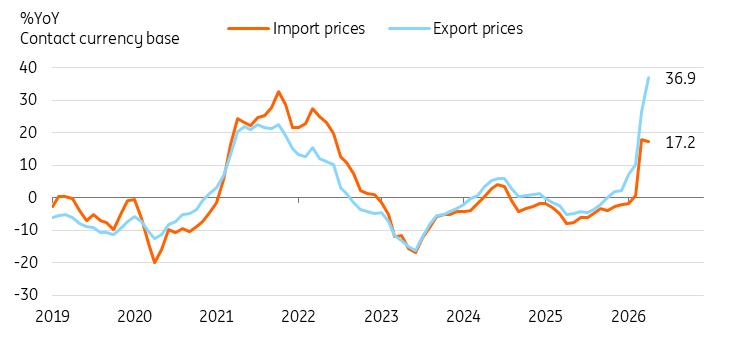
Korean exporters able to increase prices, improving terms of trade
We expect strong price effects to boost exports throughout the year, particularly in semiconductors, oils, and refinery exports.
Major chipmakers announced that their order book for 2027 has been rapidly filling up and the supply and demand gap has narrowed little. This should keep chip prices elevated for a while. For oil prices, even though the oil flows will improve gradually in the second half of 2026, prices won't come down sharply. The restoration of production sites and restocking demand will keep oil prices above $90 per bbl by the end of 2026. Thus, strong price effects are likely to continue to boost Korean petrochemical and chip exports throughout the year.
Also, these intermediary products, which make up a significant portion of Korean exports (approximately more than 55%), are able to transfer increases in input costs to output prices more effectively. This is particularly the case when demand greatly exceeds supply; consumer goods have less flexibility to do this. This was clearly shown in recent export and import price data. During March and April, export prices increased significantly, outpacing the rise in import prices. We believe that corporate earnings should improve amid positive terms of trade, which are likely to sustain levels of investment.
Terms of trade should improve, eventually supporting domestic economy
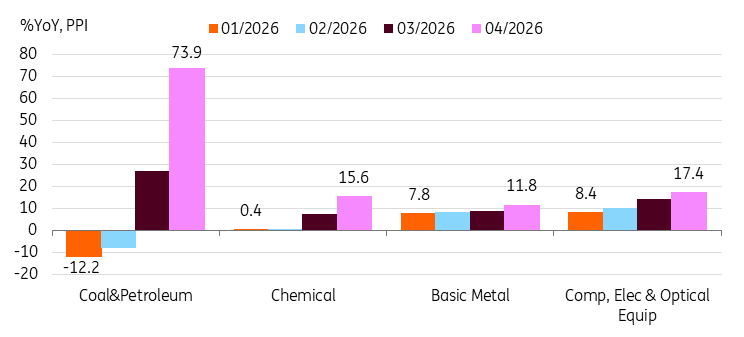
Pipeline prices are on the rise, likely to push up consumer prices
Domestic prices will face more intense pressure. Producer prices increased 6.9% year-on-year in April, up from 4.1% in March. While petroleum led the growth, rising prices are also evident in chemicals and basic metals. The government set a price cap on gasoline at the pump while extending the fuel tax cut through the end of July. Power rates should stay stable in upcoming quarters, as increased nuclear and coal generation help offset price rises. Consequently, consumer price increases are relatively constrained compared with those in other countries that rely heavily on fossil fuels. Meanwhile, increasing costs of memory chips have led to higher prices for computers, smartphones, and other electronics since the second half of 2025. Upward pressure on these items will only increase throughout 2026.
Producer price gains broadened and accelerated throughout the year
CPI inflation is expected to hit 3% as early as May
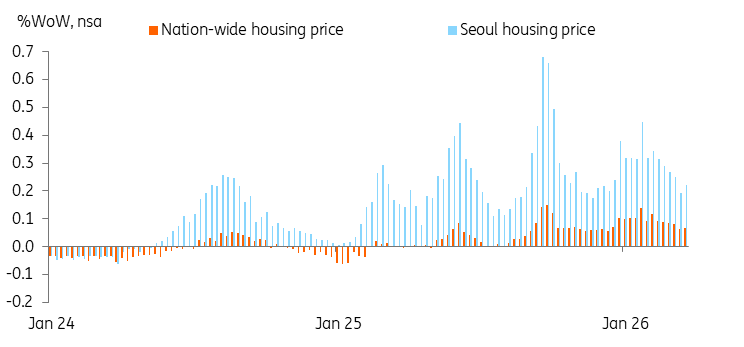
From May onwards, accumulated price pressures will begin to show up in CPI inflation, as pipeline prices clearly suggest. Not only are goods prices expected to rise steadily, but rent prices are also expected to rise steadily. Market-observed housing prices have risen for several months. A continued decline in housing supply should keep rent prices sticky. We expect CPI to hover around 3% throughout the third quarter. Core inflation, meanwhile, is expected to rise modestly above the 2.5% level. We expect CPI to rise 2.7% in 2026 and 2.0% in 2027.
Housing prices have been on the rise, adding inflationary pressures
Consumer sentiment improved despite ongoing war
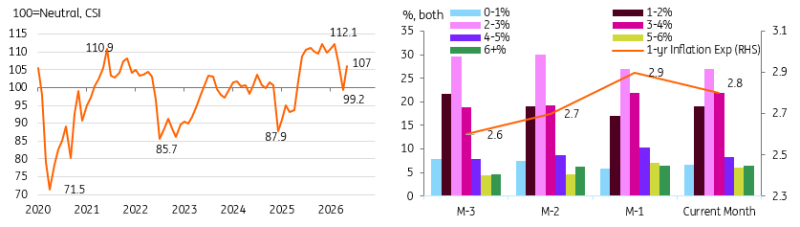
At the onset of the war, consumer sentiment took a significant hit, causing the index to fall below neutral. However, more recent data from May indicates a notable improvement in sentiment. The composite consumer sentiment index climbed to 106.1, though it still has not returned to pre-war levels. Additionally, it's worth noting that inflation expectations appear to be stabilising below 3.0%. One-year inflation expectations edged down to 2.8% in May. This supports our view that the Bank of Korea won’t be in a hurry to raise rates. We believe that government cash payouts and gasoline price caps partly boosted sentiment and lowered inflation expectations. The effects of cash payout programmes are typically short-lived. However, they can effectively serve as a buffer to support growth in 2Q26 and early 3Q26.
Consumer sentiment recovered in May thanks to government aids
The war hit domestic-oriented businesses harder
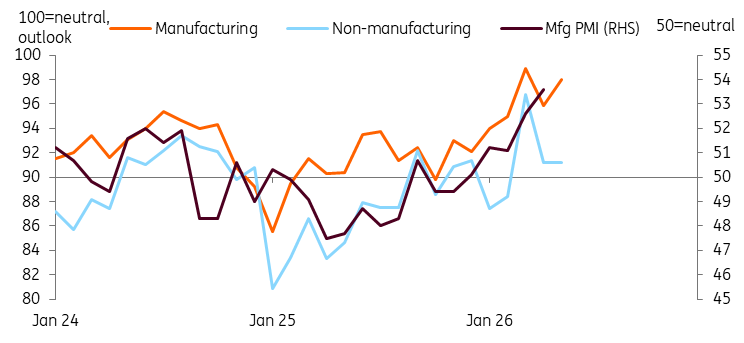
Business surveys clearly show that the impact of war has been asymmetric. As we saw strong exports and strong price action, manufacturers were able to maintain relatively positive outlook. However, sharp drops in the non-manufacturing outlook indicates the domestic oriented businesses – construction and services – struggle with rising prices and softening demand. The positive spillover to domestic economy from strong exports should remain quite narrowly focused. With a widening gap between IT and Non-IT sectors, and between external and domestic economy, the growth imbalances could accumulate in coming quarters. This will further challenge policymakers.
Non manufacturing outlook deteriorated quite sharply, weighing on domestic growth
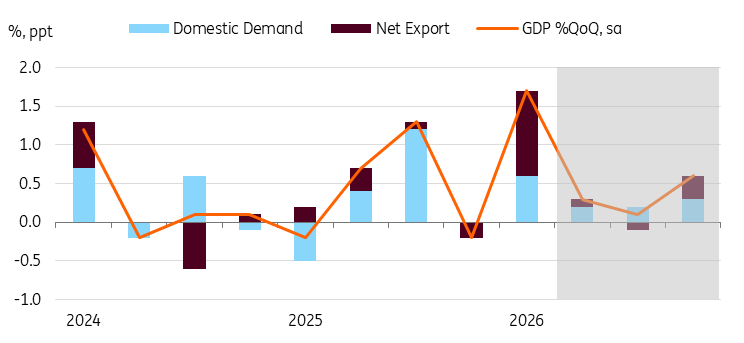
Mid-year growth set to moderate, but annual GDP to reach 3.0% in 2026
After analysing recent data releases, we upgraded our 2026 annual GDP growth forecast from 2.8% to 3.0%. We expect growth to remain firm in 2027, rising 1.8% annually.
First-quarter GDP recorded a 1.7% quarter-on-quarter, seasonally adjusted, with both domestic and external demand firm. Quarterly growth trends should hit bottom in 3Q26. The government’s fiscal spending should keep domestic demand growing in 2Q26. Yet, in 3Q26, we expect net exports to turn negative amid a sharp rise in imports. We expect substantial energy restocking once energy supply improves in 3Q26, which is ING’s base case scenario.
We expect GDP to grow 3.0% in 2026
We maintain a constructive view on Korean growth in year ahead
Easing geopolitical tensions should open up new growth avenues for Korean exporters. Demand from post-war reconstruction, expanded oil and gas storage, stronger tanker and ship orders, rising global defence spending, and the shift toward renewables is likely to broaden export growth beyond semiconductors.
Bank of Korea’s rate hikes will continue throughout 2027
Given that our GDP forecast exceeds above potential and the CPI outlook is above 2%, we anticipate the BoK will maintain its policy of rate hikes through the first half of 2027. We expect the BoK to keep rates unchanged at its May meeting, but deliver a hawkish message. Dot plots should signal at least 1-2 rate hikes within six months' time, and we may see a dissent vote. The BoK's quarterly outlook for GDP and CPI will be upwardly revised, which should strengthen the case for rate hikes in 2H26. Since we have a constructive view on next year’s growth and sticky prices, we have added one more hike in the first half of 2027.
Government fiscal policy will remain expansionary
The government has already delivered an additional budget of 26 trillion KRW, around 1% of GDP. This helped to alleviate the inflation burden on consumers and small business owners. The rise in government expenditure was funded by stronger-than-expected tax revenues. With robust chip sales expected to continue this year, we believe the government's fiscal policy will remain accommodative. We believe that if the Middle East war persists, a second extra-budget draft may even be possible this year, while next year's budget growth should be quite large, given the current government's fiscal stance.This should weigh on Korean treasury bonds (KTBs) in the medium term. The WGBI inclusion improves demand, but markets are probably concerned about fiscal sustainability. We expect the KTB yields won't rise further from the recent peak of 4.2% even if the BoK begins to hike rates. As we believe the market's overreaction to geopolitical risks and BoK's rate hike expectations will be unwound.

Comments
Log in or sign up to join the conversation.