

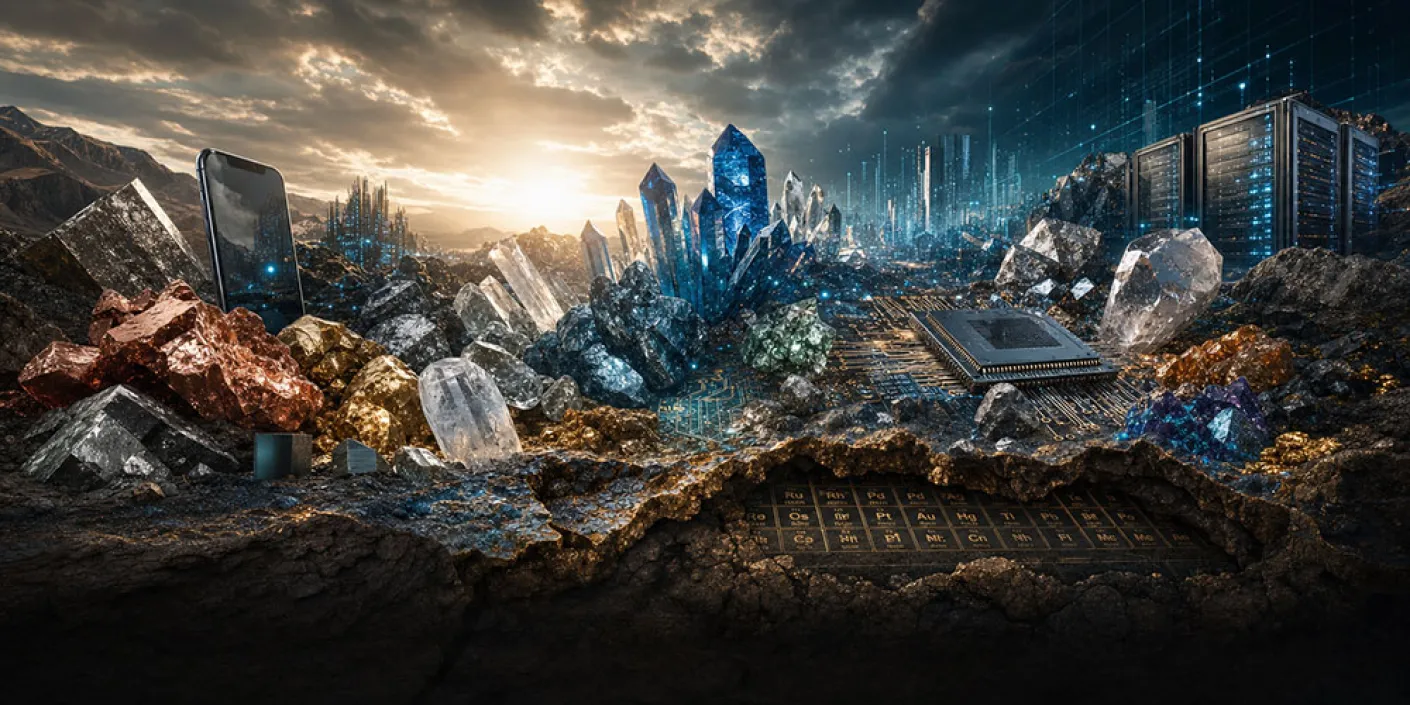
"The best investment on Earth is earth." — Louis Glickman
"Land monopoly is not only monopoly, but it is by far the greatest of monopolies; it is a perpetual monopoly, and it is the mother of all other forms of monopoly." — Winston Churchill
From the moment a digital alarm rouses you in the morning until you rest your head at night, your day is seamlessly enabled by technology. Screens light up on command. Voices answer questions. Devices anticipate your needs before you speak them. We credit this frictionless existence to brilliant software, visionary developers, and sleek interface design.
But the great illusion of the 21st century is that our world runs on code.
In reality, it runs on physical geology—highly refined, deeply excavated chunks of the earth’s crust. While the broader markets obsess over AI and the cloud, the hard truth is that every digital convenience is anchored to a massive, extractive supply chain. We have advanced technologically, but human survival remains fundamentally unchanged: we still derive much of what we do from minerals mined from the earth.
To understand how deeply we rely on the planet, we must look beneath the digital veneer at the five elemental pillars keeping modern civilization alive.
1. The Personal Connectivity Hub
We carry massive feats of engineering with us every single day—smartphones, laptops, tablets, smartwatches—treating them as if they are magic. In truth, any one of these devices is a highly sophisticated, miniature mine. Manufacturing a single smartphone requires several dozen chemical elements—an extraordinary share of the periodic table for a device that fits in your pocket, and larger devices draw on the same geological palette in even greater quantities. This marvel is built across the following core components:
The Screen: Crafted from silica (quartz sand) and bauxite, the glass is layered with materials derived from sphalerite, gallium, and indium. Indium forms the invisible, conductive film that allows the screen to register the touch of a finger.
The Battery: A lightweight powerhouse built from lithium, cobalt, and graphite to safely manage dense energy storage.
The Brain (Electronics): The microprocessor that thinks for your device begins as silicon, refined from common quartz sand into near-perfect wafers. Across it runs a web of copper, silver, and gold to carry every signal. And holding it steady is tantalum—wrung from coltan ore mined largely in central Africa—which stores and smooths the flow of electricity so delicate circuits never falter.
Speakers and Physical Body: Sound and vibration are driven by ultra-powerful permanent magnets built from rare earth elements—neodymium, dysprosium, and praseodymium. Denser still is tungsten, whose weight powers the buzz of every haptic vibration, while metals like aluminum and titanium give the body its structure.
For all its sophistication, though, this device is useless on its own. It is merely the final stop in a far larger system—one that dwarfs the hardware in your hand.
2. Infrastructure and Utilities
While portable gadgets capture our attention, the invisible infrastructure keeping society functioning day to day is far more resource intensive.
The most critical convenience in human history is the modern power grid. Electricity is entirely useless if it cannot be transported efficiently from where it is generated to where it is consumed. The entire global grid relies heavily on copper. Because of its high abundance and low resistance, copper remains the gold standard for electrical conductivity, delivering power directly from a massive generation plant into a home wall outlet with minimal energy loss.
As renewable energy continues to expand its share of electricity generation around the globe, this geological reliance changes but does not diminish. Solar panels draw on high-purity silicon and the silver printed across each cell in fine lines to collect and carry the current, while wind turbines demand immense quantities of neodymium and dysprosium—the rare earths that form the powerful permanent magnets inside the generators, turning the motion of the wind into electrical current.
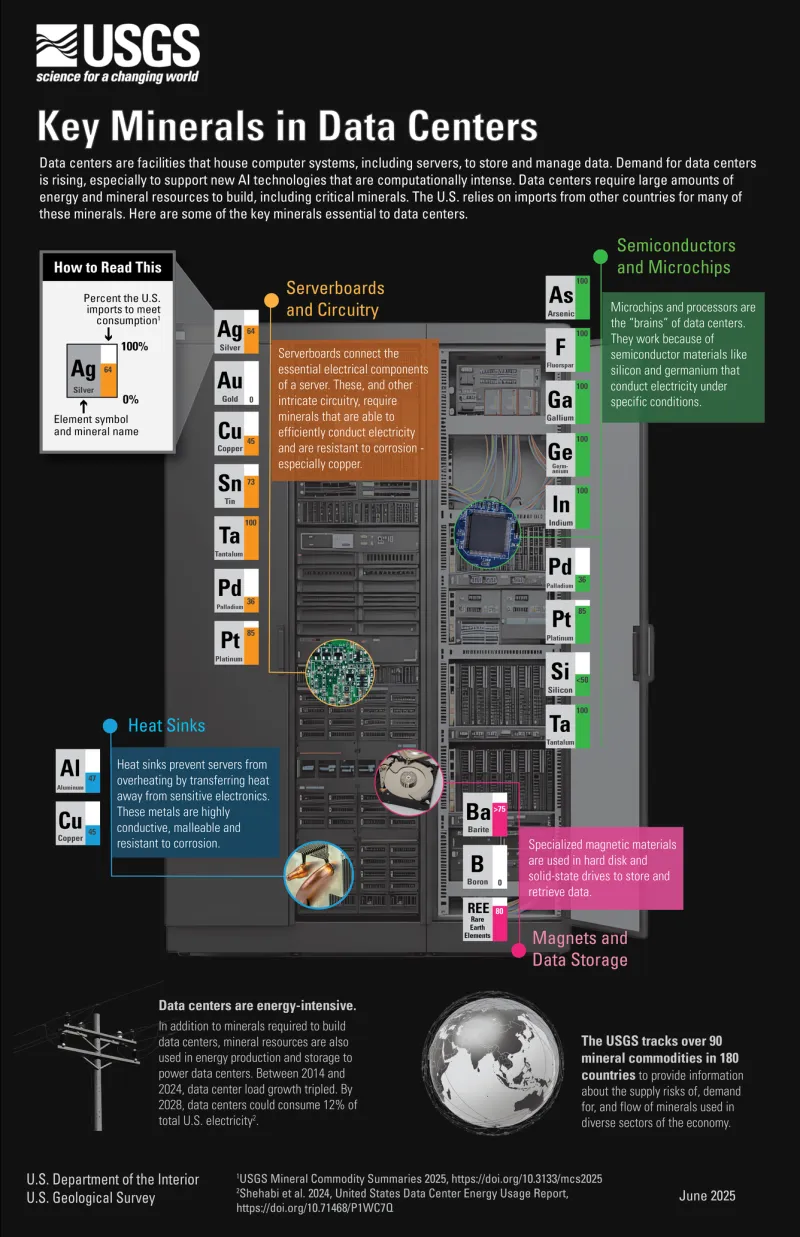
That same power feeds the vast network that carries our data. When you connect at home over Wi-Fi, your router transmits through gallium arsenide chips paired with copper antennas. That signal feeds into submarine fiber-optic cables—ultra-pure silica glass cores, wrapped in steel armor and carrying a copper conductor to power the repeaters along the way. Finally, the data reaches vast data centers: warehouses packed with silicon network switches, circuit boards plated in gold, palladium, and platinum, and thick copper and aluminum busbars distributing enormous amounts of electricity.
This heavy reliance extends to municipal water systems. Delivering safe, pressurized water and managing sanitation requires an extensive metallurgical feat. Municipal water mains require heavy-duty iron and steel, but they depend on zinc for galvanization to prevent internal rust, and copper or stainless steel for residential plumbing. It is an invisible network of metals keeping sanitation separate from survival.
3. Transportation and Mobility
The ability to move people and goods across vast distances in hours rather than weeks defines the pace of modern commerce and lifestyle. Today, the automotive and aerospace industries are undergoing a massive technological shift, and geology is driving the entire transition.
The rise of electric vehicles (EVs) has completely rewritten the mineral playbook. Where a traditional internal combustion engine relies on steel, aluminum, and a small amount of platinum in the catalytic converter, an EV shifts the focus entirely to battery chemistry—specifically lithium, cobalt, and graphite. Lithium acts as the lightweight champion of energy storage, while cobalt is required to stabilize the cathode, preventing the battery from overheating or catching fire during rapid charging.
Global logistics and aviation rely on an entirely different suite of heavy elements. Jet engines require advanced superalloys made with nickel, cobalt, and titanium to withstand the extreme temperatures and pressures of high-altitude, long-haul flight. Without these specific metals, the turbine blades inside a jet engine would literally melt under the heat required for propulsion.
4. Healthcare and Life Expansion
The most profound impact of technology is not convenience or speed, but the extension of human life itself—and, with it, the more than 8 billion people now drawing on the earth's resources. A century and a half ago, global life expectancy at birth was a staggering 30 years. You would have awakened to sunlight, relied on an outhouse for sanitation, hauled water from a nearby stream, and illuminated the night with expensive kerosene. Labor was purely manual or animal, and most of the day was dominated by sheer necessity.
With modern technology, global lifespan has more than doubled to roughly 73 years, with many developed nations pushing well past 80. This monumental shift separated work, home, and leisure more clearly, occurring in three distinct, technologically driven waves—each resting on a deeper foundation of extracted materials than the last.
Wave 1 (Late 1800s – Early 1900s): Made possible by the invisible utilities we use every day—clean running water, modern sewage systems, and food refrigeration. This was fundamentally a triumph of metal: the iron and steel mains, zinc-galvanized pipes, and copper plumbing described earlier laid the bedrock infrastructure that created the first massive spike in human lifespan by conquering child mortality.
Wave 2 (Mid-1900s): The Medical Revolution, defined by the discovery of penicillin, the mass production of antibiotics, and widespread vaccination programs that defeated infectious diseases like tuberculosis and pneumonia. These breakthroughs depended not only on chemistry but on an industrial base of stainless-steel manufacturing and a refrigerated "cold chain"—the copper, aluminum, and specialized coolants that kept vaccines viable from factory to clinic.
Wave 3 (Late 1900s – Present): Modern Management, utilizing high-tech cardiovascular medicine, stroke interventions, and advanced cancer therapies to turn once-fatal acute conditions into manageable, chronic ones.
This modern wave is bound strictly to specialized mineral resources. Consider an MRI machine: to generate the massive magnetic fields required to align hydrogen atoms in human tissue without a single incision, it relies on superconducting magnets made of a niobium-titanium alloy, kept functional by liquid helium cooling. On a smaller scale, lifesavers like pacemakers use titanium for their outer casings—entirely biocompatible, resisting rejection and corrosion inside the body—powered by dense lithium-iodine batteries built to last a decade.
But the deeper story is one of sheer multiplication. A century and a half ago, roughly 1.3 billion people each lived about thirty years, most of it in material simplicity. Today, more than 8 billion people live past seventy—and each of those longer lives is vastly more resource-intensive than the one it replaced. Every additional decade of life is a decade of hospital visits, imaging scans, implanted devices, refrigerated medicines, and the vast metal-and-silicon apparatus of modern care. We have not simply added more people to the planet; we have added more people, living far longer, each drawing on a deeper well of the earth's minerals than any generation before them. The extension of human life and the growing number of people on earth are, in the end, among the most resource-hungry achievements in our history.
5. The Military-Industrial Complex and National Defense
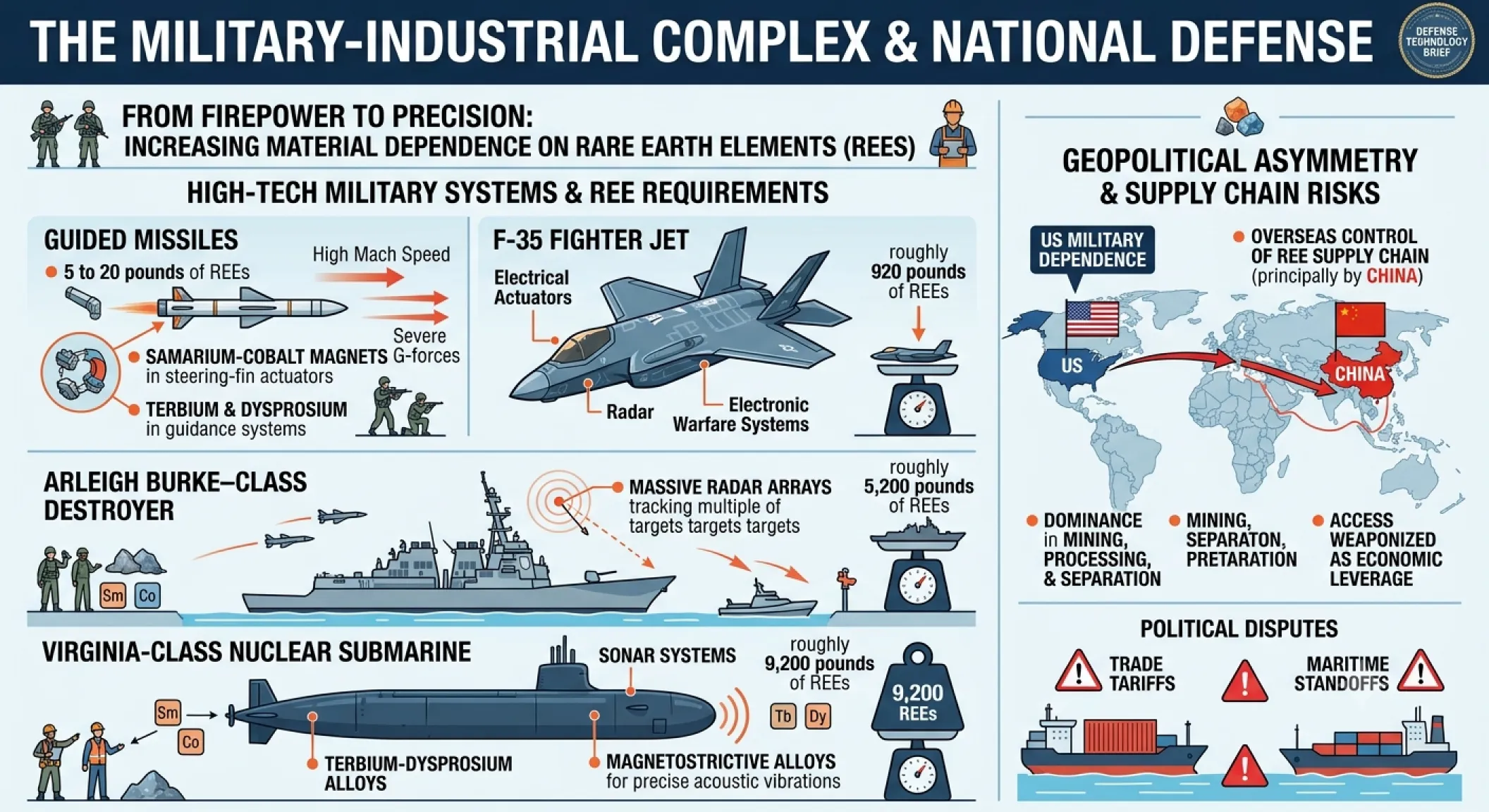
Modern deterrence prizes precision over raw firepower—but precision is not free of matter. The satellites, drones, defensive interceptors, and smart munitions that see, navigate, and strike with such accuracy do so by packing in an intense concentration of specialized elements. Far from reducing our material dependence, the move to high-tech precision has multiplied it, and the sheer quantity of rare earth elements (REEs) required to field a combat-ready military lays that dependence bare.
Guided Missiles: Require anywhere from 5 to 20 pounds of rare earths, relying on highly concentrated samarium-cobalt magnets in their steering-fin actuators to survive the blistering temperatures of Mach 5 flight, alongside terbium and dysprosium in their guidance systems to withstand severe G-forces.
F-35 Fighter Jet: Requires roughly 920 pounds of rare earths for its electrical actuators, radar, and electronic-warfare systems.
Arleigh Burke–Class Destroyer: Requires roughly 5,200 pounds of rare earths to power the massive radar arrays that track over one hundred targets simultaneously.
Virginia-Class Nuclear Submarine: Requires roughly 9,200 pounds of rare earths, including terbium-dysprosium magnetostrictive alloys that convert magnetic fields into the precise acoustic vibrations at the heart of its sonar systems.
This creates a terrifying geopolitical asymmetry. The U.S. military—widely considered the most capable in the world—is fundamentally dependent on a rare earth and critical-mineral supply chain largely controlled overseas, principally by China, which dominates not only mining but the processing and separation that turn raw ore into usable material. History has shown repeatedly that access to these materials can be weaponized as economic leverage during political disputes, whether over trade tariffs or maritime standoffs.
The Coming Kinetic Bottleneck
The great narrative of twenty-first-century progress is one of dematerialization—the comforting idea that our future lives entirely in a weightless cloud. Yet this digital illusion masks a stark geological reality: the more technologically advanced we become, the more resource-intensive our civilization gets. An artificial intelligence (AI) data center can require up to five times the copper of a traditional facility, alongside a specialized cocktail of germanium, gallium, and palladium. The technological leap of the last 150 years has, in effect, been a journey from a handful of bulk metals to the near-total exploitation of the periodic table.
I believe this hyper-dependency is now hurtling toward a structural supply cliff, driven by a triad of regulatory, legal, and operational bottlenecks that reinforce one another.
The first and most fundamental issue is the sheer time it takes to pull a new mineral supply out of the ground. The single greatest mismatch in modern industrial planning is the gap between how fast we build technology and how slowly we secure its raw inputs. A new smartphone generation takes about two years to design, and a new AI model takes mere months to train—yet according to the International Energy Agency, it takes an average of more than sixteen years to bring a new commercial-scale mine from initial discovery to active production. We are attempting to run a hyper-paced digital economy on a physical supply chain that moves at the pace of a generation.
Layered on top of that geological lag is a legal one. The very nations leading the charge into a high-tech future have made it operationally difficult to build the extraction infrastructure required to sustain it. In the United States and Europe, attempting to permit a mine or a chemical-separation facility can trigger a years-long gauntlet of environmental review and litigation. Statutes like the National Environmental Policy Act require extensive environmental impact statements that are frequently challenged by non-governmental organizations and local communities, locking world-class domestic deposits in prolonged legal limbo.
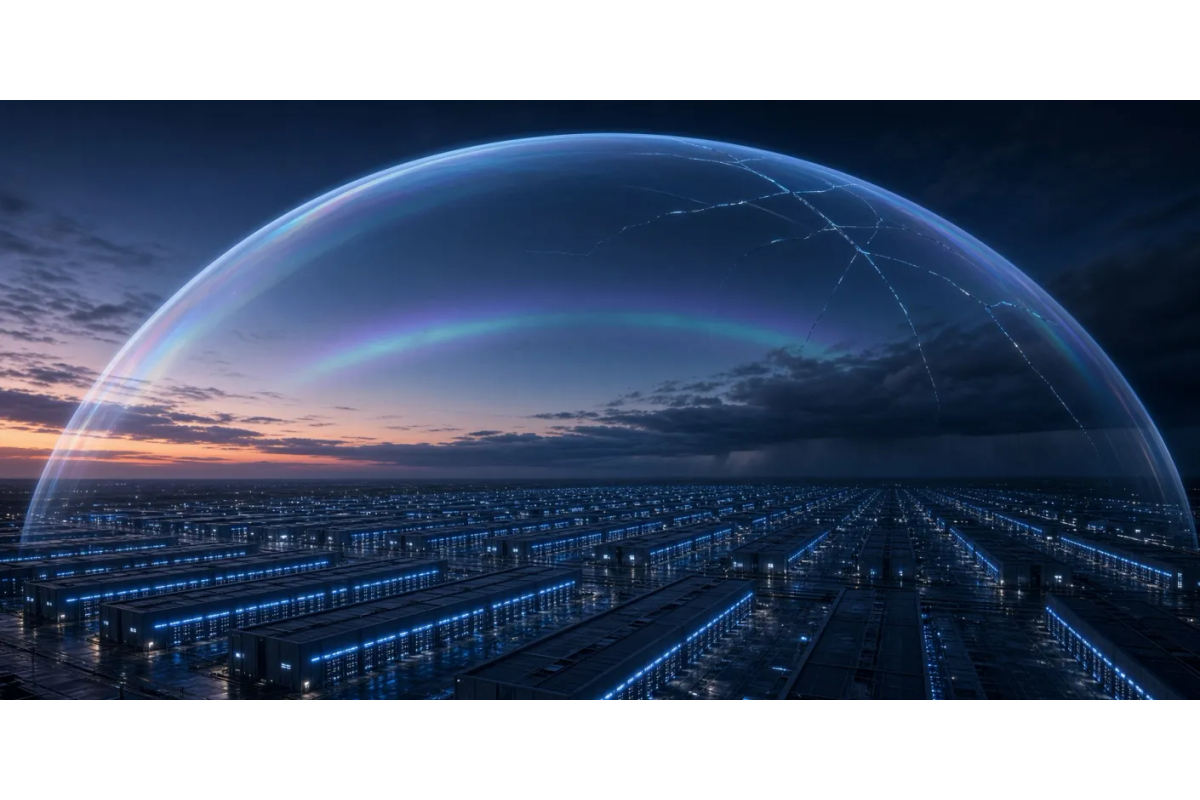
Finally, the electricity to run the digital economy is colliding with a power supply that is barely growing. For decades, developed nations retired coal and nuclear baseload faster than they replaced it, betting that demand would stay flat—and then AI sent demand curves vertical. A single hyperscale data center can draw as much round-the-clock power as a small city, and there is not enough new baseload generation being built to absorb it. The result is a zero-sum scramble in which industrial load competes directly with households for a finite pool of electricity, pushing rates upward. This is why the backlash has turned local: from Northern Virginia to Western Europe, communities are answering with moratoriums, power caps, and permitting bans—not out of hostility to technology, but because data centers are bidding up their electricity bills and crowding out the grid capacity they depend on. The deeper problem is not the data centers; it is that we spent years neglecting to build the generation and transmission that any high-tech civilization requires.
Together, these three chokepoints—slow mines, slow permits, and constrained power—form a bottleneck that no amount of software innovation can code its way around.
Conclusion: The Commodity Supercycle Reality
Human ingenuity is currently trapped in a structural bottleneck. We have designed the weapons, the smartphones, the clean grids, and the AI models of tomorrow, but we have legally and operationally constrained our ability to excavate what they are made of. Until permitting timelines match the pace of technological necessity, much of the future may remain locked inside the earth's crust.
This is the ultimate paradox of the twenty-first century: the more advanced, automated, and "wireless" our civilization becomes, the more heavily it depends on the dirt beneath our feet. Our transition to clean energy and high-tech medicine will not detach us from the earth; it may simply require us to understand and extract it with greater precision.
Markets can trade paper and bid up the valuations of cloud-based software companies all day long, but in doing so they risk forgetting a baseline rule of classical economics. As John Stuart Mill observed of those who owned the land beneath a growing society, such owners "grow richer, as it were in their sleep," because a civilization can never escape its physical dependency on the ground it stands on. The quip popularly attributed to Mark Twain—buy land, because they aren't making any more of it—applies tenfold today to the gallium, copper, and neodymium of the modern technology stack. When a structural shortage hits, the digital illusion evaporates, and real wealth reverts to what it has always been: ownership of the physical crust.
It is for these reasons that the broader markets may be fundamentally mispricing the future. Attention remains fixed on the software layer of the AI trade and on hyperscaler valuations, while the hard physical limits of the supply chain go largely ignored. We appear to be in the early stages of a secular commodity supercycle that could last years, if not decades. With demand curves steepening and new mining infrastructure legally bottlenecked, physical assets may be the true frontier. Every convenience we enjoy is a physical manifestation of human ingenuity working in lockstep with millions of years of geological pressure. We are not moving away from our elemental origins—we are discovering, again and again, that the future belongs to those who secure the earth.


Comments
Log in or sign up to join the conversation.