

Snowflake (SNOW) is one of the most-anticipated IPOs of 2020, and for good reasons. The company is in the right place at the right time, it has a smart business model, performance is outstanding according to the numbers from the S-1, and the long-term growth opportunities are enormous.
On the other hand, Snowflake has a very particular two-sided relationship with the big public cloud providers, which can create some competitive threats and put downward pressure on margins. Snowflake is operating with significant losses and there is no clear path to profitability in the short term. Valuation is also a big piece of the puzzle that is still missing in order to fully assess an investment in the data cloud leader.
Let's take a look at some key strengths, risks, and unknowns of a potential investment in Snowflake with a long-term horizon.
The Business
Snowflake operates at the intersection of two powerful trends: cloud computing and data analytics. The company has basically pioneered the Data Cloud, an ecosystem where companies can centralize all of their data from different silos and consolidate that data, generate business insights through analytics, build data-driven applications, and share that data in a seamless and secure way.
In simple terms, Snowflake allows companies to store all kinds of data from different sources in the cloud, and it also provides the capabilities to analyze such data and to easily access and share it from everywhere at any time.
The company offers a cloud-native architecture consisting of three independently scalable layers: storage, computing, and cloud services. This has many advantages for customers based on factors such as unlimited scalability, no hardware maintenance costs, integrating diverse data types, ease of access and sharing, powerful computing capabilities, and ease of use.
Unlike other cloud software companies that charge a fixed price per user, Snowflake has a consumption-based business model, and it only charges customers for the resources that they use. Customers basically pay based on usage for storage, computing, data transfers, and services.
This business model theoretically makes revenue more volatile and harder to predict for Snowflake, but it also has many advantages for customers, especially in the first stages of their relationship with Snowflake. Customers don't need to commit to a large budget upfront, and they don't pay much if they don't get much value from Snowflake's solutions, which is a strong proposition from a commercial point of view.
Importantly, Snowflake has a spectacularly high net retention rate of 158% as of July of 2020, so usage is clearly very strong, which reflects positively on Snowflake's ability to generate value and to benefit both customers and investors with this business model.
Management believes that the addressable market opportunity for its Cloud Data Platform is approximately $81 billion. Data from IDC estimates that the markets for cloud data management and analytics will have a combined value of $56 billion by the end of 2020 and $84 billion by the end of 2023. There are no independent estimates for data sharing, but Snowflake considers that this opportunity is "substantial and largely untapped."
It is very hard to quantify the addressable market for a company such as Snowflake, but the amount of data being generated by all kinds of businesses is growing exponentially, and gaining valuable insights from this data is crucial nowadays. Snowflake clearly operates in a huge and growing market, and the company is also providing a critical service to its customers.
A Two-Sided Relationship With The Cloud Titans
Snowflake currently operates on public cloud infrastructure provided by the three big players in cloud infrastructure: Amazon Web Services (Nasdaq:AMZN), Microsoft Azure (Nasdaq:MSFT), and Google Cloud Platform (Nasdaq:GOOG) (Nasdaq:GOOGL). These companies are kind of partners for Snowflake, but they are also competitors since they offer services such as Amazon Redshift, Azure Synapse, and Google Big Query.
Snowflake has been enormously successful in spite of facing competition from these three cloud computing giants, which proves that Snowflake has tremendous technological strength.
Customers always have the choice of going to Snowflake or going directly to one of the big cloud players such as Amazon, Microsoft, and Google. The big advantage of Snowflake is that it is much more focused and it also provides the possibility to diversify among the big 3 in the public cloud, which gives customers more flexibility, more control, and perhaps some negotiating power.
This strategy is quite smart and effective from a commercial point of view, but it also carries some risks for investors. The potential competitive pressure from large cloud companies will always be an important risk for Snowflake, and it also has important implications in terms of margins. The company's gross costs and gross margins are significantly influenced by the prices that Snowflake negotiates with these public cloud providers, which are also competitors.
The Numbers
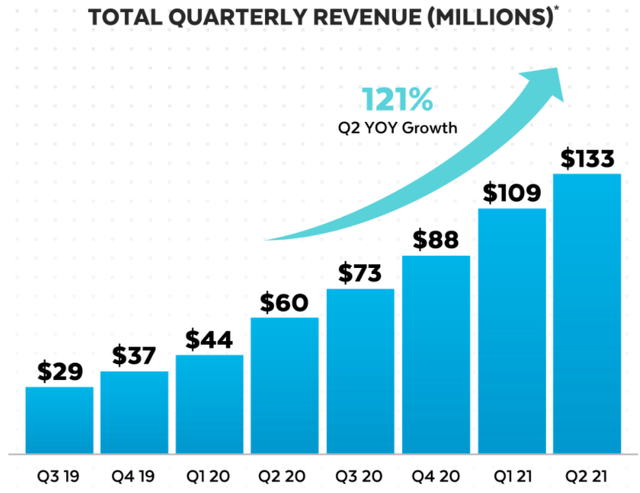
The top-line numbers from Snowflake are truly outstanding, with quarterly revenue growing 121% last quarter. The revenue retention rate of 158% is exceptionally high, which validates the usage-based pricing model as a great alternative for customers and a powerful growth driver for Snowflake.
Source: Snowflake
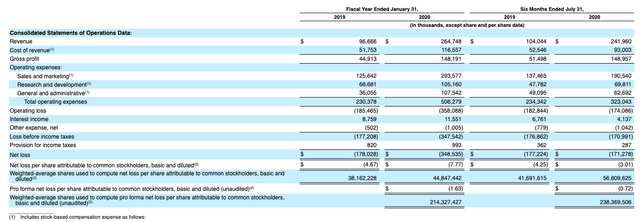
Gross profit margin is in the neighborhood of 61.5% of revenue, which is not particularly high at all. Gross margin has increased over time and can probably increase a bit more due to scale in the future, the business model in which Snowflake has to pay the public cloud providers for storage and compute infrastructure will always be a burden on gross margins.
Source: SEC Filings
Speaking about margins, the company made less than $149 million in gross profit and it spent $190.5 million in sales and marketing alone during the six months period ended in July. This represents an increase of 38% in sales and marketing investments versus the same period in the prior year.
Snowflake is aggressively investing for growth, these investments are paying off in terms of the top line performance, but it is hard to tell what will be the path to profitability for the company. This happens very frequently with high-octane growth stocks, investors assessing a position in Snowflake need to be willing to look beyond today's lack of profitability and focus on the company's long-term potential.
As of July of 2020, Snoflwake has $139 million in cash and equivalents and $452 million in short-term investments on the balance sheet. Considering that demand for the IPO looks more than healthy, liquidity should be no problem at all in the near term.
The Big Unkown
There are many unknowns when it comes to a company such as Snowflake, and investing in recent IPOs always carries some additional risks and uncertainties in comparison to companies with a trajectory of being listed in the public markets for some time.
When the company has been trading publicly for at least a year or so you can follow the company's numbers on a quarterly basis, listen to the conference calls to better understand business dynamics, and get a better understanding of the company's strengths and weaknesses over time. Investing in a recent IPO is always more uncomfortable from this perspective.
In the particular case of Snowflake, we still don't know the IPO valuation and what prices will be available to investors in the stock market after the stock starts trading, so this is obviously a big piece of the puzzle that is still missing in the analysis.
Many of the best software companies are currently trading at EV/Revenue ratios around 25/30 times annualized revenue run rate. Snowflake is well on track to $1 billion in ARRR, so a valuation in the range of $25 billion to $30 billion would not be unreasonable at all. Since valuations have been expanding for software companies and Snowflake is a much-coveted IPO, there is always a chance that initial valuation could even go considerably higher than that too.
The company raised money at a $12.4 billion valuation in February of this year, and there is a good chance that previous investors in Snowflake will make big profits from the IPO when looking at current valuation standards for the sector.
Valuation is always important, and you just can't leave valuation aside when assessing a position in Snowflake or any other company for that matter. However, there is a crucial point that many times gets overlooked by investors: If you are going to invest in high-growth companies over the long term, then picking the right business is much more important than paying a low price.
Doing a simplified equation, we can say that the current price of a stock depends on current fundamentals and valuation. For example, the market price of Snowflake will equal the company's sales multiplied by the price to sales ratio at a specific point in time. In the future, the changes in the stock price will depend on how revenue grows and how the price to sales ratio evolves.
In a single year, the change in valuation can have a considerable impact on returns. However, over long periods of time, and especially for companies with explosive revenue growth, the cumulative change in sales is a much more important driver of returns than the change in valuation.
Valuation is always relevant, but business quality and growth are much more important when investing in high-octane companies over long periods of time. Investors should first decide if Snowflake is a company that they want to own for the long term or not, and then make some capital allocation decisions based on different valuation ratios.
We don't know what kind of valuation Snowflake will have, but we can still make a plan for different allocation levels based on potential valuations and how they affect the return to risk trade-off for investors.
A simple strategy for those who want to consider owning Snowflake could be something like this, for example.
- Buying 1% of the portfolio if the stock is available at a price to sales ratio of 25 or less.
- Buying an additional 1% if the price to sales ratio is at 20 or below.
- Considering an extra 1% if for whatever reason Snowflake is trading at a price to sales ratio of 15 or less.
This is obviously a very rough roadmap, and we need to adjust the valuation parameters over time as we get access to more data from the company. The main point is that, even if we don't know the valuation, we can still make plans to assume different degrees of exposure in Snowflake depending on what kinds of valuation are available in the market.



Comments
Log in or sign up to join the conversation.