

The Short-Term Trend
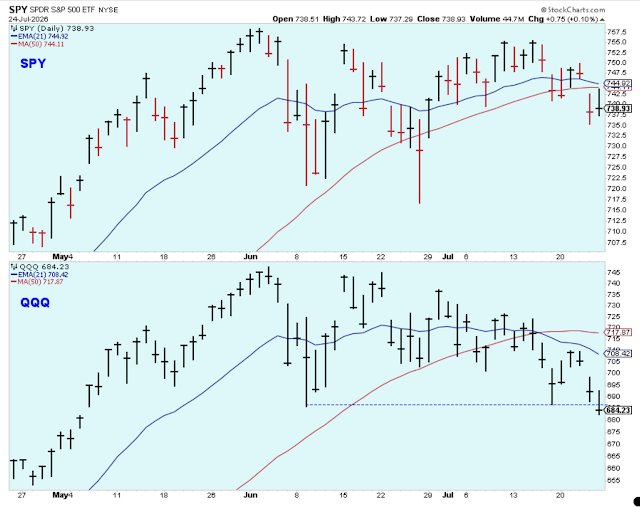
After Friday's selling there can't be much doubt that a short-term downtrend is intact.
The PMO Index is at the bottom of the range. This means it is too late for me to be selling according to my trading plan, and it also means that late next week I should start looking for signs that the short-term trend is bottoming.

Breadth has corrected quickly in this downtrend, but it still has a way to go considering that the market was extended.
The percent below the 50-day is approaching a level where the market can stabilize, and then it probably needs some time near the lows to chop up and down in order to develop a floor under prices.

This chart provides some perspective regarding the current market decline. The number of new 52-week lows is elevated, but nowhere near the levels of 2019. My guess is that we don't see new lows anywhere near the August level, but we probably will get a couple upward spikes when the downtrend is ready to bottom out. Just a guess.

The Longer-Term Outlook
The 3-month yield is again above the level of the 10-year yield. I believe this indicates that this bull market is on its last legs, but, just like everyone else, I don't know how long the last leg will last.

If the economic cycle is on its last legs, then what is keeping it afloat? Here is one really important reason shown in the chart below. The money supply continues to advance at a pace that is very helpful to the economy, as well as stock prices.

The ECRI Index of Leading Indicators is showing strength. This indicator can turn quickly so you have to watch it every week, particularly at a time like this when there are so many mixed signals. But the bottom line is don't get too pessimistic about the economy or stock prices as long as this indicator signals growth ahead.
I would get a bit more cautious about stock prices if this indicator started pointing downward, like it did in February 2018, and I would get very cautious if the indicator fell under the zero-level. If it falls under the -5 level, then I would be out of stocks until the indicator was above the -5 level again. Negative five is the line in the sand that says that bearish forces are under control.

The Medium-Term Trend
A few weeks back I decided to stop trying to track the medium-term trend partly because I just couldn't find a satisfying method of determining when they would occur.
It would be nice to know when the larger downtrend begins, because then we would know when a dip in stock prices signals that we should have a larger quantity of cash on hand.
Maybe I will try to track the larger trend again, starting with this chart below, which looks to me like it does a good job of tracking when the larger trend begins and ends. In 2018 it signaled to get out of stocks in late September, and that would have been an excellent signal. But also, it signaled to get back into stocks early January 2019.You can't ask for better timing than that from a chart.
At the moment, this chart indicates that we should have extra cash on hand, or, at least, that the stocks we own have low volatility, and that probably makes sense after a big run in the market that is ending just when the yield curve has inverted for the second time.

Let's see if this market can hold above these uptrend lines.

Outlook Summary
The long-term outlook is positive as of Jan. 11 (upgrade from weak-growth Oct. 5).
The medium-term trend is down as of Jan. 31.
The short-term trend is down as of Jan. 23.
The medium-term trend for Treasury bonds is up as of Jan. 25 (prices higher, yields lower).
Strategy During a Bull Market
- Buy large-cap stocks and ETFs at the lows of the medium or short-term market trends.
- Buy small-cap growth stocks on breaks to new highs in the early stages of market trends.
- Reduce buying when the market trend is at the top of the range.
- Take partial profits when the market uptrend starts to struggle at the highs.
- The cardinal rule is never invest based on personal politics because the stock market can do well regardless of which political party is in control.


Comments
Log in or sign up to join the conversation.