

Trump vows to take out Iranian tankers for everyone they hit.
World Running Short of Supertankers
Bloomberg reports World Running Short of Supertankers Threatens Long-Haul Oil Flow
The soaring cost of moving oil around the world is making some long-distance crude trades uneconomical, threatening to disrupt flows at a time when fuel markets have never been tighter.
The jump is being driven by a shortage of available supertankers. In some parts of the world, there are barely any of the ships — each the length of three football fields — left for hire. The squeeze is making faraway barrels less attractive and encouraging refiners to snap up supplies closer to home if they can find them.
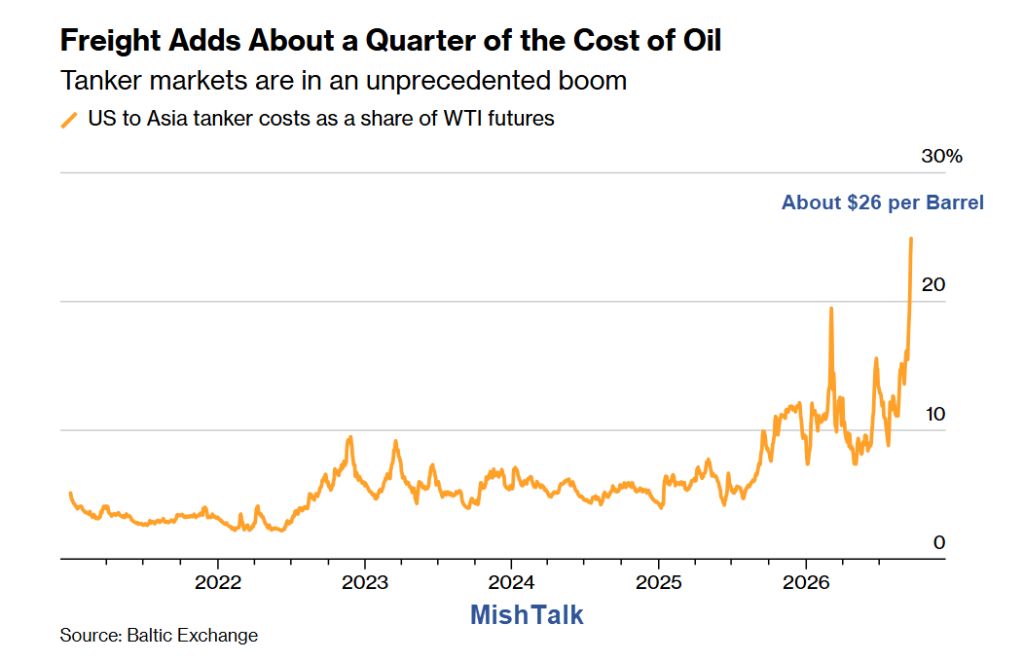
Moving a cargo from Houston to Asia now adds about $26 a barrel — $52 million a cargo — to the cost of supplying the world’s largest crude-importing region. That’s equal to roughly a quarter of the price of West Texas Intermediate futures. Before the war, shipping typically accounted for only a tiny fraction of the cost.
For oil traders, the risk is that shipping becoming prohibitively expensive. They’re concerned that the higher costs make it unprofitable for some refiners to turn crude into fuels, deterring them from buying cargoes that have to sail over long distances, even when demand to make diesel and gasoline is strong.
On the industry’s main benchmark route, very large crude carriers hauling 2 million barrels of crude from the Persian Gulf to China are earning upward of $1.2 million a day. Similar pressures are now spreading across the freight market globally.
“It has never been this expensive to move oil around,” Saad Rahim, chief economist at trading giant Trafigura Group, said at the Bloomberg Commodity Investor Forum on Thursday.
A Japanese refiner recently bought a cargo of Alaskan crude — a grade not typically well-suited for the country’s processors — because of the relatively short sailing distance, people familiar with the matter said.
Shipbrokers with years of experience said they’ve never seen supertanker availability so tight, while multiple industry executives said they’ve never known a market like it. Many said there are few, if any, of the vessels available for hire in certain locations, depending on the timeframe in which they are required.
Trump Weighs ‘Annihilating’ Iranian Regime
For the 88th time Trump Weighs ‘Annihilating’ Iranian Regime
President Donald Trump said on Thursday he faces a “big decision” on whether to launch a major new offensive against Iran’s ruling regime as attacks on commercial ships in the Strait of Hormuz continue.
“I have a big decision coming up,” Trump told Axios. “Do I want to go in and annihilate them or do I not? It’s a big decision. Anything could happen with me.”
Iran’s Islamic Revolutionary Guard Corps claimed in statements carried by semi-official Iranian news outlets that it struck a Togo-flagged vessel over what it called an “illegal crossing” of the waterway. It was not immediately clear whether Iran’s claim involved the same tanker cited by the British maritime agency.
Iran has sought to require commercial vessels to obtain permission and follow a regime-approved route through the strategic passage. UKMTO also said Friday that it had learned of another tanker struck by an unknown projectile while leaving the strait on Sept. 16. A separate vessel incident northeast of Khasab, Oman, was reported late Thursday; its crew was also reported safe.
Meanwhile, a U.N.-commissioned fact-finding mission said Thursday there are “reasonable grounds to believe” the United States committed war crimes in two Feb. 28 strikes in Iran.
U.S. military says it destroyed 5 Iranian oil tankers after attacks on Navy warship
NPR reports U.S. military says it destroyed 5 Iranian oil tankers after attacks on Navy warship
The U.S. military said it destroyed five Iranian oil tankers on Tuesday in response to the latest attacks on its warships and Tehran hit back at American targets in Jordan, the latest burst of back-and-forth strikes that have lurched the sides back toward open hostilities in a more than 6-month-old war.
Both the U.S. and Iran are seeking to exert control over the Strait of Hormuz, where about one-fifth of the world’s oil passed before the war began. Rising energy prices are posing political problems for Trump and his Republican Party ahead of the November midterm elections. A barrel of international standard Brent crude briefly climbed as high as $99.46 on Tuesday.
The U.S. forces also destroyed three Iranian oil tankers on Saturday after Iran’s Revolutionary Guards tried to attack a U.S. aircraft carrier and destroyer with ballistic missiles, warning that it would, “if necessary, destroy Iran’s limited and exposed oil fleet.” Iran later said it planned to announce a new “exclusion zone” near the Strait of Hormuz aimed at vessels intending to transit.
Tankers Out of Commission
Keep at it boys. Put all the tankers out of commission.
As of mid-September 2026, the cumulative number of oil tankers officially reported as heavily damaged, destroyed, or permanently disabled during the war stands at at least 23 to 25 vessels.
The breakdown between the two opposing forces reveals how both sides have explicitly targeted oil transit to wage economic and naval warfare:
Iranian Tankers Destroyed by U.S. Forces (10 Tankers)
Following a shift in strategy by U.S. Central Command (CENTCOM) to dismantle the IRGC’s multibillion-dollar shadow oil network, the U.S. Navy systematically targeted and neutralized the Iranian state-linked fleet:
September 5 Striking Wave: 3 tankers—the M/T Downey, M/T Stark 1, and M/T Kylo (also known as the Noxen)—were targeted and permanently disabled or destroyed.
September 8 Striking Wave: 5 tankers—the M/T Kivik, M/T Charminar, M/T Horizon 1, M/T Riesco, and M/T Derya—were directly struck and rendered completely inoperable.
Subsequent Total: Official defense trackers noted that by September 9, the U.S. had successfully destroyed a total of 10 Iranian national tankers in response to failed IRGC ballistic missile attacks on American warships.
Commercial Tankers Damaged by Iran (13 to 15 Tankers)
Iran’s Islamic Revolutionary Guard Corps (IRGC) has retaliated by targeting independent international commercial vessels passing through or near the critical Strait of Hormuz:
The September 9 Retaliatory Wave: Iran claimed direct missile and drone strikes on 8 commercial oil tankers flying various international flags.
Mid-September Unauthorized Passages: At least 5 additional commercial tankers have been verified as damaged by Iranian projectiles for violating Tehran’s self-imposed transit restrictions. This includes the Panama-flagged El Gaia, the Togo-flagged Trend, a Liberian-flagged vessel, and two other transiting tankers struck between September 16 and September 18.
The Chokepoint Multiplier
The global tanker fleet is dispersed across the world’s oceans, but roughly 20% to 25% of global seaborne oil (around 20 million barrels per day) must transit a single narrow waterway.
When 25 ships are struck in or near this bottleneck, the remaining 99.7% of the global fleet cannot simply bypass it. Land pipelines (such as Saudi Arabia’s East-West line or the UAE’s Habshan–Fujairah route) can only reroute a fraction of that volume. The hit to 25 ships effectively threatens up to a quarter of the world’s daily petroleum supply.
Damaging 25 tankers does not merely remove 25 hulls from service; it weaponizes risk, freezes transit routes, and chokes off inelastic energy supply.
Daily tanker charter rates in the Persian Gulf surged past $1 million per day for certain routes, according to energy tracking data from OilPrice. This freight spike cascades through refined product and consumer prices globally.
Just imagine what might have happened if we had not won the war 44 times.
Related Posts
September 14, 2026: Trump Asks Tankers to Schedule a Time Slot for Strait of Hormuz Safe Passage
If this isn’t “control” what is it?
September 14, 2026: Trump’s Lie of the Day: Ukraine Agrees to Not Hit Russian Energy Targets
Lies every day. Multiples today. Should I make this a regular feature?
September 14, 2026: Drone Damaged Saudi Oil Pipeline Down for 3-5 Weeks. Wait! How Long?
Four million barrels per day are now offline, likely for months, not weeks.


Comments
Log in or sign up to join the conversation.