


Schools in New York open again on Tuesday, and while many will view Labor Day as the end of summer, I usually look to the first day of school to mark it. The buzz in town has picked up, and traffic is starting to build as people return from their summer vacations. By Tuesday morning, the 1-mile commute from my home to the office will be back to a 15-minute grind, and I think anyone who believes this may be a slow week will find that not to be the case. Sure, this coming Friday may be slower ahead of the three-day weekend, but the depths of the summer slowdown are now behind us.
The most important thing heading into this week is not only the economic data and its potential impact on the Fed’s September rate decision and Treasury rates, but also Broadcom’s results. Once Broadcom’s earnings are out of the way, there won’t be much left from an implied dispersion standpoint, and that means realized dispersion should really start to contract.
Implied dispersion, as measured by the DSPX, has already fallen and may very well continue to fall. What we are waiting for most is for stocks to actually reflect what the options market expects — for realized dispersion to start declining. It has already begun to; it just hasn’t fallen as quickly as the options market has priced in.
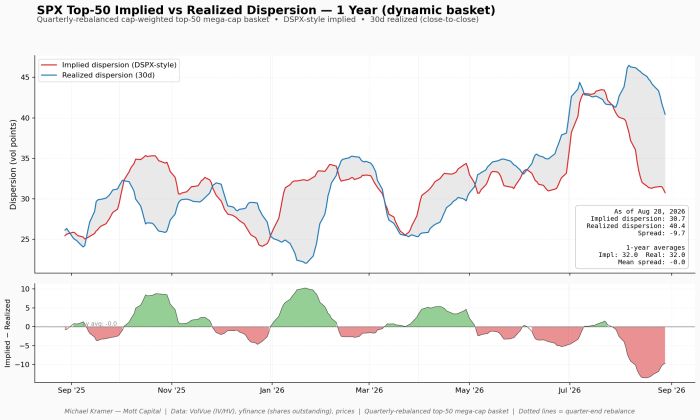
So again, markets have priced in a big decline in single-stock volatility that just hasn’t materialized yet, and this is one reason markets have mechanically performed better and why correlations within the index have remained low. In fact, 22% of the 142 stocks across our sector baskets still have realized volatility near their one-year highs — although that figure is now coming down quickly. Compare that with the options market, where just 3% of the same names are priced near their one-year IV highs, and you can see how much decline is already assumed.
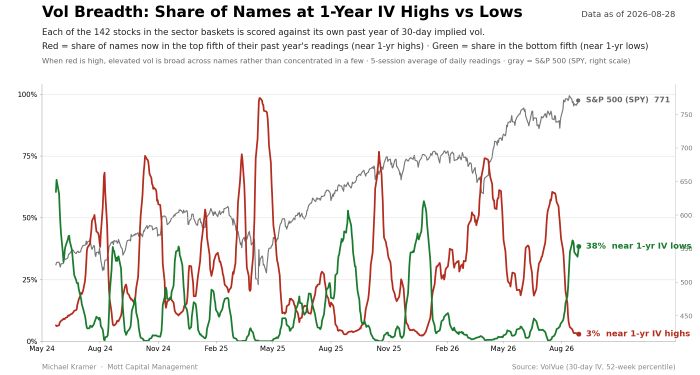
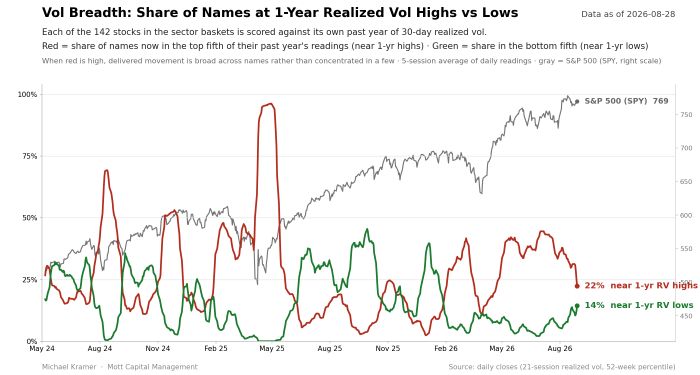
Mechanically, dispersion on a realized basis is set to unwind further, which means that at some point correlations will start to rise again, and the dispersion we have witnessed over the summer will begin to dissipate. This has already been the case in the semiconductor sector, which, again, saw implied volatility trade more in line with the headline S&P 500 on Friday.
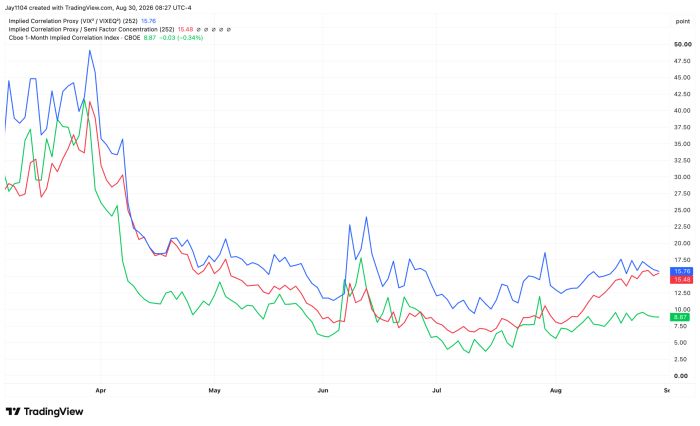
This becomes important as we enter the fall because what we have seen in the market appears to be calm and tight trading ranges, while sector rotations have been much more severe. Eventually, that calm appearance will give way, and the sectors with the biggest impact will ultimately decide which way the indexes begin to move again. If semiconductors continue to be the group with the greatest impact on the market, then a continued unwind in those stocks could lead to weakness across the entire market.
The semiconductor sector went from being one of the hottest groups in the market in June and July to being one of the coolest. The demand and excitement that once drove these stocks higher appear to have vanished, as implied volatility in these names has literally melted. Our sector vol map shows the same at the index level: the IV percentile for the SPY is about as low as it gets.
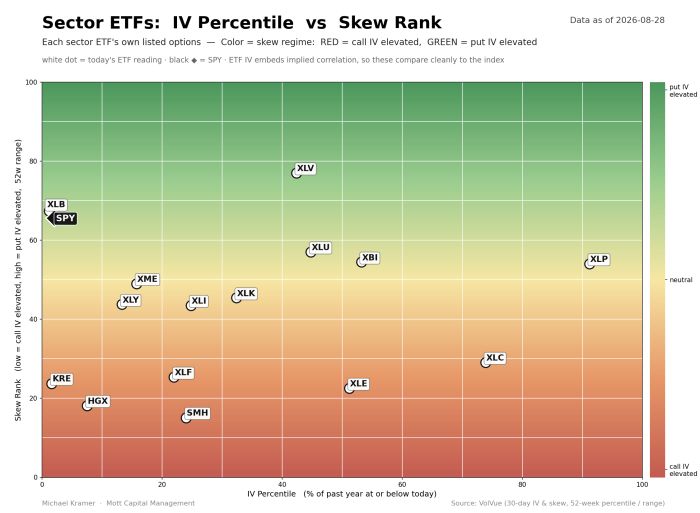
The bet going into September seems to me to be that correlations rise — and in that case, it probably means single-stock and index-level IV start to rise together, since they simply do not have much further to fall.



Comments
Log in or sign up to join the conversation.