

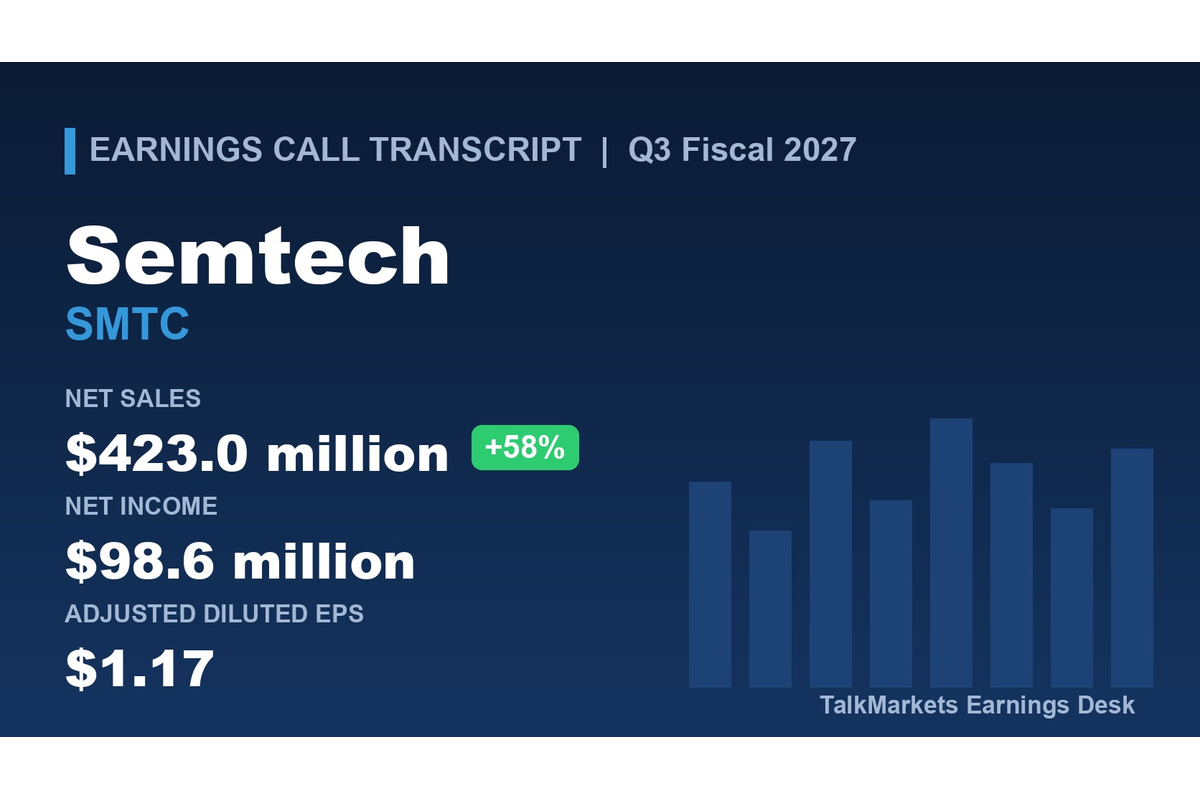
Semtech's fiscal Q3 2027 net sales rose 58% to a record $423.0 million on data center and LoRa growth, with net income of $98.6 million and adjusted diluted EPS of a record $1.17.
Ticker: SMTC
Semtech Corporation (SMTC) reported results on 23 November 2026 for the third quarter of fiscal 2027, the quarter ended 25 October 2026. The semiconductor company, which supplies chips for AI data center networking and connected Internet of Things devices, reported record net sales and a record adjusted operating margin. Net sales were also up 24% from the second quarter.
The key numbers (quarter ended 25 October 2026)
Metric | This year | Last year | Change |
|---|---|---|---|
Net sales | $423.0 million | $267.0 million | +58% |
Gross profit | $247.7 million | $138.5 million | |
Operating income | $111.1 million | $31.1 million | |
Net income (loss) | $98.6 million | $(2.9) million | |
Diluted EPS | $0.97 | $(0.03) | |
Adjusted diluted EPS | $1.17 | $0.48 | |
Adjusted EBITDA | $145.8 million | $62.7 million |
GAAP gross margin was 58.6% against 51.9% a year earlier, and GAAP operating margin was 26.3% against 11.6%. On an adjusted basis, gross margin was 59.3% and operating margin a record 33.0%, against 20.6%. Adjusted EBITDA margin was 34.5%. Interest expense, net fell to $0.2 million from $26.2 million.
Net sales by segment
Signal Integrity: $182.4 million.
Analog Mixed Signal and Wireless: $133.8 million.
IoT Systems and Connectivity: $106.7 million.
Balance sheet
Cash and cash equivalents were $251.4 million at 25 October 2026, against $195.2 million at 25 January 2026. The company expects its cellular module divestiture to close in the fourth quarter of fiscal 2027, and it reported assets held for sale of $148.0 million.
President and CEO Hong Hou said: "The Semtech team delivered another quarter of record financial results, driven by significant business growth across our broad data center portfolio and LoRa."
Source: SEC Form 8-K Exhibit 99.1
Full call transcript
Operator:
Good day, and thank you for standing by. Welcome to Semtech Corporation's fiscal third quarter 2027 earnings conference call. At this time, all participants are in a listen-only mode. Following our prepared remarks, there will be a question and answer session. Please be advised that today's conference call is being recorded. I would now like to hand the conference over to Mitch Haws, Senior Vice President of Investor Relations for Semtech. Please go ahead.
Mitch Haws (Senior Vice President of Investor Relations):
Thank you, and welcome to Semtech's fiscal third quarter 2027 financial results conference call. Participants on today's call are Hong Hou, President and Chief Executive Officer, and Mark Lin, Executive Vice President and Chief Financial Officer. Before we begin the prepared remarks, I would like to highlight upcoming investor events, including the UBS Technology Conference on November 30th, the Stifel Tech Forum on December 7th, the Nelius Research Conference on December 8th, and the Needham Growth Conference on January 12th.
Today after the market closed, we released our unaudited results for the third quarter ended October 25th, 2026, which are posted along with an earnings call presentation to our investor relations website at investors.semtech.com. Today's call will include various remarks about future expectations, plans and prospects, which comprise board-looking statements.
Please refer to today's press release and see slide two of the earnings presentation, as well as the risk factors section of our most recent annual report on Form 10K, where a number of risk factors that could cause our actual results and advance to different material from those anticipated or projected on today's call. You should consider these risk factors in conjunction with our forward-looking statements.
We will refer primarily to non-GAAP financial measures during today's call, and we'll also be referring to results for a third quarter of fiscal year 2027, and most otherwise noted. Please see today's press release and slides three and four of the earnings presentation for important information regarding our non-GAAP financial measures. The press release and earnings presentation also include reconciliations of our GAAP and non-GAAP financial measures. With that, I will turn the call over to Hong.
Hong Hou (President and Chief Executive Officer):
Thank you, Mitch. Good afternoon to all of you joining today. Semtech team delivered another quarter of record financial results, driven by significant growth across our broad data center portfolio and LoRa. As the industry moves from 800 GB to 1.60 GB and beyond for data center connectivity, we believe our portfolio's standing copper, optical, and photonics-positioned Semtech as a trusted partner for the signal integrity challenges of the next-generation AI networking architecture. Third quarter revenue with a record $423 million, growing 24% sequentially and 58% year-over-year.
We delivered strong operating leverage with record-adjusted earnings per share of $1.17, growing 144% year-over-year. Now let me move on to the discussion of our end markets. Infrastructure net sales were $175 million in the quarter, up 42% sequentially, and 125% year-over-year, once again led by data center. Data center revenue was $145 million, up 45% sequentially, and 158% year-over-year. The product ramps we laid out at our analyst day are being realized in our results with growth across optical, copper, and photonics.
In optical, we hold significant market share in 800 GB. The superb performance of 800 GB product portfolio, combined with our ability to deliver to our customers, is a key differentiator in today's capacity-constrained environment. The industry is also recognizing our product performance at 1.6T. Our GN1834D TIA built on power semiconductor society process won the optical component innovation award at ECOC, an external validation of the performance behind the 1.6T ramp.
Fiber Edge at 1.6T is expanding across fully retimed architectures, or FRO, and we are well-positioned to support adoption of TRO, a half-retimed architecture expected in the latter part of fiscal 2028. We believe pluggable modules will remain the workhorse of scale-out networks for the next few years. However, at the line speeds and bandwidth density rise, the industry is moving optics closer to the switch and XPUs through near-packaged optics and co-packaged optics to reduce power consumption and address bandwidth density requirements.
At present, MPO form factors vary by customer, but every customer consistently wants smaller form factors, more lanes, and lower power. The TIAs and drivers we developed for linear pluggable optics or LPO, a power-efficient solution Semtech has been long championed carried directly into these designs. We are engaged with a wide range of hyperscalers and transceiver module manufacturers on MPO, and we anticipate initial revenue in the second half of fiscal 2028.
We see MPO as additive to our SAM, supplementing our expanded content growth at the industry transitions from 800G to 1.6T and onto 3.2T. We expect active copper to remain a strong growth driver for Semtech as we highlighted at analyst day. Inference clusters will predominantly deploy on a single rack, where copper remains the most cost-effective and power-efficient interconnects. As signaling reads rise, signal integrity challenges compound, and the value of analog signal conditioning through our copper edge linear equalizer correspondingly rises.
We are making great progress in copper edge adoption. Our initial hyperscaler customer is deploying 1.6T active copper cables, and in the past quarter, we secured the design winds on additional platforms with the same customer, reflecting our multi-generational alignment with this hyperscaler. Subsequent to the analyst day, we achieved a new copper edge design wind at the second leading hyperscaler, this time in a line cart or onboard application.
Our engineers have been in close collaboration with the second hyperscaler to achieve signal integrity performance levels on par with an onboard retimer, at the same time reducing power consumption by 90% and eliminating added latency. We expect deployment of this line-cart application will begin in the first half of fiscal 2028. Together with the ongoing ACC ramp at our initial hyperscaler customer, this should drive substantial revenue contribution in fiscal 2028 and catalyze broader ecosystem adoption.
In photonics, our gain chips and the coherent light lasers are gaining traction with several key customers, defining the architecture for the next generation scale across optical interconnects. A very high power of VHP lasers now reliably delivers 250 milliwatt optical output at 50 degrees centigrade. A single VHP laser can drive an eight-lane silicon photonics modulator, making it very well suited for 1.6T transceivers and MPO optical engines. We're also actively developing our ultra-high power, our UHP lasers, with a 400 milliwatt of optical output.
Paired with a semiconductor optical amplifier, this can address customer requirements for a CPO scale-up light source, where the laser and amplification functions are central to system power and performance. Our photonics capacity expansion program is on track to support substantial demand for a differentiated product. Taken together, copper optical and photonics give Semtech a portfolio that spans the vast majority of interconnect architectures our customers are evaluating. From pluggable optics and active copper today, to near-packaged and co-packaged optics ahead.
We believe owning both electronic and photonic components in our portfolio allows Semtech to co-optimize chip performance and help our customers accelerate the new product introductions. Few companies currently capitalize on this advantage, and fewer still do so with a robust capacity plan and products qualifying at multiple hyperscalers. Our portfolio breadth is why we are becoming a trusted partner as the industry moves to each new generation of AI architecture.
We expect the data center momentums to continue into Q4 and fiscal 2028, supported by a record backlog, design wins, and an ecosystem that is progressively moving toward the power-efficient analog solutions that has been the hallmark of a data center portfolio. We are confident in the growth framework we outlined at our analyst day. Now moving to our industrial end market, Q3 industrial net sales were $208 million, up 16% sequentially, and up 41% a year over a year, driven by another record quarter for LoRa.
LoRa enabled net sales were a record $68 million, up 18% sequentially, and up 69% a year over a year. As we laid out at an analyst day, LoRa is a second growth vector, a differentiated high margin franchise with a broadening set of end applications. As a recent electronica event in Munich, we demonstrated LoRa+ with the Z-Wave and Wi-SUN running alongside LoRa on a single chip.
The LoRa+ platform received the two industry awards in Q3 and continues to gain traction at the device that brings LoRa together with other protocols. LoRa+ delivers a dual-band capability and expands data throughput to 2.6 megabits per second while preserving the sensitivity, multi-protocol flexibility, and ultra-low power consumption that defines the LoRa advantage. With additional product offerings announced in Q3, customers can build everything from cost-optimized sub-GGR sensors to multi-band global tractors with satellite connectivity on a single architecture and software platform.
As we demonstrated at an analyst day, enhanced data throughput enables new classes of HAI applications from high-fidelity audio verification in public safety to video and image transfer for security and drones and opens an incremental application vertical in smart home and security. Amazon Sidewalk continues to build momentum. Rain launched a new line of LoRa-based sensors in the U.S. and Sidewalk is now available in Canada and Mexico with Europe, Australia, and Japan expected to follow. This is a meaningful step towards mass-market consumer adoption at Amazon scale.
In our AirLink IoT network solution business, our RX400 and EX400 5G RedCap routers now in full-scale production won IoT Evolution's Product of the Year award. Their industry-leading power efficiency opens up remote industrial applications where the great power is limited. As customers connect more remote assets, security is becoming a deciding factor in their deployment. Our integration with Palo Alto Networks extends a zero-trust protection from field assets to the enterprise core for critical infrastructure operators.
For government and public safety customers, compatible AirLink routers can now meet the FIPS 140-3 federal security standard through a software update with no hardware replacement. Together, this capability strengthens our position in mission-critical applications where security and reliability matter most. Now moving to our high-end consumer end market, net sales for Q3 were $39.2 million, flat sequentially and down 6% year-over-year. Our TVS business grew sequentially and held up well despite the memory supply constraints weighing on the broader smartphone industry.
Drills continue to be driven by a position at the premium brand Handside Manufacturers where we are adding device content and seeing steady design-win activity with market leaders. Search switch extends our TVS content to higher world's USB power delivery port, now standard in smartphones and notebooks, maintaining consistent performance across temperature while conventional solutions de-read. We view this as incremental higher-value content for mobile and computing customers with early adoption industrial applications.
Our per se capacitive sensor design-win pipeline continue to expand across specific absorption-read, smart wearable and other consumer applications and we are deepening engagement with the lead customers across a wide set of use cases. The combination of a capacitive and forced sensing browning of value to each customer strengthens retention and puts through sensing and the TVS content within the same accounts. As we highlighted at our analyst day, power-efficient analog connectivity is a critical enabler of the global AI build-out.
Every generation of the compute demands more bandwidth at a lower power and a lower latency and Semtech meets all this requirement without high-speed analog solutions. The market is moving toward us and Semtech is uniquely positioned to play a leading role in supporting this generational AI build-out. We are encouraged by our progress and also recognize that we are in the early innings and there is much work and execution on the horizon. I am convinced the best for Semtech is yet to come.
With that, I will turn the call over to Mark for additional details on our financial results and our fourth quarter outlook. Mark?
Mark Lin (Executive Vice President and Chief Financial Officer):
Thank you, Hong. For Q3, we recorded our 11th consecutive quarter of net sales growth with record net sales of $423 million above the high end of the outlook range updated at our analyst day on October 15th. Net sales grew 24% sequentially and 58% year over year. Net sales trends by end market, reportable segment, and geographic region are included in the accompanying earnings presentation.
Adjusted gross margin was 59.3%, up 480 basis points sequentially, up 630 basis points year over year, and up 30 basis points from the midpoint outlook we provided at analyst day. Excluding the cellular model business, Q3 adjusted gross margin was 64.0%, consistent with the post-investor baseline we outlined at analyst day.
Adjusted net operating expenses were $111 million, 26% of net sales, improving from 30% in Q2, and improving from 32% a year ago, all while increasing R&D investment on key data center and lower programs and maintaining discipline in SG&A, which declined as a percentage of revenue both sequentially and year over year. Our gross margin and operating expense profile flowed through to record-adjusted operating income of $139 million, and record-adjusted operating margin of 33.0%, up 860 basis points sequentially, and 1,240 basis points year over year.
We also achieved record-adjusted EBITDA of $146 million, and record-adjusted EBITDA margin of 34.5%, up 790 basis points sequentially, and up 1,100 basis points year over year. Then PIC remained in the net interest income position for Q3. Our adjusted normalized income tax rate was 18%, consistent with our outlook. Adjusted diluted earnings per share was a record $1.17, above the high end of our updated guidance range from analyst day, up 65% sequentially, and up 144% year over year.
Auburn in cash flow for Q3 was $65 million, up 38% from $47 million a year ago, and compares to $69 million in Q2. Q3 operating cash flow reflected investments in inventory and supply agreements to support projected business growth. Free cash flow for Q3 was $55 million, up 24% from $45 million a year ago. CapEx was $10 million, or approximately 2% of net sales, and includes expenditures to grow our photonics capacity.
Our Q3 ending cash and cash equivalents balance was $251 million, and principal amount of debt was $503 million, resulting in a net debt of $252 million, and a net leverage ratio of 0.7 times, down from 1.1 times at the end of Q2, and consistent with our expectation we shared at analyst day of moving below 1 times by the end of Q3. Now turning to our outlook for the fourth quarter of fiscal 2027, which is a 14-week fiscal period.
We expect net sales of $480 million, plus or minus $5 million, up 13% sequentially, and 75% year over year at the midpoint. Our outlook includes a cellular model business for the full quarter that we continue to expect to receive regulatory clearances and close to divestiture in Q4. The mid-quarter close would reduce cellular model revenue, but we expect it to increase the adjusted operating margin with no meaningful impact on adjusted earnings per share. By end market, we expect an increase in infrastructure revenue led by data center.
At our analyst day, we said we expected fiscal 2027 data center revenue would more than double from fiscal 2026. Our Q4 outlook now puts fiscal 2027 growth at more than 2.3 times fiscal 2026, placing Q4 data center growth at about 40% sequentially and about 222% year over year. This compares to Q3 year over year growth of 158%. We expect an increase in revenue from our industrial end market. LoRa is a second growth pillar for Semtech and grew 18% sequentially in Q3.
For Q4, we expect LoRa to grow at a similar rate. We expect high consumer revenue to decrease about 10% sequentially, reflecting typical seasonal trends, partially offset by content gains in our TBS products. Based on expected product mix and net sales levels, we expect adjusted gross margin to be 58.9% plus or minus 50 basis points. At the midpoint, this equates to a decrease of 40 basis points sequentially and an increase of 730 basis points year over year, reflecting the relative mix of lower margin cellular models revenue.
Excluding the cellular model business, we expect to adjust a gross margin of 64.3%, representing a 30 basis point sequential increase for this metric. Our gross margin outlook reflects the continued mix shift towards Data Center and LoRa, which carry gross margins that are among the highest in Semtech's portfolio, but also reflects incremental costs as we ramp capacity of our photonics business. We expect gross margins to progress towards 70% in our analyst day model, based on forecasted increases in 1.60 Data Center applications and growth in LoRa.
Adjusted net operating expenses are expected to be $123 million, plus or minus $2 million. Included in this outlook is increased R&D spend to accelerate time to market on key Data Center, photonics, and LoRa projects, along with SG&A that continues to decline as a percentage of revenue. Our R&D investments continue to deliver strong returns and remain disciplined on SG&A. This results in an expectation of adjusted operating margin at the midpoint of 33.3%, up 30 basis points sequentially, and up 1,510 basis points year over year.
Adjusted EBITDA is expected to be $166 million, plus or minus $3 million, resulting in adjusted EBITDA margin at the midpoint of 34.7%, up 20 basis points sequentially, and up 1,380 basis points year over year. We expect adjusted interest in other expense net to be approximately half a million dollars. We expect an adjusted normalized income tax rate of 18%, unchanged from Q3, and reflecting expected geographic mix of income.
These amounts are expected to result in adjusted diluted earnings per share of $1.33, plus or minus $0.03, up 14% sequentially, and up 202% year over year at the midpoint. With that, I'll turn it back to Mitch.
Mitch Haws:
Thank you, Mark. We can now turn the call back over to the operator for the question and answer session.
Operator:
Thank you. We will now be conducting a question and answer session. If you would like to ask a question, please press star 1 on your telephone keypad. A confirmation tone will indicate your line is in the question queue. You may press star 2 to remove yourself from the queue. For participants using speaker equipment, it may be necessary to pick up the handset before pressing the star keys. Our first question comes from the line of Quinn Bolton with Needham and Company. Please proceed with your question.
Quinn Bolton (Needham and Company):
Hey, guys. Congratulations on the nice quarter and outlook. I guess I wanted to start with a question on the 14th week in the January quarter. Can you give us any sense how much does that hit the top line? How much does that hit off-ex? Should we think about it? Do you get a full sort of 7% benefit from the extra week in revenue and off-ex? What are you sort of assuming as part of the guide for that 14th week?
Mark Lin:
Hey, Quinn. This is Mark. If I look through our portfolio of products, the 14th week, maybe if anything, it could benefit our consumer TVS business and the consumer business because we ship that business a little bit more linearly just from the volume of production. But we don't really look at the other businesses on a week-by-week basis. There's a little bit of batching for those products. But on off-ex, you did hit it, we would have about 7% incremental personnel expenses, but that's embedded in our forecast.
Quinn Bolton:
Okay, so no real significant benefit on the top line and probably an extra week on off-ex. And that's great. And then I guess in the past, you've talked about having 50% or low 50% risk, sorry, not risk, market share estimate on 800 gig KIAs. And I think you've set a target to reach a similar market share on 1.6 TIA by the end of calendar 2026.
Just wondering if you feel like you're on track to hit that sort of 50% share target in 1.6T by the end of this year.
Company Executive:
Yeah, hi, Quinn. Thank you for the question. Yes, so for 800 gig, we come a long way from two years ago, 18% to now we believe well over 50%. And we have the same aspiration. We're seeing the same trajectory for 1.6T TIA. And remember, we come from early of this fiscal year of zero to now we are in the process of gaining share and we have the same aspiration.
And as we have the right product and validated also by the industry award, we have the right capacity, we have the right engagement with the customers in 1.6T shipment is in the process ramping up. And we do believe we'll get to that level in the near future.
Quinn Bolton:
Do you think that's a big hit in fiscal 28 rather than say by the end of fiscal 27, is that a more reasonable assumption to kind of get to those share aspirations?
Company Executive:
So Quinn, when you see when you're in a steep ramp, it depends on which timelines you intercept, which snapshot at what time you're taking that. I do believe when we exit the year, we'll be having the market shares higher than today. And we'll continue that trajectory into the FY 28.
Quinn Bolton:
Excellent. Thank you. Congratulations.
Company Executive:
Thank you. Thank you.
Operator:
Our next question comes from the line of Timothy Arcuri with UBS. Please proceed with your question.
Timothy Arcuri (UBS):
Thanks a lot. Hong, you mentioned in the prepared remarks that supply, you said that it's kind of a driver for your optical business. Can you talk about sort of where you stand versus your, you know, versus your peers and your lead times? Is that driving a lot of the share gain? And I guess I asked because can that be sustained as the supply sort of normalizes out? Thanks.
Company Executive:
Yeah, Tim, that's a good question. So our supply is, you know, we have been working on the supply issue about two years ago. We actually, our operations team, especially our chief operating officer, saw that and we went out and qualified additional steps and secure more capacity. At this point of time, the foundry capacity is not a limitation. And on the back end, we're building the diversification and also the resiliency as well.
For example, some of the testers will have a longer lead time, but it's going to be supporting our FY28 plans. So we view that as a differentiation because in the past, there are probably more competition, but now, you know, there are a few of us will have the capacity. But this compounded with, you know, the growth, with the performance and the qualification cycle.
Since our product is already in the qualification with all module manufacturers, we know, you know, even for someone new to come in with a product and they will have to go through the same process to get their customer and their customers qualified and even they have the security. So I say the combination of the performance, the roadmap alignment, and secure the capacity gave us the confidence for the future growth trajectories.
Timothy Arcuri:
Got it. And then Mark, one for you. So gross margin is up like 30 bits on a pretty big sequential, you know, increase in some pretty high margin businesses. So I would have thought maybe it could be up a smidge more than that. Can you just sort of talk, are there any costs like headwinds to that? Thanks. And that's excellent, you know, module business. I mean, thanks.
Company Executive:
Yeah, sure, sure. So let's just say 64% is not a holding point for us. So we expect growth in our gross margin and we believe we have a clear path to our 70% gross margin target that we provided to analysts today. For Q4, there are a few moving pieces, some puts and takes, a little bit of mix, but there's also, you know, we're wrapping our photonics fab. So there's a bit of headwind there for the near term, but it's a pretty short, near term.
We, we project that business will, that business ramp will come online and then really contribute to our overall gross margins. Now, getting to that 70%, there's some pretty clear building blocks in my view, right? Well, we're moving to 1.6T from 800 gig. That's kind of in the, in the very near term. We have NPO, that's additive to our gross margin. And then the market is moving towards a linear solutions. So just a lot more opportunity there to grow the business and grow and grow gross margins.
Timothy Arcuri:
Okay. Thank you so much.
Company Executive:
Thank you.
Operator:
Our next question comes from the line of Sean O'Loughlin with TD Cowen. Please proceed with your question.
Sean O'Loughlin (TD Cowen):
Great. Thanks guys. Congrats on the results. Thanks for letting me hop on and ask a question here. So maybe a dovetailing with Tim's last question, you know, we've got data center in the, in the guide specifically, you've got data center strong, LoRa strong. I think that's, you know, about half a sales putting those two together. Maybe can you just talk about the puts and takes of that, you know, other bucket?
I think you mentioned some memory supply constraints and maybe just as a part of that, can you talk about the, on the revenue side that's contemplated in the guide for the held for sale modules business? Thanks.
Company Executive:
Yeah. So Sean, if I can address that question, you're right. There are some puts and takes in general of the broad category of data center had higher gross margin. And if you double click on that, the fiber edge had a high gross margin, accretive to the average margin, the fiber, the copper edge, even more so there was a third piece of that growth pillar, the photonics, you know, Q4, we're projecting a meaningful contribution of the photonics. You know, that's the pre pretty new business.
We only become, it became the product owner nine months ago. So we are in a steep ramp in resources, in development effort, in building up the infrastructure in capital spending. So that part of the contribution is a little bit of drag to the data center, gross margin, but we're catching up very quickly. And, you know, among the portfolio, you're saying puts and takes, that's the, that's the take. LoRa continue to be very strong contributor in high margin. And the rest of the portfolio is the balance.
So 30 basis points sequential improvement. It's a meaningful step towards a 70% gross margin goal. We're pretty confident that the future driver gave us the opportunity to accelerate the gross margin improvement.
Sean O'Loughlin:
Great, thanks for all that color, Hong. And then as a follow up, I just I wanted to ask about the second copper edge when you mentioned, you know, design win, I guess within the last six weeks, but then, unless I misheard, a pretty short, you know, flash to bang for design win into actually shipping that to revenue.
And I was just wondering if, if that maybe you could just talk about how that developed and was the customer sort of waiting for the first design win to start shipping in volume, sort of see how it goes, or if there was another dynamic that sort of is shortening the timeline here. Thanks.
Company Executive:
Yeah. Good question. So since the analyst day, there's only a few weeks, there seem to be a decade, there's in development, there's good development in the copper edge front. There are two things. One is that with the existing customer hyperscaler customer, we are in the process of ramping 1.60 ACC for backpoints. With that customer, we secured two additional design wins of ACC for their new platforms. The second design win is, as we discussed, linear equalizer onboard, we have been actively engaging with multiple customers.
We finally get one of them to the finish line and secured a design win of linear equalizer onboard for a major inference platform of that customer. So we are projected to start ramping and shipping revenue in the first half of 2028 fiscal year.
Sean O'Loughlin:
Great. Thanks. Congrats again.
Company Executive:
Thank you. Thank you.
Operator:
Our next question comes from the line of Cody Kree with StoneX. Please proceed with your question.
Analyst (StoneX):
Thanks for taking my questions and congrats on the progress. Maybe just following up on that last question, Hong, now with the expansion of your ACC design wins, your copper edge design wins, can you maybe talk about the breadth of your ACC engagements across hyperscalers and the various customer base? Can you talk about, and also are you any closer to helping a size, the fiscal 28 copper edge opportunity and maybe even 28 or beyond?
Company Executive:
Yeah. So, Cody, that's a good question. Thank you. So we have been talking about over the last two years, we spend a lot of effort evangelizing the copper edge advantage in ACC for platform level and linear equalizer on board level. And we form the ACC MSA and help to generate white papers and educate the entire industry. So the activity has been tremendous. And what we also found out that the ACC penetration at the table level on platform just takes time.
You need to find the right opportunity, the right timing for hyperscalers to redesign their platform. And that will be the right insertion point. A couple of times with a possible proliferation, what we found in the last month, they run out of time. So they chose to use the existing solution. So pass down the ACC at the back point. But on the other hand, the linear equalizer on board, the dynamics is very different.
Hyperscalers redesigning the board, the compute board, the memory board and the switchboard almost on the monthly basis. What we found and what they found very often, they are shy in signal integrity from one end to the other end for 200 gig. And so traditionally, they have been using re-timers to simplify the DSP on board. But we have been working and supporting the hyperscalers, some potential customers with a re-driver solution, basically linear equalizer on board.
We still have to develop optionality for them to do AC coupling, DC coupling, number of channels, inter-changeability, pin-to-pin compatibility with the re-timers in case their qualification process goes sideways. So those are the time consuming parts. The great news is that this hyperscaler, the second hyperscaler we were talking about and finished all of that and getting the signal integrity on par or better than using re-timer.
Of course, with a 90% of power saving with a removal of the latency and they chose to use a re-driver instead of re-timer to raise the signal integrity. You can just imagine this is going to be a catalyst for other hyperscalers to use the same solution. And better yet, when the data rate goes to 400 gig per second, the signal cannot even travel from one side of the board to the other side of the board without a re-timer or re-driver.
So you're going to see for 400 gig per lane, the linear equalizer on board is going to become a mainstream solution. So we're very excited about this.
Analyst (StoneX):
Thanks for that color, Hong. Maybe moving to NPO, CPO. Can you maybe help give us some color on the shape of the ramp that you expect next year specifically at NPO? And how are those engagements transitioning to design wins? And how does your dollar content at TIAs and drivers compare to your model dollar content?
Company Executive:
Yeah, good question, Todi. For CPO, we are developing CPO scale up lasers. But that's a contribution of potential revenue beyond the 2027. On the other hand, MPO, we do believe by the second half of 2027 will have the meaningful revenue contribution. To us, as I said that before, MPO is LPO on steroids. They use the same content of linear equalizer, linear TIA, linear drivers.
And also we have our VHP lasers can be incorporated with the eight-lane or four-lane silicon photonics modulator to make the laser in the module, in the optical engine. So our content compared to pluggable transceivers is going to grow from such the TIA to TIAs plus drivers for at least, and then with a potential to insert lasers. We talked about we are in development for photodiodes, high-speed photodiodes.
But that's probably too late to insert into the 1.6 T or 3.2 T MPO at a 200 gig per lane, and we're preparing for a future product. So MPO, we're very well positioned. CPO is a story for 2028 and beyond, and we'll see the meaningful revenue, the second half of FY28.
Analyst (StoneX):
Hong, any help on the content increase of adding the driver and the lasers versus just the TIAs?
Company Executive:
Yes. So we talked about that before. For linearized application DST-less applications, the requirement is more stringent. Therefore, there's incremental premium for the product.
Analyst (StoneX):
Okay. Thank you, Chris.
Company Executive:
Thank you. Thank you.
Operator:
Our next question comes from the line of Joe Moore with Morgan Stanley. Joe, your line is now live.
Joe Moore (Morgan Stanley):
Great. Thank you. I wonder how you think big picture about potential issues with land power shell in data centers, given that it could be a constraint on your business, but also a lot of the drivers of using your products are sort of getting to a lower power budget, lower power footprint within the riders. How are you thinking about that dynamic as we look forward?
Company Executive:
Yes, Joe. So for data centers, certainly the powers are used to support the infrastructure, but even for the key pillars between compute memory and networking, majority of the power are consumed in the compute complex. For networking, people report anywhere from 15% to 20% of total power consumption. They absolutely favors the low power solutions. So the linear solution, linear analog solution, typically save power from 90% to 50%.
That is why people are moving from pluggable optics to MPO and better yet CPO in the future to even reduce the power consumption in the first couple centimeters. So I think that's why in our prepared remarks, we say the market is moving toward us and the industry and the networking architectures increasingly favors low power linear analog solutions, and we are going to be riding on that trend.
Joe Moore:
Great, thank you. And then separately, there's been news about potential restrictions on Chinese transceiver models, and given the breadth of your management, can you talk about any impact that you may have from that?
Company Executive:
Yeah, so we are paying as close attention to that, but the good news is that all the major module manufacturers, our customers, if that were to happen, there would be some shift between the different customers and shipment between the different customers. So it wouldn't be had any meaningful impact to us. So we are the pure play component supplier, and many of the US-based customers are among our largest customers.
Joe Moore:
Great, thank you.
Company Executive:
Thank you. Thank you.
Operator:
Our next question comes from the line of Rick Shafer with Oppenheimer. Please proceed with your question.
Rick Shafer (Oppenheimer):
Hey, thanks, and I'll have my congratulations, guys. You've kind of hinted at it a couple times long. You've mentioned Hi-Flow, and I was kind of looking for a little bit more of an update there. I know you guys are clearly investing in capacity. I know you talked, I think, in the past about potentially quadrupling capacity by the end of this year and then doing the same next year.
So I was curious if you could level set up some sort of where capacity will be in units, revenues, exiting next year in terms of your laser capacity and, you know, any sense of design winner revenue funnel tied to that? And, you know, I'm curious, part of my question is too, is that all like 250 milliwatt lasers? Or does that include some of the new high power, you know, 400 milliwatt stuff?
And if I could speak in just the last little thing, I think Mark said, if I heard him correctly, that lasers and PDs are actually going to be gross margin accretive as they ramp. So I just wanted to make sure I heard that correctly.
Company Executive:
Yeah, so Rick, let me address your questions. So HIFO product is built upon this pretty differentiated high wall plug efficiency laser platform. So currently we are supplying in volume that gain chips using tunable lasers to support metro and scale across data center applications. The same design, but, you know, whether cavity coded delivers narrow bandwidth and low noise and high power efficiency attributes. So those are ideal characteristic for coherent light. So we are sampling multiple customers for coherent light optical transceiver applications.
For that, typically they only need about 100 to 150 milliwatt and our laser can do that day in, day out. Then I talked about the VHP lasers for IMDD intensity modulated direct drive, which can be incorporated in 1.6 T optical transceivers in really we're targeting to get them insert into 3.2 T optical transceiver in future years because our laser can deliver one 250 milliwatt single mode power with excellent beam profile. It allows a very low loss coupling into silicon photonics modulator and wave guides.
So we are engaging with several customers in applications and it can be as early as 1.6 T to insert. Then of course we use that platform to deliver to develop ultra high powered lasers for CPO scale up for future years. So we have multiple drivers and, you know, they're coming on to the market at a different time in future years and the roadmap of alignment and the customer engagement activities are really quite exciting. Right now we are gated by the capacity.
So that's why we're increasing capacity and we on track, as I said, to expand the capacity by three to four X by the end of this year and another three to four X by the end of next year by three X increase, for example, end of this year, we will be having the capacity to support a run rate of $25 million a quarter. And of course you can just scale that by the future capacity increase. And Rick, you heard us right.
We expect the photonics gross margins to mirror data center gross margins.
Rick Shafer:
Oh, thanks. Thanks, Mark. And thanks for that detailed answer. And it is hopefully a quick one, but I'm just curious, you know, on ACC and linear equalizer on board, you know, clearly that's a emergent market seems to be especially on the board level at the board side. It seems like it's happening quicker than I expected. I can speak for myself.
You know, I guess as we look forward, how do you look at that combined and between ACC like the cables and then the onboard linear equalizer application? So if you're splitting that market or however you want to talk about at home, but I'm curious, I mean, is this a, you know, roughly a balanced market or do you see onboard being a much bigger opportunity? Thanks.
Company Executive:
Yeah. So, Rick, these are all emerging opportunities and I think it's hard to quantify, but I would imagine the linear equalizer onboard easier to apply and there's a bigger market opportunity than the ACC for back to plane interconnects. Thank you, Rick. Thanks. Thank you.
Operator:
Our next question comes from the line of Harsh Kumar with BMO Capital Markets. Please proceed with your question.
Harsh Kumar (BMO Capital Markets):
Yeah. Hey, I had two questions. One is going back to the guidance and perhaps a question that Quinn asked. When you are doing your planning for the guidance for the January quarter, are you assuming any revenue at all from the data center business or the lower business from that extra week or is it just tiny and de minimis and doesn't really matter?
Company Executive:
Harsh, as we said, you know, other than the consumer business, because of the volumes at which that business ships at, you know, the other businesses don't ship exactly linearly on a week-to-week basis. So, we don't plan on a week-to-week basis for modeling. The consumer business, for sure, right, just the quantity, it just ships out. There's not really another way to do it.
That's why I think the consumer business, let's say it's slightly less than seasonal, slightly performing better than seasonal, I should say, right, with our guide. So, there is some impact from that extra week. The other businesses, really, not so much.
Harsh Kumar:
Okay. Thanks, Mark. And then my question, another question was a question that I guess a lot of buy-siders are asking me now. You know, the assumption is that 2027 is kind of bulletproof, calendar is done, but 2028, there's a lot of questions on visibility. As you talk to your customers or your hyperscaler, I guess friends in the valley, what are you hearing in terms of the outlook and the conversations you're having for demand for 2028 calendar?
Company Executive:
Yeah. So, Harsh, I can answer that question. Yeah, you were saying that compare notes with my peers, I probably have more opportunity to do that recently because I often get calls from my customers to pull in the demand and escalate, and they want to get more parts sooner while within the lead time. And across the board, the demand I hear, and especially for us, is very robust. We have the record booking in Q3 and record backlog.
And also, as we discussed, the future architecture is to all favor, linear analog applications and to save power for high data read, low latency, and low power consumption. And also, the customer engagement activities. On multiple programs, we talked of the fiber edge for 1.60, NTO, CPO, linear equalizer on board, ACC photonics for transceivers, and photonics for coherent light, and photonics for scale across tunable lasers and future CPO scale up lasers. The activities and opportunities, just enormous.
So, I do, that's what gives me the confidence and the conviction for 2028 calendar year. We at the analyst day saying that FY27 to 26, we're going to be double, more than double the data center revenue. Well, now, if we take the midpoint of the guidance, FY27 would be finishing the data center with the revenue roughly about $520 million that represent about 133% year-over-year growth. We are pretty confident based on these three factors. I just talked about the backlog, the industry trend, and the momentum.
We're going to be double that in FY28 to over a billion dollars.
Harsh Kumar:
Thank you, Hong.
Company Executive:
Thank you, Hans. Thank you.
Operator:
Our next question comes from the line of Torries Vanberg with Stifel. Please proceed with your question.
Analyst (Stifel):
Yes, thank you, Hong, Mark, Mitch. Congratulations on the record quarter. So, Hong, there's been a lot of macro things happening since your analyst day. So, I feel like I have to ask this question, especially in light of what you said about you're maintaining your growth forecasts. Obviously, you're tracking higher for fiscal 27, but what about that four-year CAGR of 70%. Do you still feel very confident about that? And maybe more importantly, is that growth still predominantly driven by your own content growth versus unit growth?
Company Executive:
Thank you, Torry. Yes. So, if anything, of course, the analyst day was only a few weeks ago. It feels like a decade ago. Many things have changed, but it's actually the conviction for us is stronger. And because of the fiber edge design wins, and because of the activities on the MPO, it's because of the photonics product engagement with the customers. So, in the meantime, LoRa and the rest of the portfolio are achieving the record quarterly results.
So, we are pretty optimistic that we're going to smash the framework we have outlined with the new momentum.
Analyst (Stifel):
Very good. Thank you for that. And a follow-up for you, Mark. So, I think you did say that eventually the photonics gross margin is going to be a creative, obviously near term. That's not the case. So, I'm just curious, what are some of the guideposts that we should keep an eye on as far as that gross margin getting incrementally better? I mean, I assume it's a scale thing, because obviously you have to offset some fixed costs, right?
But any guideposts on that scale, anything like that, that you could share with us would be really helpful. Thank you.
Company Executive:
Torry, you hit the nail on the head. It really is just scaling the business. So, as that business grows, we need to be able to ramp capacity before we can ramp shipments. And that's just a near term take, as we said before. But we expect the photonics business to have data center gross margins. So, in the end, I think it's a great investment in the business. It's a great added addition to our portfolio.
And I think the rest of the portfolio, 1.60, both in fiber edge and copper edge, will help propel gross margins. Like we said before, 64% is not a holding point, right? We expect some meaningful growth off of that 64% base.
Analyst (Stifel):
Very good. Congrats again.
Company Executive:
Thank you. Thank you. Thank you.
Operator:
Our next question comes from the line of Craig Ellis with B. Riley Securities. Please proceed with your question.
Craig Ellis (B. Riley Securities):
Yeah, thanks for taking the question and congratulations. And congrats on getting ACC equalizer enabled ACC really going at the number of hyperscalers. I wanted to follow up on the comment that we expect initial NPO revenue and fiscal to have 28. And it seems like we're engaged with both hyperscalers and module makers. Can you talk a little bit more about the breadth of engagement on both of those sides? And would you expect revenues to ramp from both types of customers, or primarily one of the two?
Company Executive:
Yeah, so we got a pretty broad engagement with pretty much all the major module manufacturers. And at the hyperscaler, on the hyperscaler side, probably about four in the US and three in China. Those are the major hyperscalers. They are having very active NPO programs. But of course, they usually are having multiple module suppliers engaged in supporting their pursuit. So we see a pretty diverse form factor in terms of the densities and number of lines.
And we're doing some customization in order to fit into their form factor. But some of them are pretty close and pretty far along. So that's give us the confidence that starting from the second part of the year, the photonic engine NPO will be available. But I have not tracked on their ASIC or switched I and XPU readiness for the timing. So that's why at this point, it's too early to comment which one is going to be the first.
Craig Ellis:
Got it. That's really helpful. And then, Mark, the follow up question is to you, you're really clear in terms of your color on the impact of the 14 week to OPEX and fiscal 4Q. What are the gives and takes as we look out to how OPEX will perform as we go from 14 week fiscal 4Q to fiscal 1Q28? Thank you.
Company Executive:
So there are OPEX. We have roughly 7% Edwin into Q4. I think that's very, very natural in a 14th week. I think you should have a similar pickup into Q1, all else being equal. So maybe this is going into our capital allocation priorities and what we're spending in the business. We're still very bullish in the data center markets. We still are spending reasonable amounts in R&D to support customer backed products, both for data center and for LoRa. Really, we're trying to support our portfolio.
So we're seeing as we're incrementing up in R&D, SG&A is coming down to the percentage of revenue at pretty healthy levels, too. So we remain pretty prudent. That's been our playbook in terms of how we're spending OPEX. But the headwind that we have in Q4, actually, it's just an extra week, right? I'm not really doing it as that much of a headwind nor that much of a tailwind going into Q1.
Craig Ellis:
Very helpful. Thanks, Mark.
Company Executive:
Sure thing. Thank you.
Operator:
Our next question comes from the line of Christopher Rawlin with Susquehanna International Group. Please proceed with your question.
Analyst (Susquehanna International Group):
Hey, guys, thanks for squeezing me in. Two quick ones for me. I guess first on optical, I think the Chinese module manufacturers, they talked about some delays in assembly due to tie floods and also three nanometer DSP shortages. Are you guys seeing any of this from any of your customers?
Company Executive:
Yeah, Chris, we have been paying close attention to that, but we have not experienced any push out or consolation on our components.
Analyst (Susquehanna International Group):
Excellent. Thank you. And then, Hong, as I have you, if you could just dive back into the ACC wins, I'm not sure I totally understood. I guess, first of all, you were talking about, I believe, a win on an additional platform with your initial hyperscaler. Was that for their inference platform? Am I getting that right? And then secondly, the new hyperscaler, I think you guys talked about line cards. And that sounds to me perhaps like Nix, which could be a high volume opportunity.
Am I getting that right? Should we be excited on that socket? And any way to think about how meaningful it could be?
Company Executive:
Yeah, Chris, let me clarify. The first one, the main hyperscaler, we had ACC design wins, and now the design wins are expanding into two new platforms. And it can be for inference, it can be for training as well. But the second design win of linear equalizer on board, that's the second hyperscaler's major inference platform. So those are the two design wins we were talking about.
Analyst (Susquehanna International Group):
I see. Was that also attached to a line card? I think there was some...
Company Executive:
Yeah, linear equalizer on board is a line card design win.
Analyst (Susquehanna International Group):
I see. Thank you very much.
Company Executive:
Thank you. Thank you.
Operator:
Our last question comes from the line of Tristan Garo with Robert W. Baird. Please proceed with your question.
Analyst (Robert W. Baird):
Hi, good afternoon. Thanks for letting me in. As you talk about the warmth of a cup of cable and linear equalizer, and as I believe a lot of this is based on Tomahawk 6, and certain speeds improve, is there a path where ultimately you could consider a crossover of ACC versus AEC, or is it just different application? Just try to get a sense medium term of the volume of the trinity of what it is to AEC, even though the two don't completely overlap.
Company Executive:
Yeah, so Tristan, that's a good question. So for AEC, it's probably still provide marginally longer reach. So ACC, we know it can reach up to 2.5 meters in production for 1.60. So for some customers, they can use ACC to interconnect the servers to top of the rack. Certainly, you have the right distance for it. But with the current hyperscaler, the design wins for backplane interconnect. And then for the linear equalizer on board, it's all fair game.
It can be in a compute board, it can be in switch board, it can be in memory board as well. So wherever the 200 gig per lane or 400 gig per lane trees exist, they have the challenges on signal integrity. And redriver linear equalizer can come in to help bridge that signal integrity and link budget.
Analyst (Robert W. Baird):
Okay. And then as a follow up, it looks like the CPU market could be delayed a bit. It looks like some hyperscalers are demanding a detachable connector for reliable purposes. Does that increase or extend the life of MPOs and any commentary on the timeline for CPO? Have you seen a change as a result of this redesign? Or how does it potentially impact you from a mixed end point?
Company Executive:
Yeah. So Tristan, that's a great question. In my view, the MPO is better and easier and faster in adaption because it leverage the ecosystem and improve the serviceability. So I think the MPO, we will have more opportunities in there because we can insert our TIAs and drivers and even lasers in that as for the CPO, the only play in the contribution from the open ecosystem is the CPO lasers. And so we are developing that for the future years. But MPO represents a great near term opportunity.
As we said, we expect a seven revenue contribution even in the second half of fiscal 2028.
Analyst (Robert W. Baird):
Great. Thank you very much.
Company Executive:
Thank you. Thank you.
Operator:
We have reached the end of the question and answer session. Therefore, I'd like to turn the floor back to Mitch Haws for closing remarks.
Mitch Haws:
That concludes today's call. Thanks to all of you for joining us today. We look forward to seeing you at various investor events during Q4. Good evening.
Comments
Log in or sign up to join the conversation.