

Roku (ROKU) delivered remarkably solid earnings for the second quarter, but management was quite conservative regarding the outlook for a recovery in advertising demand. Because of this, the stock has pulled back after earnings, and it remains below the much important area of $170 per share.
However, investors who are focusing too much on the transitory impact of the recession could be missing the forest for the trees. The economy comes and goes, but Roku is building the foundations for sustained growth in the years ahead, and the stock offers compelling upside potential from current price levels over the long term.
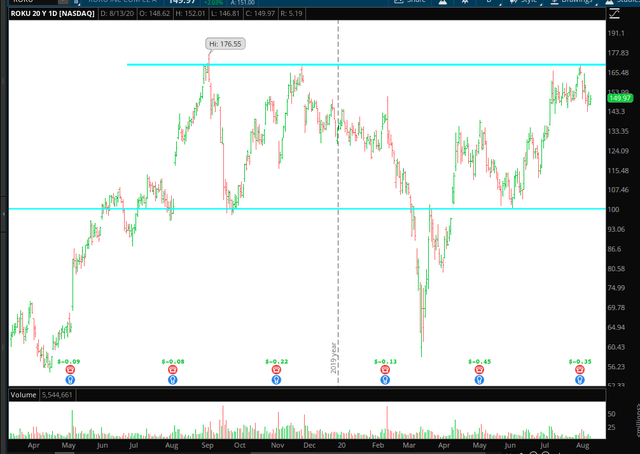
Source: TOS
Accelerating Growth And Abundant Potential
Roku delivered very solid numbers for the second quarter, with revenue reaching $356.1 million and increasing 42% versus the same quarter in the prior year. The number was materially ahead of the $311.55 million expected on average by Wall Street analysts. This kind of performance is unquestionably healthy, especially for a company that depends on advertising.
However, management provided a grim outlook for advertising demand in the near term. According to CEO Anthony Wood:
The outlook for the ad industry remains highly uncertain for the balance of this year, and we believe it will be well into 2021 before TV ad investment recovers to pre-pandemic levels
Leaving macroeconomic factors aside, the company is executing very well and driving an acceleration in many of the most important operational metrics.
Some key highlights for the quarter:
- Platform revenue increased 46% to $244.8 million
- Roku added 3.2 million incremental active accounts in Q2 2020 to reach 43 million. This is a record for the company in a non-Q4 quarter.
- Streaming hours increased by 2.3 billion hours over the last quarter to 14.6 billion.
- Average Revenue Per User reached $24.92, an increase of 18%.
- The Roku Channel reached U.S. households with an estimated 43 million people.
In a nutshell, revenue growth decelerated somewhat due to economic factors, but the company is still driving accelerating user growth and engagement. Management cannot control economic conditions, but they can control how they face challenging times, and they seem to be doing a very good job at protecting and even enlarging Roku's fundamentals.
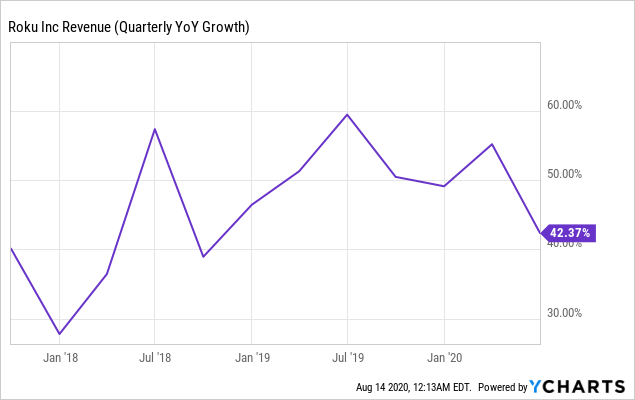
Data by YCharts
International expansion could open the door to massive growth opportunities for Roku in the long term, and the company is barely getting started in terms of capitalizing on such an opportunity.
Player sales in both Canada and the UK more than doubled year-over-year during the second quarter, and Roku TV sales account for more than one in four smart TVs sold in Canada. Management also highlighted a strong performance in emerging markets such as Mexico and Brazil over recent months.
Attractive Valuation
Valuation is an art as much as a science. Having a fixed valuation target for a company is too rigid and short-sighted, and value estimates should always be dynamic and probabilistic as opposed to static and deterministic.
The value of the business depends on the earnings and cash flows that such a business is going to produce in the future. The future can never be known for certain, only estimated, and those estimates necessarily carry a large margin of error.
A stock is not undervalued when it has low valuation ratios. These low valuation ratios simply reflect the fact that the market has low expectations regarding the future of the business. The stock market is not always right, but it is right more often than not.
When the valuation is reflecting mediocre growth prospects and the company has in fact mediocre growth prospects, then the stock is not undervalued at all. The stock is undervalued when the market is underestimating the company's fundamental quality and long term growth potential.
The chart below shows consensus revenue numbers for Roku over the coming years. As we can see, growth rates are expected to remain high but decelerating over time.
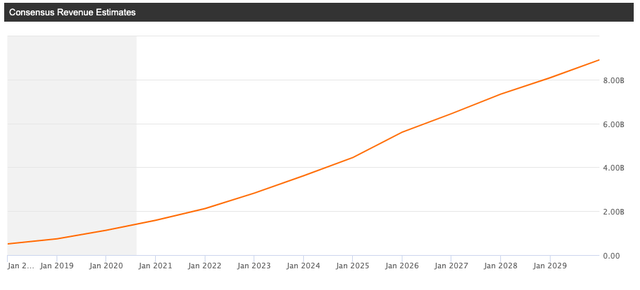
Source: Seeking Alpha
In order to see the data more clearly, the table shows the average revenue estimate, the year over year growth rates, and the forward price to sales ratio for Roku based on Wall Street expectations in the years ahead. The table also shows the lowest and the highest revenue estimate among the analysts following the stock.
| Fiscal Period Ending | Revenue Estimate | YoY Growth | FWD Price/Sales | Low Estimate | High Estimate |
| Dec 2020 | 1.58B | 40.38% | 11.57 | 1.54B | 1.64B |
| Dec 2021 | 2.12B | 33.47% | 8.67 | 1.86B | 2.39B |
| Dec 2022 | 2.82B | 33.45% | 6.49 | 2.35B | 3.33B |
| Dec 2023 | 3.62B | 28.11% | 5.07 | 3.43B | 3.93B |
| Dec 2024 | 4.45B | 23.00% | 4.12 | 4.11B | 4.76B |
| Dec 2025 | 5.60B | 25.92% | 3.27 | 5.46B | 5.74B |
Source: Seeking Alpha
To begin with, even if we take the average estimate of $2.12 billion in 2021, the stock would be trading at a price to sales ratio of around 8.7. This is not excessive at all for a company growing revenue at more than 30% under rather conservative assumptions.
Even more interesting, the gap between the high and low estimates for Roku is quite large. For 2021 we have a high estimate of $2.39 billion and a low estimate of $1.86 billion, a massive difference of over 28% for the high and low revenue estimates next year.
If you believe that the actual numbers will be closer to the high end than the low end of the estimate range, then Roku is actually much cheaper than what it seems to be at first sight.
For your reference, the most bullish revenue estimates put Roku stock at price to sales ratio of 7.6 for 2021 and 5.5 for 2022. These numbers are actually quite compelling.
When a company outperforms growth expectations investors can be rewarded with both higher than expected revenues and expanding valuation multiples. In simple terms, if revenue grows faster than expected the price to sales ratio tends to increase too, providing a double boost to the stock price.
The Bottom Line
When looking at the risks, advertising demand is intrinsically cyclical and depending on economic conditions, and Roku has fully acknowledged that the recession is hurting revenue growth in the short term.
It is too early to tell how long it will take for demand to fully recover, and this will be an uncertainty factor weighting on Roku stock until we get more clarity on the economic horizon.
Roku is also facing competition from companies of all sizes, including giants such as Amazon (AMZN) and Google (GOOG) (GOOGL), among many others. Roku has proven over time that it is not afraid of competition, and a deep focus can be a crucial source of advantage for Roku. The company is 100% focused on online TV, which puts it one step ahead of the tech giants with lots of areas of focus and different priorities.
Those risk factors being acknowledged, the fact is that Roku is executing exceptionally well during challenging times. The company is driving accelerating user growth and expanding its ecosystem across the board.
Once the economy improves, and it will most probably improve over the coming months, Roku will be able to translate solid operational improvements into accelerating revenue growth and probably improving profit margins too. Programmatic is the future of advertising, and connected TVs will keep stealing dollars away from traditional TV advertising over the years to come. Roku is in the right place to capitalize on these opportunities.
International markets are practically virgin territory for Roku, and recent data in this area looks quite interesting. If Roku succeeds in international expansion, then the stock could deliver massive returns from current price levels.
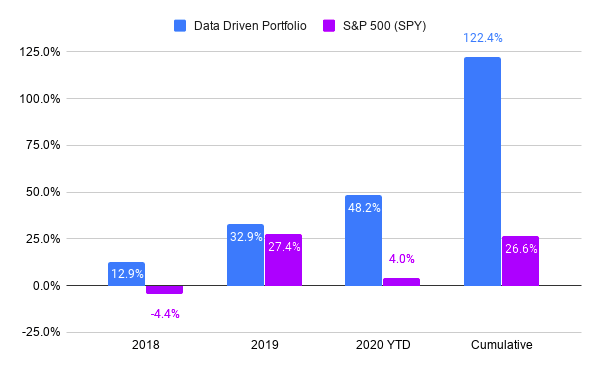
Performance as of August 9, 2020



Comments
Log in or sign up to join the conversation.