

As you might imagine, I literally get scores of emails loaded with information every day. On Mondays, it can approach 100. As a self-confessed information junkie (is there a 12-step program for us?), my inbox is a rich trove of data and intelligence. 15 years ago, a big day was 20 or so emails. I could cope. Now, I am time pressed to absorb even half of what’s on my plate.
For 26 years, this letter has attempted to take all of that information and distill it into what I feel is important that week in a shorter form for you. The amount of data that gets left on the cutting room floor is larger than ever. But then, you know that as you are experiencing the same thing. I want to thank you for giving me the most valuable thing in all of the universe: your attention. I really do try to make each and every letter worthy of your time.
This week is no different, as the amount of important events is larger than normal, but there are a few things that we need to pay attention to: the large move in interest rates and what it means (and more importantly, what it doesn’t mean!); and the constant barrage of p(doom) (the new way to write doom and gloom) on energy and AI. Let’s jump in:
Why Are Interest Rates Rising?
While most eyes are focused on the Fed, as they have begun an interest rate hiking cycle, this particular Fed is actually behind the market, which is by design. Warsh is specifically not giving forward guidance, and wants to move the Federal Reserve policy to follow the markets, rather than trying to lead them. Further, the Fed is only one component in the interest rate setting complex.
Obviously, inflation is important. The strength of the economy (and unemployment) will cause rates to rise. And competition for capital will cause rates to rise. All three of those environments are impacting long-term rates now.
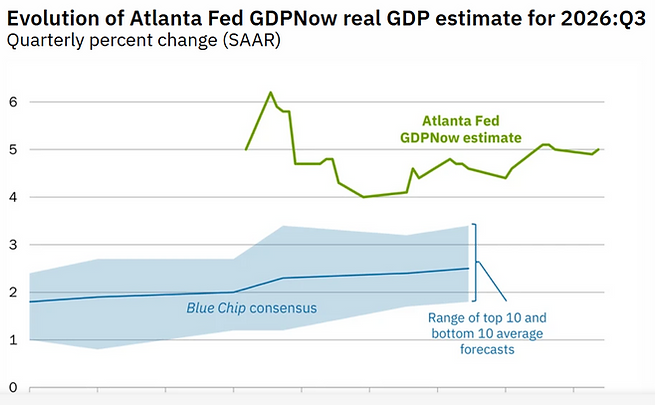
The Atlanta Fed GDPNow forecast is for a 5% annualized GDP for the third quarter. We are one week from the end of the fourth quarter, so while revisions are normal, we are getting to the place where a strong third-quarter GDP is highly likely. Yes, I get all the headwinds. And if you are in the housing business in one form or another, you could be forgiven for thinking that we are in a recession. But the general economy is doing quite well. And without going into exhaustive detail, with lots of charts and graphs, that economic strength generally (though not always) feeds into higher interest rates.
Source: Federal Reserve Bank of Atlanta
Which Way Inflation?
There are many that are characterizing the current rise in interest rates, especially longer-term rates, as the return of the bond vigilantes concerned about rising government debt and interest rate costs. And there is certainly reason to be concerned. Inflation is well above the target.
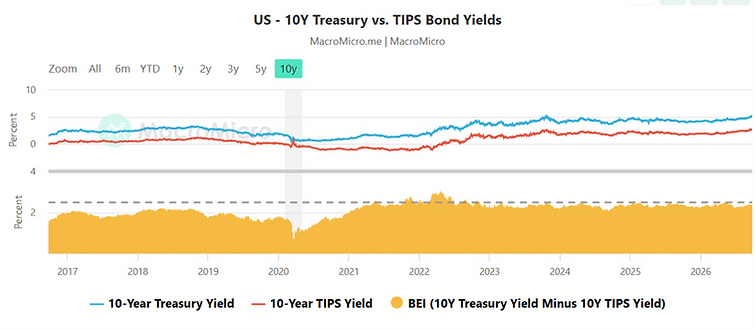
As of market close on September 24, 2026, the TIPS yield curve has short-term real yields at 2.16% for 1-Year TIPS maturities with a breakeven inflation rate of 2.38%. 5-Year TIPS maturities have a real yield of 2.53% alongside a breakeven inflation of 2.45%. At intermediate durations, the 10-Year TIPS is yielding 2.81% with a breakeven of 2.27%. At the long end, 30-Year TIPS real yields are near 3.17% with breakeven inflation of 2.23%.
Source: MacroMicro
The Fed’s target rate for inflation is 2%. The market is telling us that they don’t believe the Fed will have it down to below 2% even within five years. Of course, that will change a great deal over time, but today the market would clearly like to see more progress on the inflation front before interest rates begin to subside.
What’s Driving Corporate Yields?
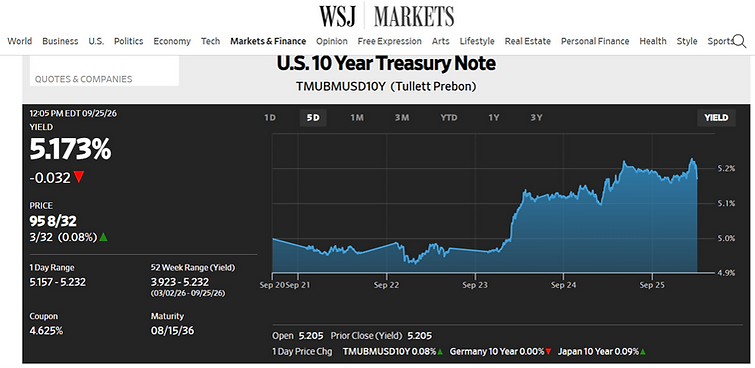
We saw a rather vicious rise in the 10-year yield on Wednesday from below 5% to over 5.2% and it is settling down this morning to 5.17%. There are a lot of factors, but some of it is as Torsten Slok and others have pointed out, the competition for capital is becoming somewhat fierce. This is what happens when an economy is doing well. Businesses want to expand and need capital.
And that is brought into sharper focus by the trillions of dollars being borrowed to fund the artificial intelligence expansion.
Sidebar: the data centers being built are immediately used when they open. The demand for information is practically infinite, especially as the cost for that information goes down. I am not one that believes that every participant in the AI race will be profitable. But some will be wildly so. We just don’t know who. And that is why so much money is being invested. And that money is unprecedented in scope and size and is crowding out other investments and raising the price of money all across the spectrum.
First let’s look at the move up this week in 10-year treasury rates. That is being reflected everywhere.
Source: WSJ
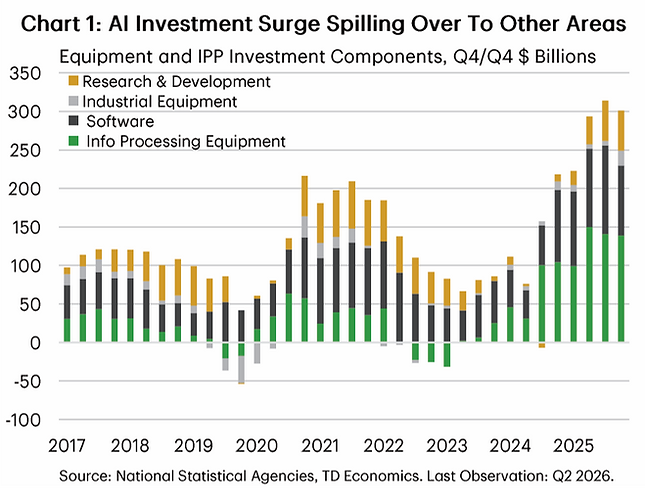
In the chart below, we can see how AI -related processing equipment and software have simply overwhelmed other capital investments like R&D and industrial equipment. The growth is simply astonishing.
Source: TD Economics
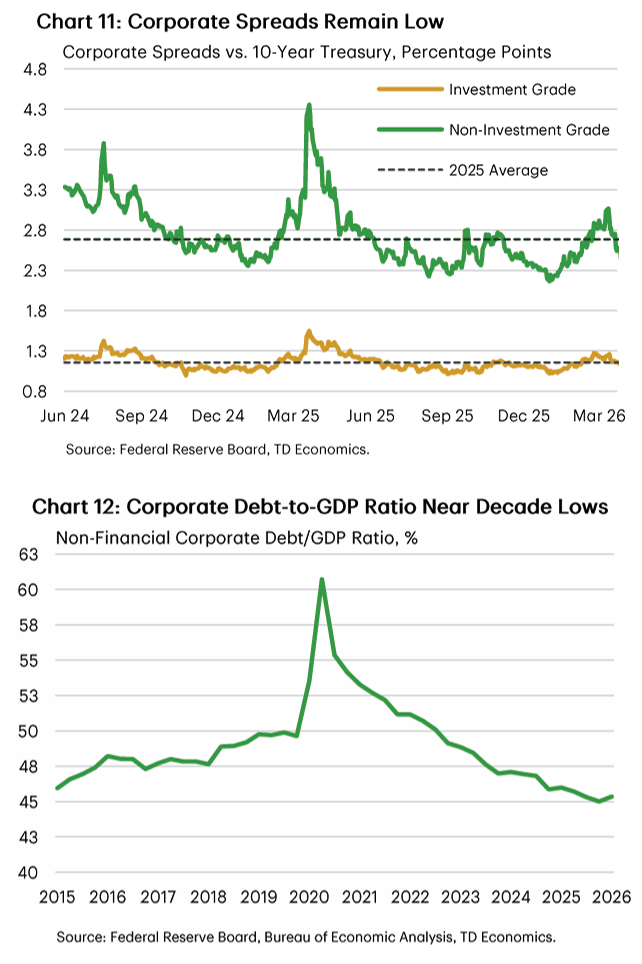
All that being said, corporate spreads over 10-year treasuries are relatively low. This is a reflection on strong corporate balance sheets. Corporate debt to GDP ratios are near a 10 year low.
Source: TD Economics
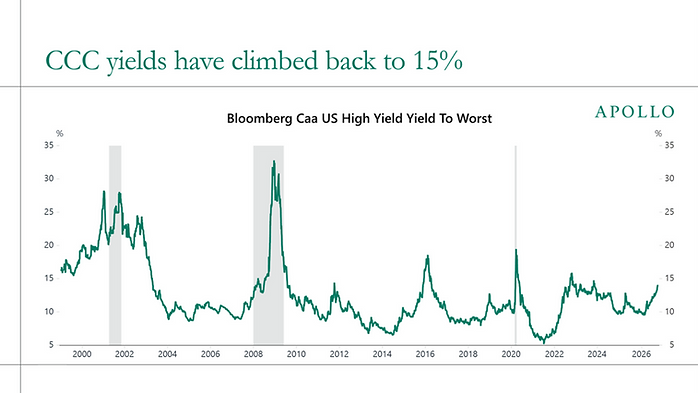
But that is not to say that lower rated bonds are not under stress. Let’s see what Torsten Slok of Apollo has to say:
Higher for Longer Hits the Lowest Rated
Higher for longer is a slow squeeze for low-quality credit. Every month rates stay elevated, more CCC borrowers from the 2021–22 vintages hit the refinancing wall with less cash to service their debt, and with CCC yields around 15% while the broader credit market stays calm, the bill from the cheap-money era is landing on the weakest balance sheets first.
The pain is sharpest in heavily levered, PE-backed technology, healthcare and consumer discretionary names, where floating-rate debt, thin margins and AI disruption risk leave little room to absorb years of elevated borrowing costs.
The bottom line is that monetary policy is working with a lag and working unevenly. Strong balance sheets have locked in cheap fixed-rate debt and have barely felt the Fed's tightening, while the most leveraged borrowers feel it in full as floating-rate costs and maturities reset, so the transmission mechanism is running mainly through the bottom of the credit stack.
For investors, the message is to move up in quality, because high-quality credit still offers attractive all-in yields without the default, restructuring and liability-management risk that is now concentrated in lower-rated credits.
In short, it is a good idea to invest in companies with earnings because they can pay their higher debt-servicing costs.
Source: Apollo
Sidebar: this will make well-managed distressed debt funds attractive. Think Oaktree or Apollo or Fortress, to mention some of the more well-known names (I have no business relationship with any of them). Just saying…
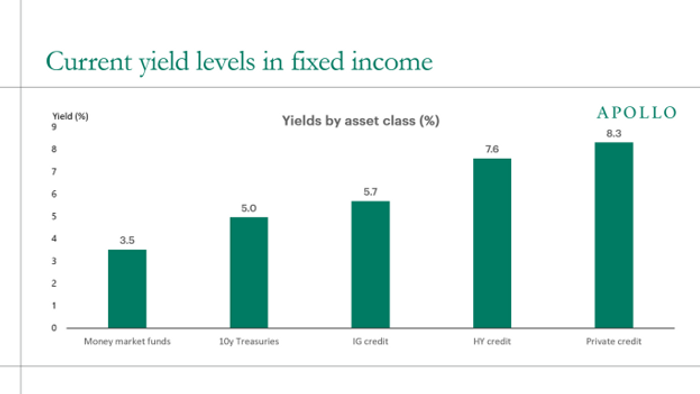
Finally, one of the charts is from Torsten Slok at Apollo. These are the current yield levels across various types of fixed income offerings. In the next section, I want to particularly focus on that mutual fund money market return of 3.5%.
Source: Apollo
Reversing Financial Repression
Since about 2010, I have been critical of holding interest rates close to the zero level, as it hurts savers and retirees. In one sense, it is partially responsible for the bull market in stocks because there was no (or very little) return on savings from fixed income (TINA - There Is No Alternative), so retirees were forced to take risk in equity markets. As it turned out, this has worked well, at least up until now.
But now, we have alternatives. Below is a graph of the yield curve on US government debt. You can get 4.9% on two-year government debt. That seems to be the sweet spot right now, as you only get an extra 70 basis points for tying your money up for 20 years (unless you are an insurance or long-term investment institution, why would you do this?).
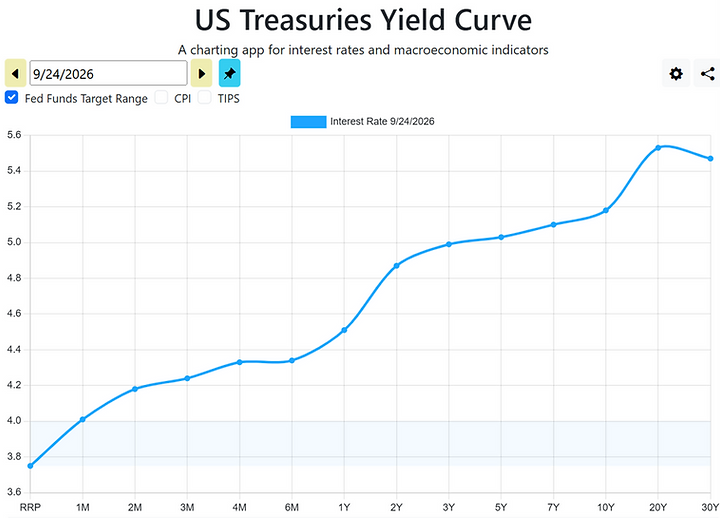
Source: U.S. Treasury Yield Curve
Businesses all over the country are making decisions as to how they allocate their cash. A few years ago, there was not much reason to go more than 90-180 days for cash equivalents. Now? We have choices. Let’s look at some actual practical alternatives you can use to improve your returns over money market funds or cash in the bank. To illustrate this, let’s look at what we do at Mauldin Economics.
Every business has its own nuances. And the publishing business is no different. While my letter has been and always will be free, we sell other publications. For the sake of simplicity, let’s say we sell a one-year subscription to a letter for $120. Under accounting rules, we can only recognize one month’s allocation ($10) at a time. So, while we get $120 in cash up front, we slowly recognize that income over the next year. The part that is not yet recognized is called deferred income.
I’ve been in the publishing business now, in one form or another, for 34 years. I can’t tell you how many companies have gone bankrupt by spending all that subscription income upfront and not having enough money left to pay taxes or other fulfillment needs. This was very apparent in the 80s, and by the early 90s, responsible publishers always set aside their deferred income. Typically, that was in a money market or other liquid forms.
At Mauldin Economics we use Treasury Direct. Basically, you can buy US treasury debt all up and down the curve directly without a brokerage commission, fee or other charges. For the last 15 years, we have simply put that deferred income into short-term treasuries. We preferred the liquidity option over whatever small incremental return we had for moving up the curve.
Today, we are in a discussion as to how far out the curve we need to go to increase our returns. Because we are constantly selling subscriptions to one letter or another, the amount of money to build up in the deferred income account is significant, at least to us. Because of the peculiar dynamics of our industry, we pretty much know, barring a subscription apocalypse, roughly how much cash we will need in one year. The simple decision was to just buy short-term treasuries, which always offered a small premium to money market mutual funds or banks. The better decision today will be to move out the yield curve, likely no more than 1-2 years to modestly increase our returns.
That is not much different than what you as investors must decide about your cash. Will you need it all within two years? Five years? How much risk do you want to take?
You can get high-grade corporate bonds at around 6%. High-yield rated corporate bonds are 7.7%. If you really want to move out the risk curve, you can get 16% on CCC junk bonds. Obviously, a 10% premium suggests there is a lot of risk in that part of the curve.
Let’s file this in the category of be careful what you wish for. Savers have wanted a higher return for almost 15 years but borrowers want lower interest rates. That is changing. The point is that financial repression of low rates is ending. So now we have higher rates. And for the reasons established above.
Higher-yielding money market mutual funds concentrated in treasuries pay between 3.5% and 3.7%. You can get roughly 1% more in one- and two-year treasuries through Treasury Direct.
The Problem with Diesel
My son reports that diesel fuel for his truck is now over six dollars in Texas. This is even as the price per barrel oil has come down some this last week. Ironically, there is not that much of a shortage in actual barrels of oil around the world. Yes, we are not floating in a sea of oil, but it is available at a price.
The problem with diesel is that it is not that we don’t have enough oil to produce it, it is that we don’t have enough refining capacity. We all know that Ukraine is taking one Russian refinery after another out of production. This has led Putin to not allow diesel to be sold into the world markets from Russia, as he needs it for his war efforts. Understandable. But this produces price pressures for the rest of the world.
And of course, the Iran war is cutting off production from getting through the various straits, and refinery capacity is being targeted as well. We all know that.
So what do US politicians want to do? They want to make it seem like they are doing something, so they are now calling for export controls on diesel. On a list of dumb ideas about what to do because of the war, this one may be at the top. We don’t need diesel to fuel our war efforts.
Right now, we ship a great deal of diesel around the world. And yes, that is making refineries more profitable. They have gone from 80% plus capacity utilization to the low and mid 90s, producing as much diesel as they possibly can as the “crack spreads” are at their highest ever point.
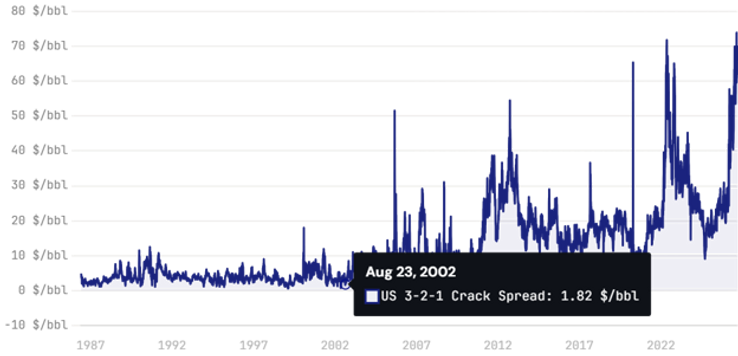
Source: Eco3min
I had this conversation with my wife last night, as she was talking about the diesel price our son is paying. Why should we limit exports? Diesel prices are too high.
I found it somewhat difficult to explain. If we limit exports, in theory the price of diesel would come down. Except that refiners would reduce their production, as they are not interested in the absolute amount of diesel produced, but in the profits they make for refining diesel. And that means having a crack spread as attractive as possible. Further, that would raise global diesel prices for all our allies, which would show up in the cost of everything we import.
Even worse, it would make the price of gasoline higher. Why? If exports are banned, refiners cannot simply stockpile unlimited diesel. They would have to reduce production. Because gasoline and diesel are produced together, producing less diesel also means producing less gasoline. Less fuel production means tighter supplies and higher prices for both diesel and gasoline.
Further, it might mean retaliation from our trading partners (I mean, with Trump retaliating for everything, why wouldn’t they?). It helps foreign competitors.
Making the idea even worse, by the time they could get such a ban implemented, it would have no effect on the price of diesel prior to the midterm elections, which is kind of the point of the political exercise. It might make for good political talking points, but it is still a dumb idea.
For those more interested in the details on the energy situation, the best thing I have read on oil prices and oil production is from David Bahnsen writing in his Dividend Cafe.


Comments
Log in or sign up to join the conversation.