


And whether or not it is clear to you, no doubt the universe is unfolding as it should. Therefore, be at peace with God, whatever you conceive Him to be. And whatever your labors and aspirations, in the noisy confusion of life, keep peace in your soul. With all its sham, drudgery and broken dreams, it is still a beautiful world. Be cheerful. Strive to be happy. - Desiderata by Max Ehrmann ©1927
There is a wonderful poem called Desiderata, that I’m sure we have all read many times, by Max Ehrmann. It is a compilation of seemingly random thoughts that are wisdom about living life. No real connection between these thoughts, other than when viewed in its entirety, it is a fabulous way to look at life and the world.
Each week I read hundreds of “desiderata” about finance and economics and the world, perhaps interesting in their own right, but when taken together offer a far more complete picture than focusing on one point. It is easy to find problems, as there are many, but focusing on them to the exclusion of the positive is more than just counterproductive. It drains the soul.
Maybe it’s just my impression, but the mainstream media has become more focused on writing about the negative over the years. This is because negative headlines and stories produce more engagement and clicks, thus more revenue. It also produces an overall negative mood in the country, as we can see from numerous surveys. Stories about the marvels of free markets and capitalism in providing the greatest lifestyle in the history of the world, just don’t have the same “mental grab.” “If it bleeds it leads,” was the mantra of most editors in the newspaper era. In the social media world of today? It dominates. Much of that concern is justifiable, but it is not the entire picture.
Today, we’re going to look at a lot of various data points and analysis, that when taken together give us a much clearer picture of the total world.
Is 29,000 Jobs Enough?
“Payrolls were softer than expected, rising 29k in September and below the estimate of 90k. The prior two months were revised down by a total of 60k. Of this, private sector jobs grew by 46k vs 89k in the month before (down from the initial print of 127k) with a drop in government.
“The household survey reflected strong job growth, though this is a very volatile monthly number, rising by 406k but because it didn’t keep up with the rise in the labor force of 485k, the unemployment rate ticked up to 4.2% from 4.1%.
“Smoothing out the monthly volatility, the 3-month job gain average is 51k vs the 6-month average of 66k and the 12-month average of 41k. For perspective, in 2019 the monthly job gains were 165k.
“Bottom line, the debate continues as to what the monthly job gains are needed in order to satisfy the increases in the labor force which we know have slowed. I’ve seen estimates everywhere from zero to north of 50k so the 3-month average is kind of in the range.” (H/T Peter Boockvar)
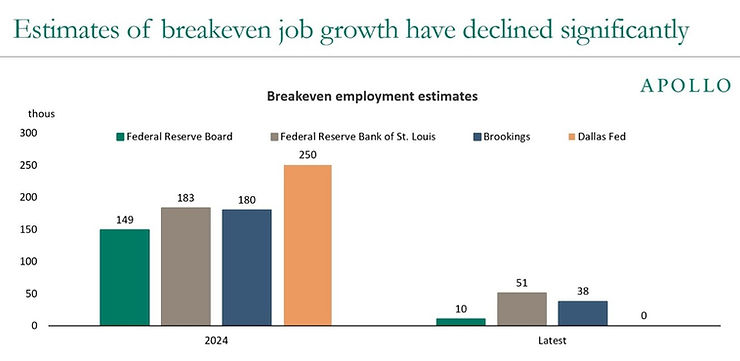
Torsten Slok of Apollo notes that breakeven job growth has collapsed from 200,000 per month to close to zero today, driven by a sharp drop in immigration shrinking labor force growth and continued baby boomer retirements pulling down participation. The graph below shows how much things have changed among economic observers in just the last two years. These are estimates of what the breakeven job growth would be to keep the unemployment rate steady. These estimates are from the Federal Reserve, the Federal Reserve Banks of St. Louis and Dallas and the Brookings Institute. Two years ago, the average breakeven estimate among these four was roughly 190,000 jobs. That’s a tall order. Today it is 25,000 jobs, and the 29,000 jobs print, which historically seems quite weak, is in line with a steady unemployment rate. Which is exactly what we got.
Source: Apollo Global Management
This is mostly a function of immigration reducing the labor force and baby boomers retiring in ever greater numbers. Eventually (as in a year or two) the immigration overhang gets worked out. And then I would expect the breakeven number to increase. But back to 200,000 new jobs every month? I am not sure that’s in the cards.
29,000 jobs is not a lot. Is it enough? Let’s see what the numbers look like for the rest of the year.
The good news buried in this report? Unemployment remains low. That’s not to say that everybody has a job that they would like, at the pay they want. Three of my kids are looking for jobs, so I hear how hard it is to find them.
What Will the Fed Do?
We have now had three FOMC members basically saying this week that there is no urgency in raising rates, the implication being no rate hike in October. This unemployment data coupled with improving PCE inflation numbers gives Warsh the space not to raise rates six days prior to an election, something I have maintained that would be politically problematic. No harm in waiting till December.
The State of the Economy
Let’s look at the data on the general economy. One of my favorite sources is Philippa Dunne and Doug Henwood writing in the TLR Analytics. Philippa has given me permission to use these charts from their report this week.
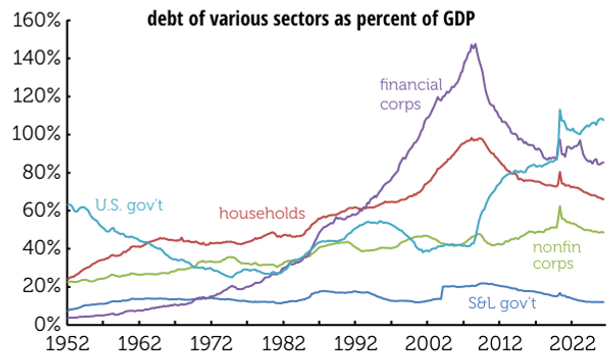
First, with the exception of the government, every sector of the economy is reducing their debt: financial corporations, households, nonfinancial corporations and even state and local governments. Household debt is down to where it was in 1998.
Source: TLRanalytics
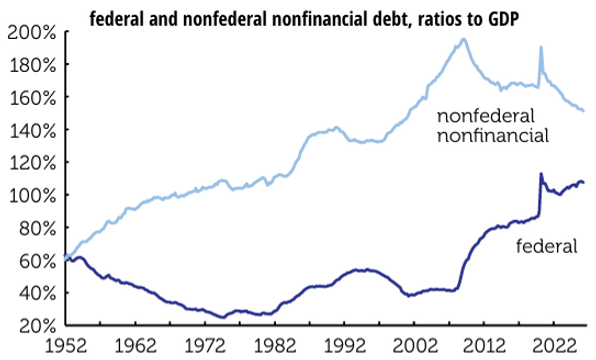
Nonfederal financial debt (not including banks and financial institutions) has dropped from a high of 200% of GDP to below 160%. Part of that is the growth in GDP, but most of it is actually paying down and reducing debt. This will be important if we have the financial crisis I am predicting as debt is always a problem in financial crises. So the less you have to begin with the better off you are. Whether it is corporations or personal.
Source: TLRanalytics
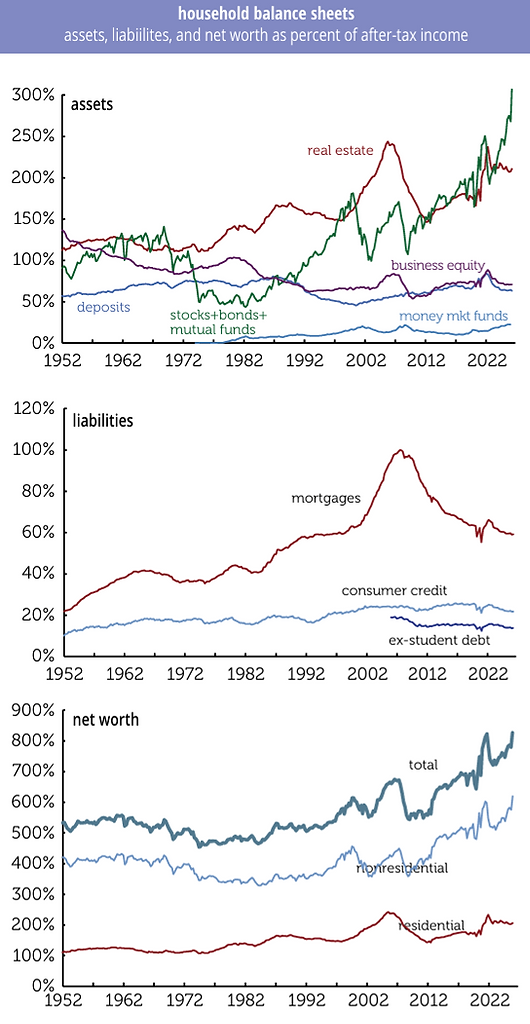
Household balance sheets are continuing to improve. Stocks and bonds and mutual funds are the source of much of the growth. Note that in the chart below that mortgage liabilities are dropping, and when you take out student debt, consumer credit is modestly lower. And that’s with a larger adult population. Net worth is increasing. Of course, that net worth is increasingly skewed to the top half and quarter and 10% and 1% of the population. In some cases heavily so.
Source: TLRanalytics
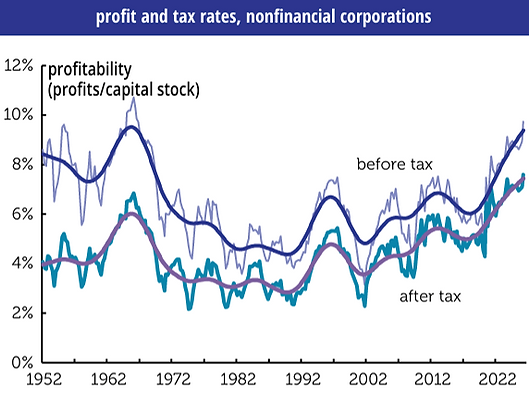
And nonfinancial corporations are having an incredible run. Profitability in terms of percentage was in the 60s before tax, but after tax we are at an all-time high. The corporate tax rate is 22%, and this last quarter there was an effective tax rate of 22.1%.
Source: TLRanalytics
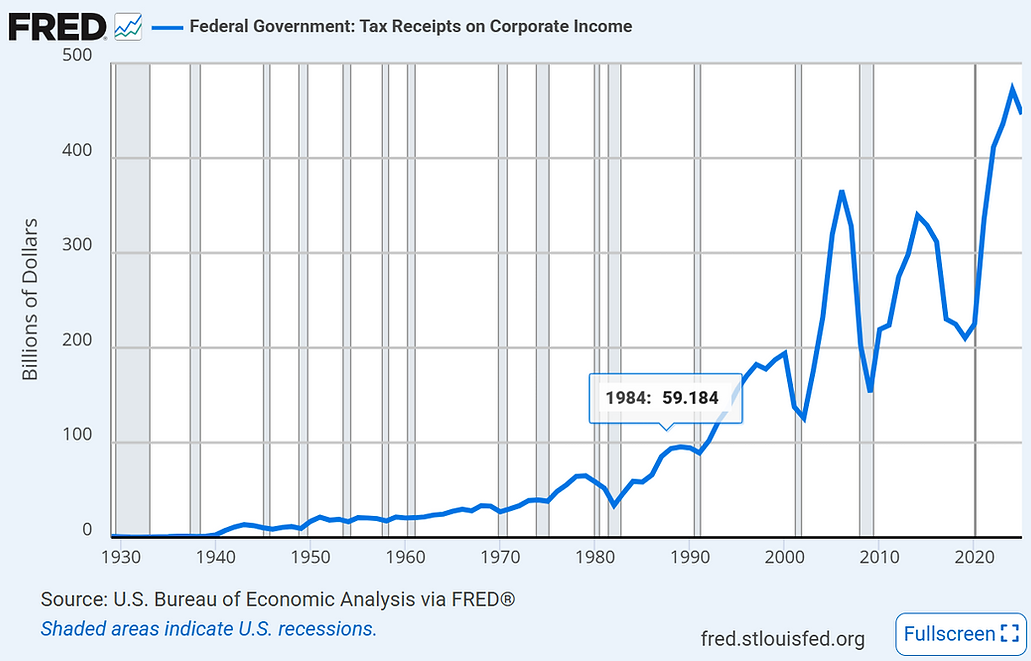
I should point out that even with a 22% corporate tax rate, the high profits of US corporations from total tax revenues from corporations have increased dramatically since the rates were cut. We are close to an all-time high that we saw only a few quarters ago.
Source: Federal Reserve Bank of St. Louis
I find TLR Analytics to be one of the best sources of analysis on government data and general social trends that I know of. The newsletter is targeted to institutions, as it is pricey. That being said, if you would like a trial subscription, drop a note to Philippa Dunne at [email protected].
It’s Not Just Data Centers Powering the Growth
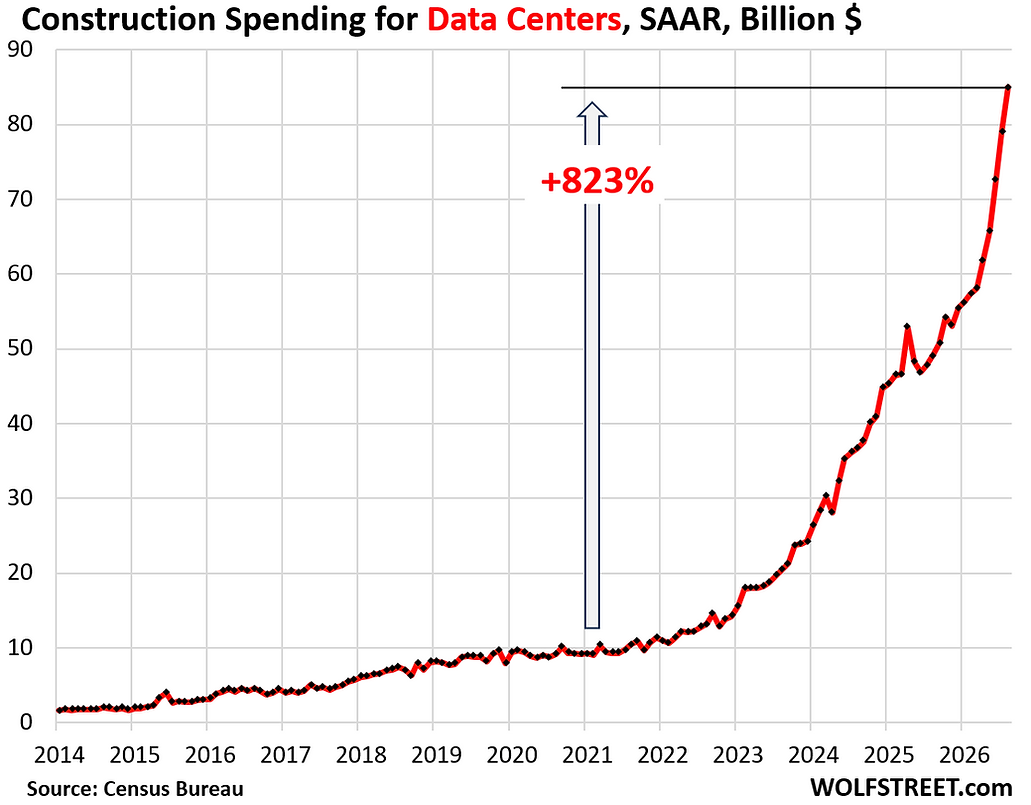
We are all aware of how much construction spending on data centers is boosting the economy. The growth of construction spending is up 823% since 2021, to roughly $85 billion a year currently. And that does not include the servers and racks, the electronic equipment, connection with servers to the Internet, power supplies, etc. All of that spending is driving a significant portion of the growth in GDP.
Source: Wolf Street
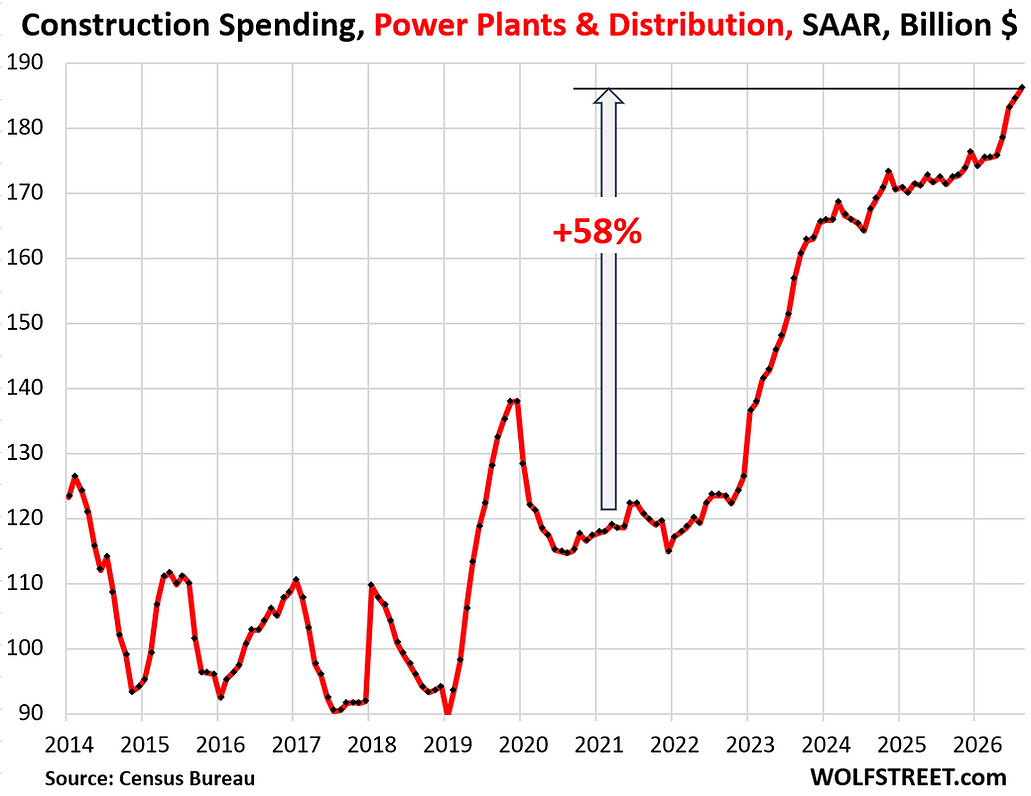
And the spending on power plants to power these data centers is monstrous as well, growing to an annualized $186 billion a year currently. All of which creates demand on the construction labor pool.
Source: Wolf Street
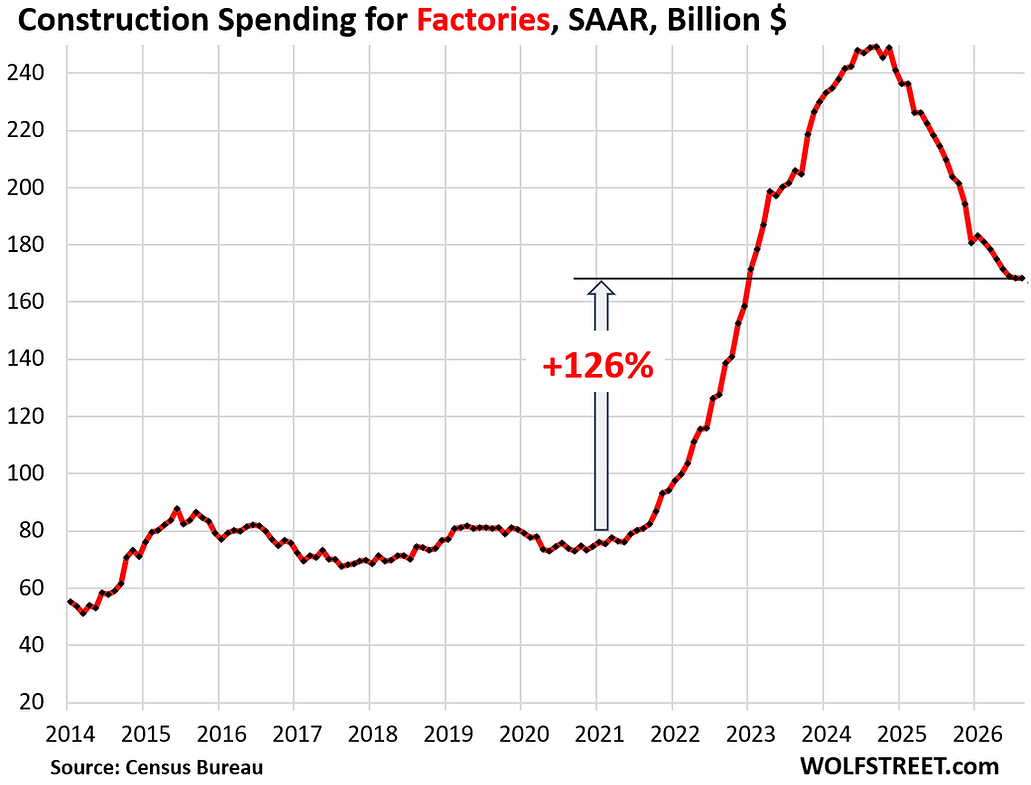
But the construction story is not just data centers and power plants. What almost no one talks about is the relatively large growth in factory construction. Here’s Wolf Richter:
“Factory construction spending growth – “growth,” not actual spending – has taken a backseat to the mania of data centers; “actual spending” on factory construction ($168 billion annual rate) is still nearly double the spending on data centers ($85 billion annual rate).
Spending on factory construction at an annual rate of $168 billion in August was unchanged from July, and down by 19.8% year-over-year.
But it was still 126% higher than what it had averaged over the six-year period 2015-2020.”
Source: Wolf Street
This coupled with a constantly reduced level of immigration labor, as you might imagine, is creating havoc in the construction world. Data centers are skewing the cost, as they will simply pay whatever they have to pay in order to get the experienced labor they need. Material prices are up more than 50% since 2021. The Producer Price Index for construction spiked 10% this last year.
Anecdotally, in talking with those involved in the construction world, the common complaint is finding workers at a price that is affordable. At some point, I think we are going to have to rethink our entire immigration process. I get that these immigrants have come to the country illegally. And we need to control our borders and be more selective in who we let in. That being said, with boomers retiring, we are simply going to need more workers, and we are not producing them organically (the old-fashioned way) in the quantities we need.
But at some point, when we finally do make the commonsense immigration reforms that are needed, we are going to have to contemplate people who are in the country and are working and contributing to be allowed to stay. It’s an emotionally charged subject, but economics and the need for workers will eventually come front and center to the conversation. Basically, GDP growth comes down to the number of workers times productivity. While technology is having a productivity moment, we’re going to have to focus on the number of workers problem sooner rather than later.
(This conversation could take an entire letter or two. There will be no consensus that doesn’t require compromise from the various parties involved in the negotiations.)
The Changing Nature of Warfare
Jim Brooks is a well-regarded geopolitical analyst and commentator on military affairs. He recently wrote about the massive changes going on in Ukraine and Russia. I am picking selected quotes from his article.
(For fun, here is the AI-generated image for that article.)

Source: The New York Sun
“Offering a glimpse of the future of warfare, the IT leader who gave Ukraine its ‘Army of Drones’ in 2022 now plans to build Ukraine’s ‘Army of Robots.’
“Technological warfare does not stand still. We need the next breakthrough,” Mikhaylo Fedorov posts about his new project. “Our bet is on the robotization of warfare. The mission of the Army of Robots is to save lives.”
Mr. Fedorov has a track record. Last February, as Ukraine’s Defense Minister, he persuaded Elon Musk to cut off Russian use of Starlink. This month, he persuaded American tech billionaire Alex Karp to become the first investor in his new defense technology company.
Setting markers, Mr. Fedorov told tech leaders at a conference in Lviv last weekend that his goal is for a humanoid robot to kill the first Russian soldier in six months. He set a one-year deadline for the first robot assault on an enemy position with no infantry involved.
“Make robots fight instead of people,” he said.... “Robots should do the most dangerous work so our service members can come home.”
Robots are changing the way wars are being fought. Drones obviously. Russia and Ukraine just had their first “sea battle” between naval ship drones (Ukraine won). Helicopters are no longer needed for medevac as drones drive to the injured party and bring them to hospitals.
“On the battlefield, Ukraine’s tech advances are making some military specialties go the way of the horse-mounted cavalry. From this 4.5-year long war, Ukrainian snipers account for three of the five longest confirmed kills in the world. But now, Ukrainian snipers are shifting into drone work. A 2.5-mile shot can’t compete with an all-seeing drone roaming over miles of front lines. Ukrainian officers estimate that the life span of a Russian soldier who ventures into the 30-mile wide ‘kill zone’ is 20 to 30 minutes.”
Drones are now doing the incredibly dangerous work of clearing out landmines, which stopped the 2023 Ukrainian offensive in its tracks. 50,000 drone missions were carried out by the first half of this year.
Russia and Putin are not sitting still. “President Putin’s response is to throw money as well as men at the problem. Russian government spending on the military is to jump by 27 percent, to $203 billion next year, Reuters reports, citing Russian budget documents. Next year, Russia plans to spend $12 billion on production of jet-powered drones and loitering munitions, President Zelensky said Saturday in his nightly address to the nation. “In September, the Russians launched more than 2,730 jet-powered “shaheds,” he added, referring to a Russian version of an Iranian design.”
Like much military technology, this will have implications for commercial robots. Elon Musk’s and others’ vision of the world on millions of personal humanoid robots is being pushed into reality by what is happening in Ukraine and Russia. US manufacturers are learning and working in tandem with Ukrainian forces. Trump has just launched an initiative in the military to produce more modern tools for our military.
On the problem side, housing construction is in the doldrums. Mortgage rates are at recent highs. That being said, almost 50% of current mortgages are below 4%. Just slightly under 20% of mortgages are under 3%! Makes it hard to want to move or sell. Income and wealth distribution is still way too high.
Energy prices and especially diesel availability is an issue. The growing acceptance of socialism among frustrated young people is problematic.
But on balance? The world is progressing and things are getting better, if not always in a straight-line fashion. We need to recognize that the world is not coming to an end, it’s just changing very rapidly.



Comments
Log in or sign up to join the conversation.