

Dutch retail sales are expected to increase by 3% in 2026, driven by 4.5% growth in e-commerce. Supermarkets and drugstores are gaining online market share at the expense of online-only retailers. At the same time, rising costs and intense price competition are making it harder for retailers to translate sales growth into higher profits
3% retail sales growth in 2026
Retail sales are expected to increase by 3% in 2026, the same as last year. Consumers remain cautious about their spending, which means growth is modest despite improved purchasing power.
Ongoing geopolitical tensions and the resulting rise in energy and fuel prices continue to weigh on consumer confidence and spending appetite.
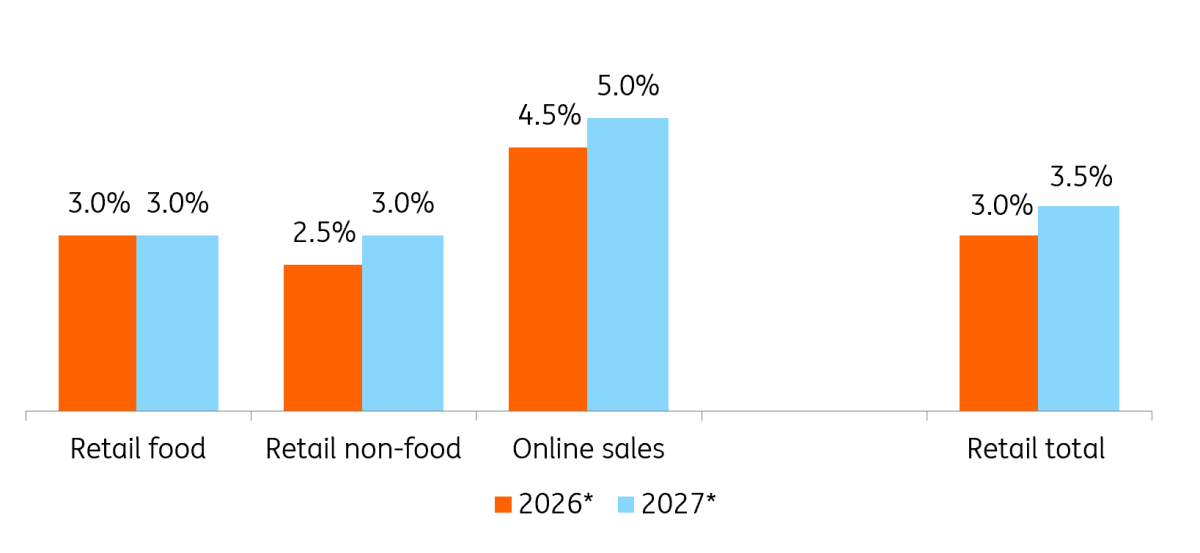
Within the retail sector, e-commerce remains the primary growth driver with an expected increase of 4.5%, outperforming food retail (3%) and non-food retail (2.5%). Looking ahead, a similar growth pattern is anticipated for 2027, broadly reflecting expectations for the Dutch economy as a whole.
Retail sales growth of 3% again in the Netherlands in 2026
Retail sales volumes in the Netherlands in 2026
Source: CBS, *forecasts 2026 and 2027 ING Research
Prices for shoes, furniture and consumer electronics continue to ease
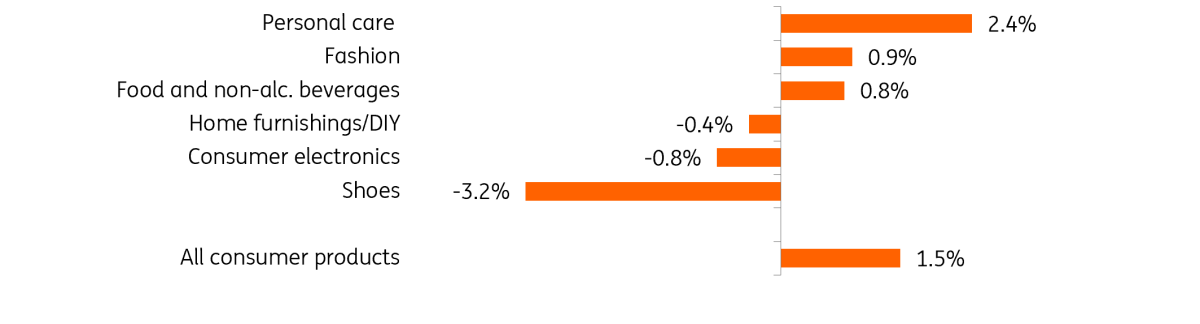
Despite higher energy and fuel costs, consumer goods prices increased by an average of just 1.5% in the first seven months of 2026, down from 2.4% a year earlier. The slowdown was particularly evident in food and non-alcoholic beverages. After prices rose by an average of 4% in 2025, food inflation eased significantly, with prices increasing by less than 1% between January and July 2026.
Price pressures have also moderated across much of the non-food segment. Personal care products, such as shampoo and perfume, became on average 2.4% more expensive, while clothing prices rose by around 1%. In contrast, prices for shoes, furniture and consumer electronics were slightly lower than a year earlier.
However, the recent easing in food inflation is unlikely to last. Drought-related supply disruptions and geopolitical tensions are expected to push food prices higher again later this year. In the non-food segment, price developments are expected to remain broadly in line with last year, with only modest inflationary pressure.
Personal care products, in particular, became more expensive in 2026
Consumer prices (CPI), January to July 2026, year-on-year
E-commerce steadily expands its market share
With expected turnover growth of 4.5% in 2026, e-commerce remains the retail sector’s primary growth engine. Growth is projected to remain robust at around 5% in 2026. While the era of double-digit growth has come to an end, the long-term shift towards online shopping continues. As a result, e-commerce is steadily increasing its share of total retail sales, further strengthening its position at the expense of traditional retail channels.
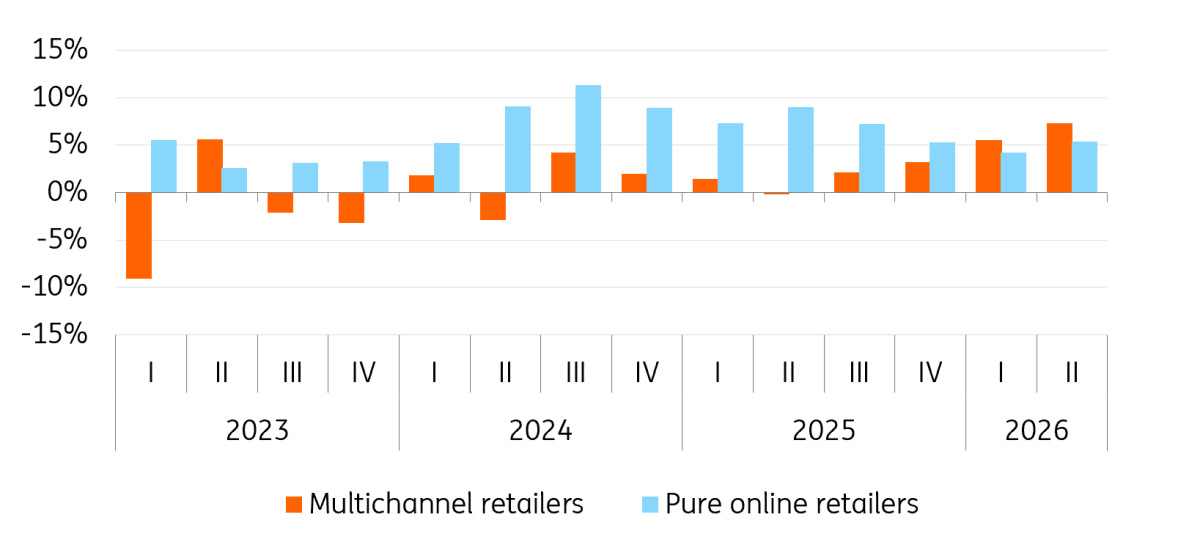
In 1H26, multichannel retailers outperformed online-only retailers for the first time since 2023
Revenue growth in online sales in the Netherlands, year-on-year
Multichannel retailers outpace online-only retailers
For the first time since 2022, online sales growth among multichannel retailers has outpaced that of online-only retailers. While it is still too early to conclude that a structural shift is underway, the trend suggests that traditional retailers are starting to regain online market share.
This is partly explained by shifting consumer demand. Online spending is currently growing fastest in segments where multichannel retailers have a strong market position, particularly supermarkets and drugstores. In addition, traditional retailers have significantly strengthened their digital capabilities in recent years through investments in websites, mobile apps, and logistics networks. As a result, they are increasingly able to compete online, combining the convenience of e-commerce with the advantages of an extensive physical store network, such as click-and-collect services, local fulfilment, and in-store customer engagement.
Growth does not automatically translate into profit
While sales continue to grow, market conditions remain challenging for many retailers. Rising sourcing, logistics, and labour costs are increasing pressure across food, non-food, and e-commerce. At the same time, fierce competition and price-sensitive consumers limit the scope to pass these higher costs on. As a result, profit margins remain under pressure and achieving profitable growth is becoming increasingly difficult.
Omnichannel excellence becomes a competitive advantage
In a market where competing on price alone is becoming less sustainable, creating clear customer value is increasingly important. Retailers can strengthen their competitive position through distinctive product offerings, strong private labels, customer loyalty programmes, and a seamless omnichannel experience. Companies that successfully combine cost discipline with clear differentiation are better positioned to maintain pricing power and protect margins in an increasingly competitive retail landscape.

Comments
Log in or sign up to join the conversation.