


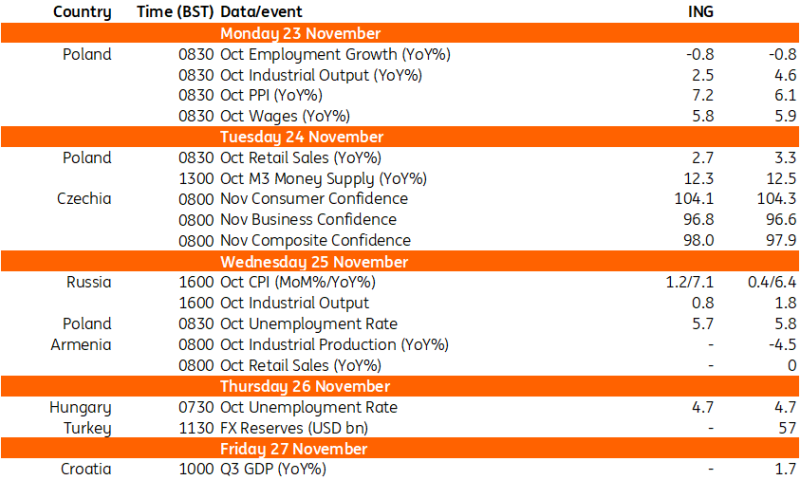
Poland will release industrial output, labour market and retail sales data, while Czech confidence indicators are expected to show weaker consumer sentiment but a modest improvement in business confidence
Poland: Industrial weakness persists as consumption loses momentum
October industrial output and labour market data will be released on Monday. Fewer working days than in October 2025 mean that we should expect low-single-digit annual growth in industrial output, as the underlying trend remains lacklustre and uneven. Cost pressures in industry are mounting, pushing producer prices (PPI) higher. Recent readings suggest that price pressures not only stem from rising refining prices but are becoming increasingly broad-based. Nevertheless, this has not translated into stronger pressure on core consumer prices, as weak demand is forcing businesses to compress margins.
The labour market has stabilised, with wage growth in the enterprise sector slowing to below 6% year-on-year and employment continuing to decline. With demand for labour somewhat weaker, supply-side deterioration, reflecting the shrinking working-age population, is playing an increasingly dominant role. The unemployment rate remains low and among the lowest in the European Union.
October retail sales data follow on Tuesday. Fewer trading days and a high reference base for food sales will outweigh some recovery in fuel sales following another cut in VAT and excise duty on gasoline. We also see limited room for stronger sales of durable goods, which have proved surprisingly resilient to the strain on household finances from higher fuel bills and slowing wage growth. Consumption is projected to weaken further in the coming quarters as elevated uncertainty keeps the propensity to save high.
Czech Republic: Consumer confidence likely weakened on higher food prices
Consumer confidence likely deteriorated in November, with Tuesday's release expected to reflect the impact of rising food prices. That said, the consumer mood likely remained solidly above its long-term average, as households continue to benefit from decent nominal and real wage dynamics. In contrast, business confidence likely edged up in the same month, somewhat correcting its previous pronounced losses while remaining below its long-term average, pressured by rising input costs and ongoing uncertainty.
Key events in CEE & CCA next week



Comments
Log in or sign up to join the conversation.