

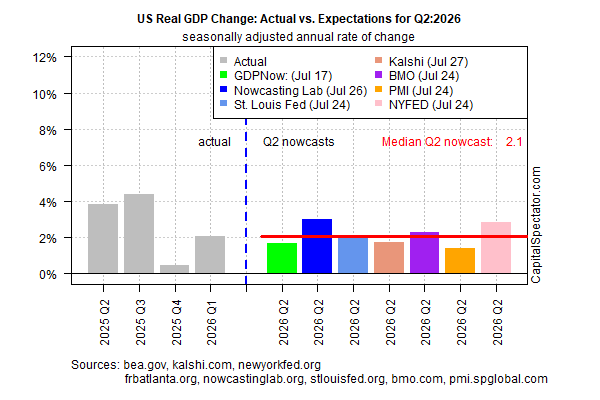
The Iran conflict continues to unsettle the outlook for the US economy, but the effects of the Middle East crisis may be hard to spot in this week’s second‑quarter GDP report. The government’s initial estimate is expected to roughly match Q1’s moderate 2.1% real annualized gain, based on the median of nowcasts compiled by The Capital Spectator, with the Bureau of Economic Analysis set to publish the official data on July 30.
Today’s median estimate has ticked up to 2.1% from 1.8% on July 18, while the Econoday consensus is slightly higher at 2.3%. Overall, Q2 is poised to reaffirm the economy’s resilience despite a series of macro shocks. The Iran conflict remains a key risk by keeping energy prices elevated, which ripples through supply chains, raises costs, and adds pressure on the Federal Reserve to tighten policy. The threat of further escalation continues to hang over markets, sustaining geopolitical uncertainty that acts as a tax on growth by lifting energy costs, complicating trade flows, and keeping inflation risks skewed to the upside.
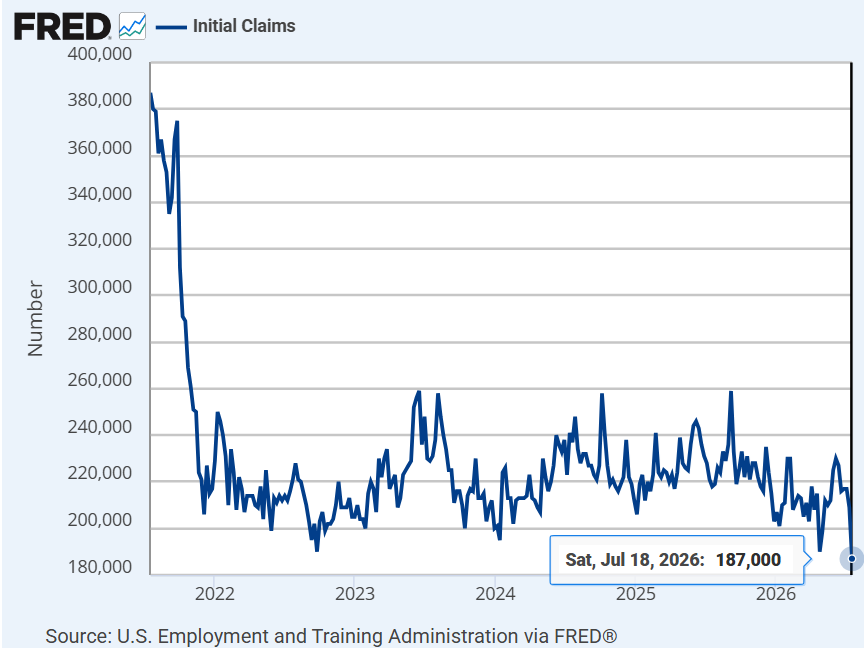
Even so, consumer spending has held up, supported by income growth and a labor market that continues to add jobs at a modest pace. Layoffs remain low, and new filings for unemployment benefits fell to 187,000 last week—the lowest since 1969. Jobless claims at a half‑century low alongside $100 oil suggest a labor market with virtually no slack, a combination that could become problematic if the conflict persists. A brief lull in hostilities this morning hints at improvement, but after five months of stop‑and‑start warfare, visibility remains poor.
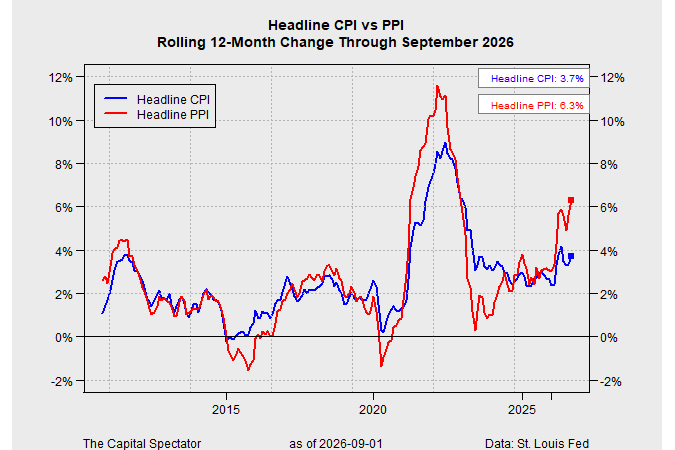
As a result, the Federal Reserve will find it increasingly difficult to ignore elevated inflation signals. And with so much riding on the path of energy prices, geopolitical stability, and labor‑market tightness, the first half of the year may prove a poor guide to what the second half ultimately delivers.

Comments
Log in or sign up to join the conversation.