


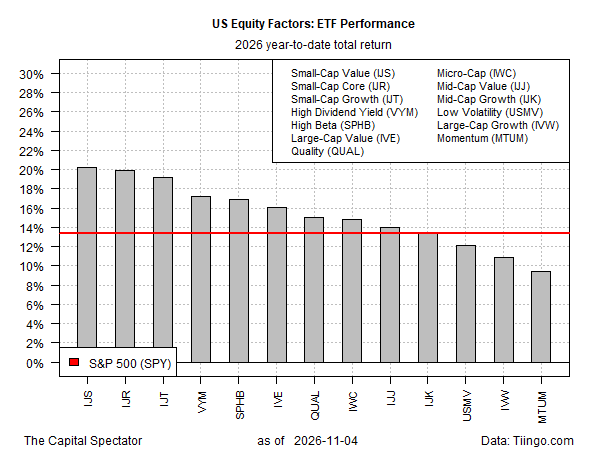
Small-cap stocks are maintaining their performance advantage this year, putting them on track for their first calendar-year run of leadership over the S&P 500 since 2022, based on a set of ETF proxies.
Assuming current trends hold through year-end, small caps will outperform because they are generating stronger positive returns rather than simply losing less than large caps, as was the case during their last period of annual leadership in 2022.
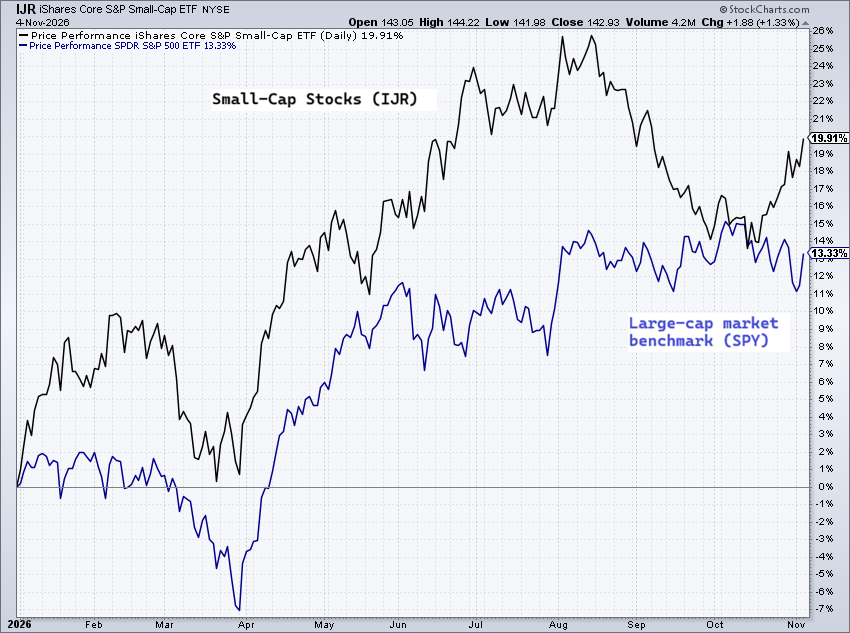
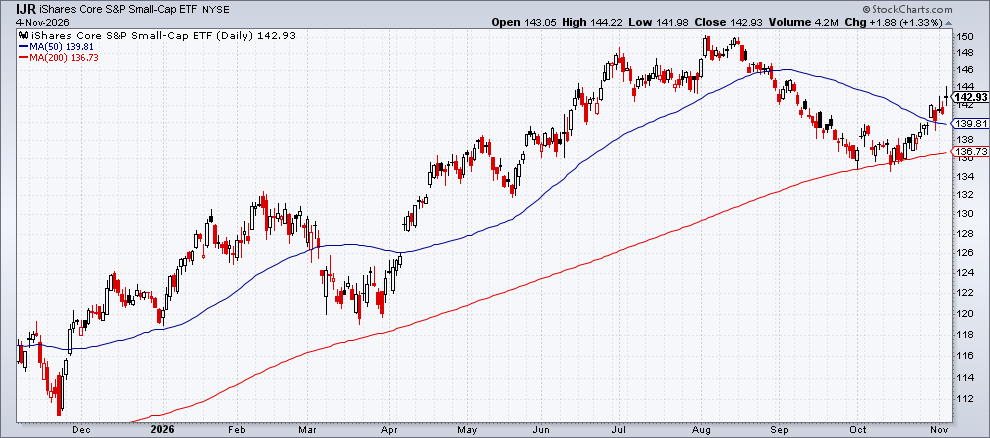
The iShares Core S&P Small-Cap ETF (IJR) has gained 20% year to date through Nov. 4, comfortably ahead of the 13.3% advance for the SPDR S&P 500 ETF (SPY).
Notably, the strength in small caps is both broad-based and persistent. The value (IJS) and growth (IJT) segments of the small-cap universe are also outperforming the market benchmark (SPY) by a wide margin this year.
Even more impressive, small caps have held the lead over large caps for most of 2026. A recent pullback in IJR raised concerns that another small-cap resurgence was about to fizzle out, as several previous attempts have in recent years. But IJR has rebounded sharply in recent weeks while SPY has drifted lower, widening the performance gap once again.
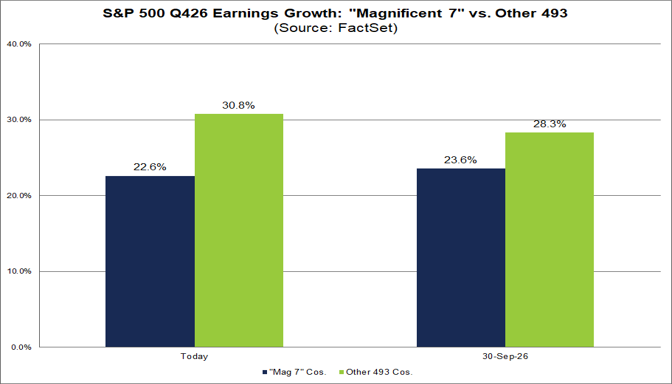
Part of the explanation is that the cap-weighted S&P 500 has been hampered by its heavy concentration in mega-cap technology stocks. As several Big Tech leaders have stumbled lately, their outsized index weights have masked relative strength across much of the broader market. Although the Magnificent Seven remain a powerful driver of corporate earnings growth, momentum is slowing as the rest of the S&P 500 catches up.
FactSet estimates that the Magnificent Seven are now reporting lower earnings growth than the other 493 companies in the S&P 500 for the third quarter. The firm expects that trend to continue in the fourth quarter, projecting earnings growth of 22.6% for the Magnificent Seven versus 30.8% for the rest of S&P index companies.
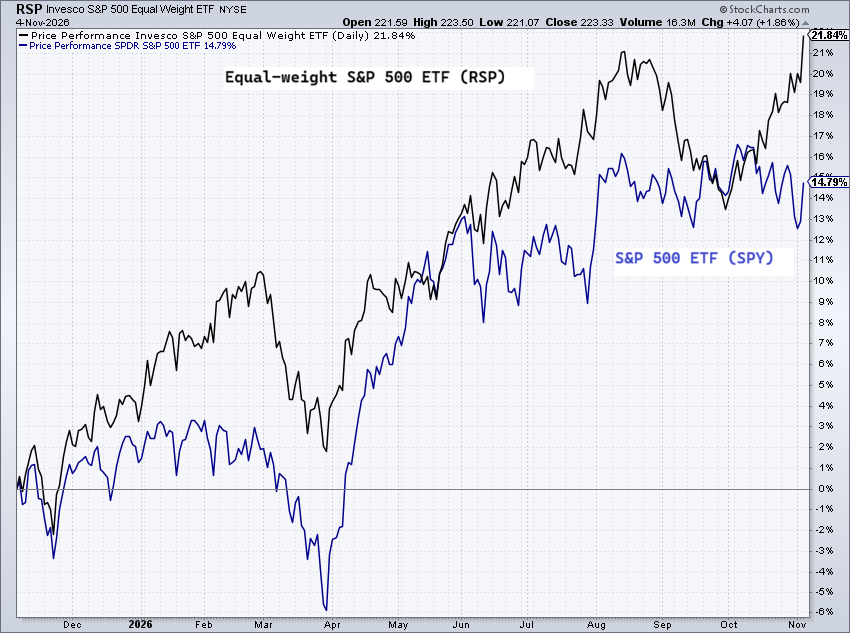
The shift has fueled concerns that elevated AI spending and rich valuations for Big Tech are becoming harder to justify. As a result, investor interest has rotated toward a broader set of stocks, helping revive the relative strength of the equal-weighted S&P 500 ETF (RSP) versus its cap-weighted counterpart (SPY).
The key question is whether the recent cooling in the AI trade represents a healthy consolidation that sets the stage for the next leg of the bull market, or the beginning of something more serious, as skeptics continue to argue.
For now, it appears premature to view the recent weakness in AI-related and big-tech shares as anything more than a normal correction following an extraordinary rally. Another plausible interpretation is that the bull market is broadening, allowing smaller companies to regain some of the ground lost during the mega-cap-led advance.
That said, previous small-cap breakouts have failed to gain lasting traction, leaving investors understandably cautious. The persistence of this year’s leadership is encouraging, but confirmation is still needed. A key near-term test will be whether the small-cap IJR ETF can surpass its August high and break out to a new peak. If it does, the case that the small-cap revival is genuine will become considerably stronger for the near-term outlook.



Comments
Log in or sign up to join the conversation.