


Jensen Huang is back, but investors are still debating whether the AI/tech trade that powered the bull market can regain its footing.
Nvidia’s board decided to reinstate its embattled CEO, reportedly under pressure from President Trump. The move helped spark a broad market rally yesterday, reflecting the company’s central role in the AI ecosystem and its outsized influence on the technology-led investment theme that has driven much of the bull market. The key question is whether the rebound marks the start of a renewed AI-driven advance or merely a temporary respite from growing concerns about valuations, growth expectations, and the payoff from enormous AI-related spending.
What is clear is that investor preferences have shifted. Through a factor-risk lens, small-cap stocks and several defensive segments have emerged as this year’s strongest performers, while many of the growth-oriented exposures that drove the market higher have stumbled after an extended run. ETF-based proxies suggest investors are directing capital toward areas long overshadowed by mega-cap technology just as many AI-linked bellwethers have come under pressure.
The next phase for markets may depend on whether Nvidia can restore confidence in the AI theme. If Huang’s return helps revive enthusiasm for the sector, the current rotation could prove temporary. If not, investors may be witnessing the early stages of a broader advance led by a different set of winners than those that defined the bull market’s first act.
Meanwhile, small caps are the year’s top performers. Three flavors of the asset class are essentially tied for first place in 2026, posting gains of more than 13%, roughly double the year-to-date advance for the SPDR S&P 500 ETF (SPY).
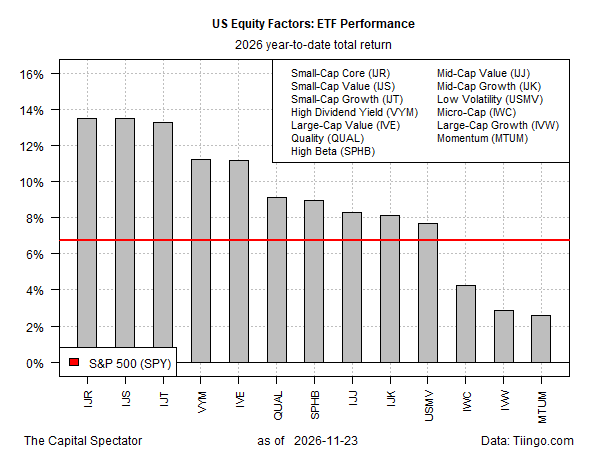
The small-cap premium now dominates the year’s performance profile, towering over the factors that previously led by wide margins. High beta (SPHB), momentum (MTUM), and large-cap growth (IVW) have fallen out of favor after surrendering much of their earlier advance.
The key question is whether confidence in AI can be restored and, with it, the market environment that prevailed for most of the bull run. A rebound would likely require investors to regain faith not only in AI’s long-term potential, but also in the massive capital spending and rich valuations that accompanied the boom. If that happens, the recent rotation may prove short-lived. If not, the market may be signaling that investors are looking elsewhere for the next source of returns.
One reason for caution: the latest earnings data suggest that the odds of AI and Big Tech quickly reclaiming market dominance have diminished, according to FactSet. Not only did the Magnificent 7 collectively miss earnings expectations and underperform the broader S&P 500 on both earnings surprises and growth, but analysts also expect that gap to persist in the fourth quarter, raising questions about whether the sector can justify the valuations and spending assumptions that previously underpinned its outperformance.
FactSet’s John Butters reports: If current third-quarter results hold through the end of earnings season, “this will mark the first time the ‘Magnificent 7’ companies have reported lower earnings growth than the other 493 S&P 500 companies since Q4 2022.”
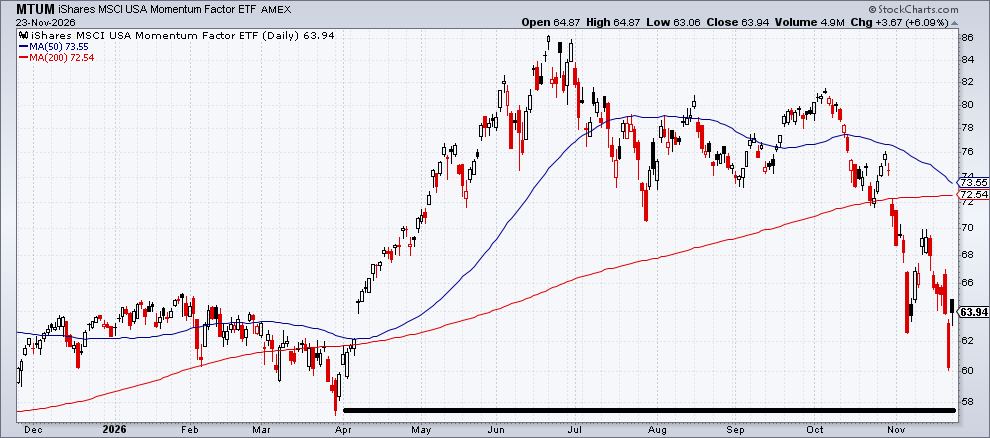
With the fundamental case for the Magnificent 7 under greater scrutiny, Wall Street will be increasingly focused on price action for clues about investor sentiment. The large-cap momentum strategy (MTUM) is among the benchmarks to monitor in assessing whether the market’s animal spirits can be revived. As the chart below highlights, however, there is a long road to recovery after MTUM’s recent mauling, particularly if it tests a key support level in the weeks ahead. Similar profiles apply to other belwhethers for the AI trade, including a tech sector ETF (XLK).
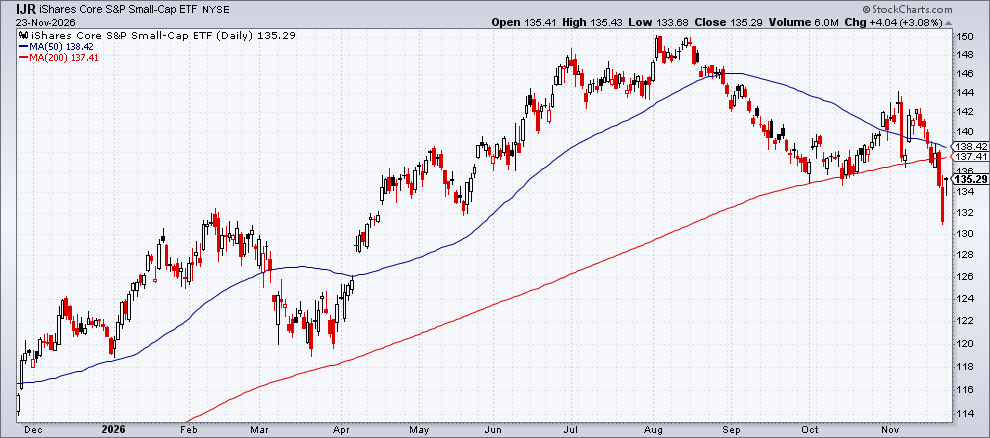
The trend remains stronger in small caps (IJR), although signs of vulnerability are emerging there as well. It’s important to note that IJR’s recent strength has been largely relative, driven mostly by losing less than its previously high-flying counterparts than by generating impressive gains on an absolute basis.
Broad market sentiment will likely determine what happens next, and on that front the benchmark SPY still looks fragile despite yesterday’s Nvidia-fueled rally.
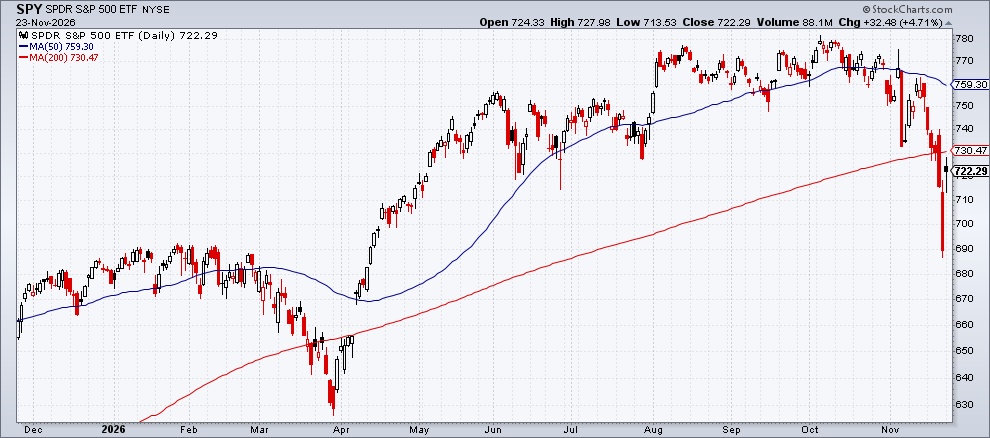
SPY remains in an uptrend, leaving room for debate about how much damage has been inflicted in recent weeks. One of the defining patterns of the past several years has been the market’s ability to absorb sharp setbacks and quickly recover. Another rebound could emerge, but there is greater uncertainty this time about what catalyst might drive it.
Reinstating Huang has helped steady sentiment, but it remains unclear whether that will be enough to restore the market’s former enthusiasm for AI and large-cap technology. The recent selloff has weakened the bull case, and it will take time to determine whether investors view it as a temporary setback or the start of a more durable shift in market preferences.
For now, the most likely outcome is a period of range-bound trading as investors seek clarity on several key variables, including earnings growth, the path of interest rates, the conflict with Iran, and the durability of the recent acceleration in U.S. economic activity. Viewed through that lens, the odds of another rapid V-shaped recovery appear lower than in previous episodes.

Comments
Log in or sign up to join the conversation.