


The Democratic rout of Republicans in Tuesday’s midterm elections has far-reaching implications for policy in Washington, which in turn is likely to influence investor sentiment on Wall Street. Here’s a quick look at several of the key issues in play.
One area likely to attract close attention is how Democratic control of the House and Senate could affect the artificial intelligence buildout. Even before Tuesday’s elections, the surge in AI-related capital spending appeared unsustainable. The question now is how a decisive Democratic victory could alter the rapid nationwide expansion of data centers.
Polling suggests the issue has become increasingly controversial. Roughly half of Americans oppose building data centers within a few miles of their homes, according to a Politico poll published last week. Notably, opposition has risen sharply since January, when only 28% of respondents were against such projects.
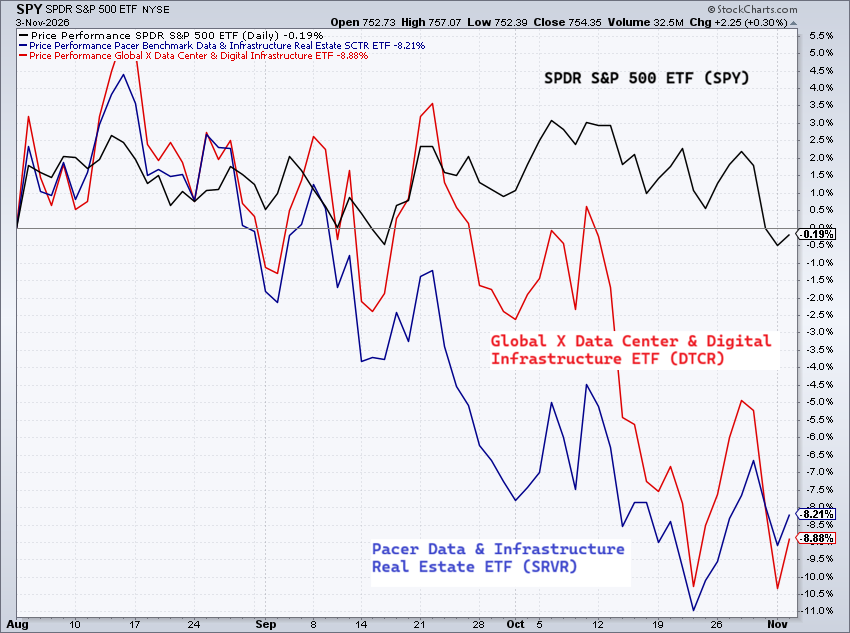
With public sentiment increasingly favoring restrictions, Democrats may seek tighter oversight of data-center development. The market has already begun pricing in that possibility. Two ETFs that serve as proxies for data-center and digital infrastructure stocks have fallen sharply in recent weeks, even as the broader market, represented by the SPDR S&P 500 ETF (SPY), has remained largely flat.
More broadly, political analysts expect Democrats to push back against business-friendly policies such as corporate tax cuts, regulatory rollbacks, and efforts to ease environmental or labor requirements. With President Trump still in the White House, however, the next two years could be characterized by political gridlock.
Legislative stalemate is not necessarily negative for stocks. Divided government tends to reduce the odds of major changes in taxes, regulation, and spending. By limiting policy surprises, it can provide businesses and investors with a more predictable operating environment, an outcome that markets tend to prefer.
At the same time, divided government would likely reduce the odds of new consumer-focused spending programs or broad tax-cut packages. That could be a net positive from the perspective of federal debt. With Democrats controlling one branch of government and Republicans another, legislative gridlock makes it more difficult to pass measures that significantly expand budget deficits. While stalemate is unlikely to reverse the long-term rise in federal debt, it could reduce the risk of major new fiscal initiatives that add to Washington’s borrowing needs.
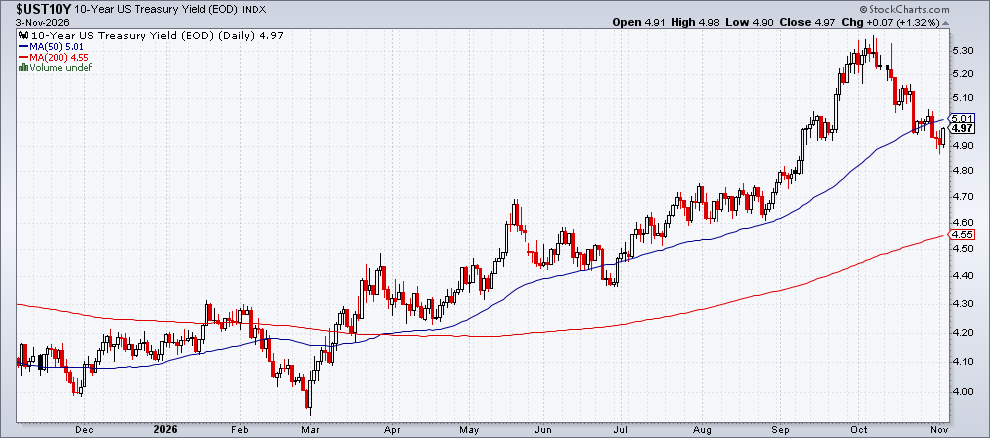
The bond market will provide an important real-time test of whether investors view gridlock as a meaningful check on fiscal risk. If the 10-year Treasury yield stabilizes or moves lower, it may signal confidence that divided government will restrain deficit-expanding legislation. Conversely, persistently higher yields could suggest that investors remain concerned about the long-run trajectory of federal debt regardless of the election outcome.
That said, fiscal concerns are only one of several factors influencing Treasury yields. Inflation expectations remain a critical part of the equation, shaping how investors assess the outlook for interest rates, economic growth, and the appropriate level of long-term borrowing costs.
The 10-year Treasury yield’s retreat below 5% in recent days suggests that the market is, for now, somewhat less worried about inflation and fiscal risk. The more important test, however, will be how the bond market responds to the shift in Washington’s political balance in the days and weeks ahead.
Beyond fiscal policy, investors will also be watching geopolitical risks, which have a history of influencing both energy markets and inflation expectations. Some analysts argue that a lame-duck president may feel less constrained in pursuing a more aggressive foreign policy agenda, including a tougher stance toward Iran. Any renewed escalation in tensions could disrupt oil supplies or heighten concerns about supply risks, potentially pushing energy prices higher and complicating recent progress on inflation.
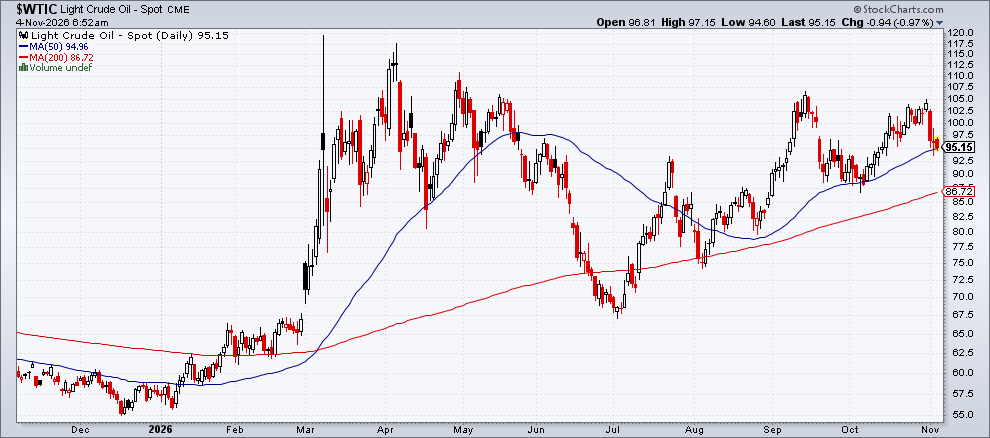
Crude oil prices will be an important barometer of market sentiment toward Iran-related risks. A sustained increase would suggest investors are pricing in higher odds of supply disruptions and renewed inflation pressure, while stable prices would imply limited concern about a geopolitical shock.
The U.S. oil benchmark, West Texas Intermediate (WTI), is trading below $100 a barrel again. The question is whether that reflects a durable easing of geopolitical concerns or merely a temporary pause before markets reassess the risks of renewed tensions in the Middle East.
Another risk factor to watch is tariffs. Even with a divided government, the president retains significant authority to impose or increase tariffs through executive action and existing trade laws. As a result, Congress may have limited ability to restrain a renewed push for tariffs if Trump chooses to revive or expand such measures. Any escalation on that front could unleash a new wave of higher costs for businesses and consumers, adding a fresh source of inflation pressure at a time when markets are still debating whether the recent rise in prices will prove temporary or persistent.


Comments
Log in or sign up to join the conversation.